
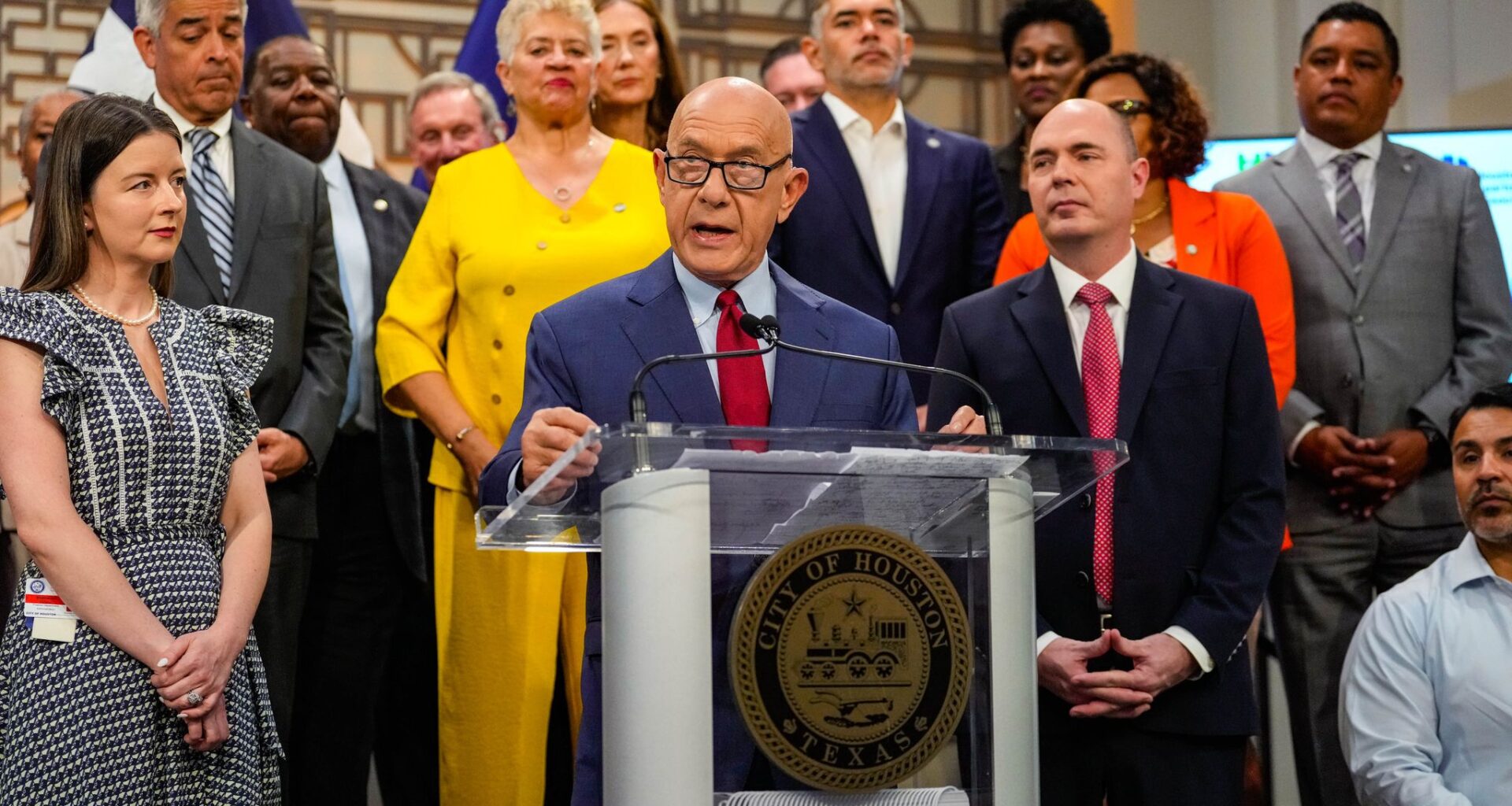
Houston Mayor John Whitmire speaks about his proposed 2027 budget and a new trash fee proposal during a presentation at City Hall in Houston, Tuesday, May 5, 2026.
Raquel Natalicchio/Houston Chronicle
Houston’s budget
Regarding “Whitmire’s balances Houston’s budget by neglecting neighborhood needs,” (May 8): Bill King and Jordan Thomas both provided their thoughts on Mayor John Whitmire’s budget. King calls it pragmatic fiscal modernization; Thomas calls it another burden loaded onto communities already failed by the city. Both make fair arguments, but neither names the number that makes this budget most consequential: $221 million.
That’s the full amount this budget proposes to extract from our water utility every year. The budget presents two mechanisms separately: a right-of-way fee sending $104 million annually from the water utility to the general fund, and the absorption of the solid waste’s $117 million budget into that same utility.
Article continues below this ad
That is money that will no longer help Houston meet its serious infrastructure obligations: a $9 billion federal consent decree; a 70-year-old water purification plant that serves 2.2 million residents of the city but is nearing failure; and over $480 million in deferred pipe repairs. No other major Texas city merges solid waste into its water utility fund.
This budget is a band-aid for this year. Both the administration and the controller project the gap returning to the hundreds of millions by FY2029, and we are setting the precedent of drawing from the water well. If drawing from the well is pragmatic now, we should be prepared to call it pragmatic every time the general fund runs short in FY29 and beyond.
Thomas rightly identifies the communities bearing this budget’s costs, but the $5 monthly trash fee is the smaller inequity. The consent decree exists because Houston left those communities living with dangerous sewage overflows. The fund being drained was built to fix that. When infrastructure capacity erodes, it erodes in those communities first.
And so does trust in government.
Article continues below this ad
Water fees
Regarding “Houstonians have mixed feelings about a proposed trash fee,” (May 18): Before I forget, the trash fee is unfortunately necessary, but too small and not enough. However, the budget gimmick of folding the waste department into the water department is flat-out wrong. We Houstonians were told that the water rate increases were needed to improve the aging water infrastructure and, therefore, grudgingly accepted the last one in April of this year.
These are taxpayer funds dedicated to improving our water infrastructure; these funds were not advertised as funds to bail out other city departments. The change in city governance is a bureaucratic step to make the budget seem closer to being balanced without fixing the underlying problem in the waste department.
Article continues below this ad
Political tactics
Regarding “Houston taxpayers deserve more answers on Whitmire’s budget,” (May 11): Evan Mintz asserts that Whitmire is more comfortable with backroom negotiations than genuine public collaboration. Agreed. Even worse is the resulting pressure to comply.
Using a political tactic called “manufactured inevitability,” major public decisions are made behind the scenes, then framed very early on as already settled, fully justified and beyond reconsideration. Implementation begins with little time or appetite for due diligence or deliberation.
I first noticed it during the proposed abandonment of Polk Street for the George. R. Brown Convention Center expansion, when the mayor described the move as a done deal months before the expansion design was finalized. The result of this reckless approach is that Polk Street was effectively closed and mobility sacrificed, even though the legal approvals are still not in place.
Politically, this works well for the mayor. So well, in fact, that the manufactured inevitability narrative now extends far beyond Polk Street. Policies involving bike lanes, roundabouts and proposed residential trash fees are additional examples framed as both urgent and necessary.
Article continues below this ad
Is it truly necessary, though, to close Polk? Were the bike lane and roundabout removals proven to be in the best interest of safety? Will a trash fee be the best step toward solving the city’s budget deficit?
While manufactured inevitability may be effective politically, it comes at a high cost to Houstonians who lose transparency, meaningful participation and confidence in the integrity of their city.
Marcie Hysinger, member of People for Polk