
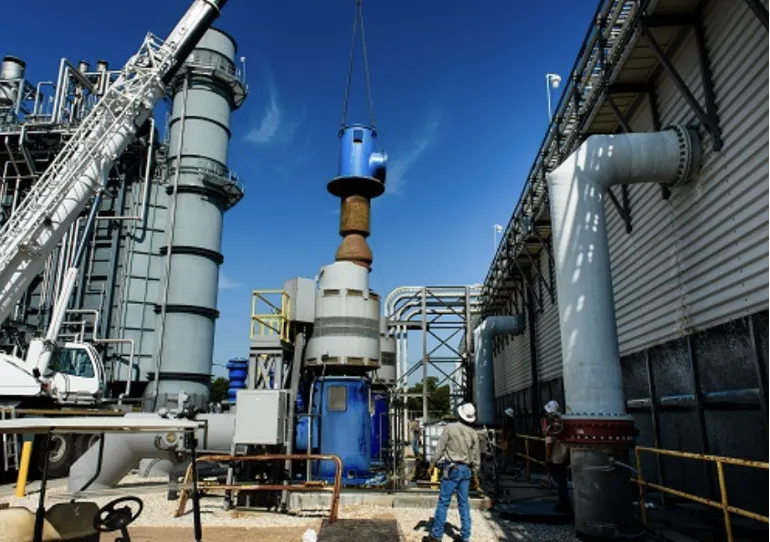
After hearing a presentation from Austin Energy, the Austin Electric Utility Commission voted 8-3 earlier this month to recommend adding new natural gas-powered peaking units, or “peakers,” to the city’s energy mix — a decision that heads to the Austin City Council for a final vote Thursday.
The recommendation for action puts city leaders at the center of a high-stakes tradeoff with growing scrutiny: While peakers can prevent blackouts and stabilize costs during extreme demand, they also rely on fossil fuels that worsen air quality and climate change — and community leaders say the process behind the proposal lacks transparency and risks further burdening historically marginalized communities.
All 10 of the city’s current peakers are in East Austin in largely African American and Hispanic neighborhoods. With no details forthcoming from Austin Energy about the location of proposed peaker units, community leaders are concerned that the city will steer them to East Austin.
 Kirk Watson
Austin Mayor Kirk Watson strongly backs building additional peakers, saying new units will be more efficient than current ones. Austin Energy officials agree, saying that additions would produce 80–95% fewer emissions than existing units. New peakers also would be employed before older, less efficient units in the case of extreme demand, officials said.
Despite those benefits, peakers increase levels of nitrous oxide, particulate matter, and ozone in the atmosphere when in operation, increasing Travis County’s already-present risk of exceeding the Environmental Protection Agency’s air quality standards.
As the name suggests, these units are switched on during peak demand hours. For a Central Texas city like Austin, that demand typically comes on hot summer days when the AC is on full-blast. According to a National Libraries of Medicine meta-analysis, the hottest days are also those where the effects of ozone and nitrous oxide pollution — respiratory and cardiovascular issues, most notably — are exacerbated.
The recommendation for action comes after the Austin Energy Utility Oversight Committee encouraged Austin Energy at its meeting last November to begin the process of site selection, all-resource request for proposals, and community engagement for the peakers. The oversight committee, composed of all 10 city council members and Watson, reviews issues related to Austin Energy.
Community flags transparency concerns
 Kaiba White
The recommendation drafted by Austin Energy strays from the norm as it does not name a specific company to contract with nor does it provide a cost estimate. It’s a “blank check,” Kaiba White, a member of the Electric Utility Commission, said of the approach.
“It’s very unusual to have a contract go to council without a cost estimate. I’ve literally never seen that,” White stated. “Austin Energy has manipulated a situation where they’re not sharing any real information.”
 Lisa Martin
White noted an absence of modeling, emissions impact, or evidence of alternatives, and stated that Austin Energy has not revealed what technology is being used or how often they will run the units. Austin Energy’s Chief Operating Officer Lisa Martin did mention at the Electric Utility Commission that the utility planned to add 400 MW of peaker power potential, but this is not explicit in the formal recommendation approved by the commission.
Also absent from the recommendation is a site location, though Austin Energy has publicly provided a shortlist of 14 sites throughout the city. Currently, Austin Energy’s active peakers are located in East Austin at Decker Creek Power Station and Sand Hill Energy Center. Both sites were included in the shortlist due to existing infrastructure and transmission lines there.
While exact demographics for the Sand Hill area are unclear, a Clean Energy Group map represents the population living in close proximity to Decker Creek Power Station as 85% low income and 41% people of color. The Decker location is also within one mile of an elementary and middle school.
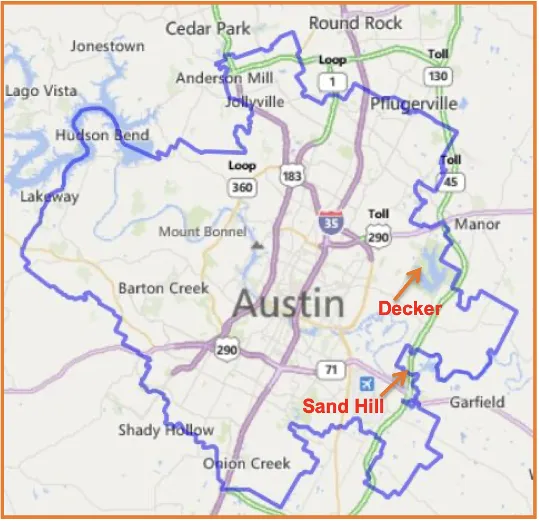 Austin Energy service area with current peakers identified
Credit: Austin Energy Nelson Linder
To Austin NAACP President Nelson Linder, the lack of transparency from Austin Energy about the location follows a broader pattern of failing to consider East Austin residents in decision-making. Ratepayers here are “concerned they’re not being listened to,” he says.
 Marian Sanchez
“They [city officials] think that because this is East Austin, somehow they can do this and get away with it because they don’t have the power. Even if it’s not East Austin specifically, they’re going to go the path of least resistance,” Linder added.
“Austin Energy’s input process for this issue has not been effective and could best be described as checking a box,” noted Marian Sanchez, Solar Equity Coordinator for PODER.
“Three sessions were held with very limited notice, and unfortunately, the communities that would be most impacted were not at the table,” Sanchez said. She called on city council to reject the proposal.
The demand dilemma
Austin Energy’s case for new peakers hinges on its projected increase in demand and load growth. Lisa Martin projected that reliability risk hours — when an outage is most likely — from 2030-2035 would be 575 hours per year without added peakers, 475 with new batteries but no peakers, and 45 if peakers are added. She added that bringing new peakers into the equation would reduce the region’s extreme weather financial risk by 48 percent.
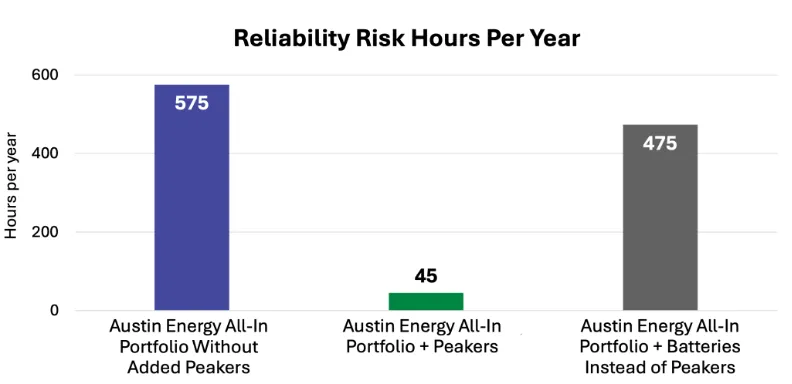 Projected hours where customers will be at risk of power outages from 2030-2035
Source: Austin Energy
“This is the risk of high congestion costs, and our customers bear the burden of that risk on multiple fronts,” Martin stated. “This is a signal that we’re in a shortage of power in Austin.”
According to Commissioner White, those data are not consistent with the projected build-out of the local market, taking growth in population, data centers, and electric vehicles into consideration: “I think they think they need it. They predetermined that gas peakers are the thing they would do so they’re doing it,” she stated.
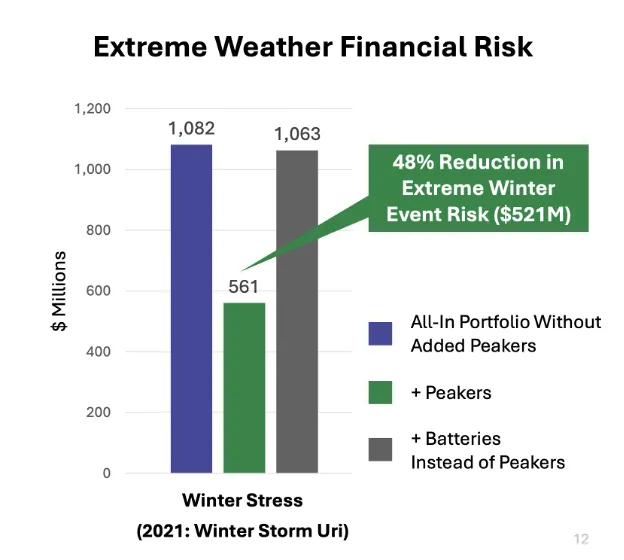 Projected reduction in extreme weather financial risk from 2030-
Credit: Austin Energy Cyrus Reed
Electric Utility Commission member Cyrus Reed and other members of the Sierra Club are “vying for a third-party analysis” to ensure Austin Energy’s demand calculations are correct. White additionally spoke to the request for an outside entity to project demand and re-evaluate from there.
In 2014, Austin Energy “wanted to invest in a combined cycle gas plant and they had a third-party study” which ultimately resulted in expansion of wind and solar instead, White noted.
Other members of the Electric Utility Commission argued that additional evaluation would not be worthwhile. “I’m concerned that we can study this a whole bunch of different ways and we’ll end up right where we are, and we’ll have wasted some time that we may or may not have,” stated Commissioner Matthew Kirksey.
Breaking the cycle
 Alexia Leclercq
, Founder and Executive Director of Land Justice Community School, which promotes climate justice education and organizing, remembers when peakers were incorporated in the resource plan. She noted the push at that time for a strong utility-scale battery goal and to explore multiple proposals before opting for new peakers.
Now, she feels disappointed, but not surprised, that this is moving forward. “The City of Austin has continually shown us that there is deep inequity in their decision making,” she said.
Leclercq stated that introducing peakers to meet demand on hot days creates a dangerous cycle, as emissions from natural gas contribute to atmospheric global warming, creating even more hot days and even more demand that will need to be addressed.
“It’s really important for East side city council members to push back against Austin Energy and shift us towards renewable energy and energy use,” Leclercq said.
Council Districts 1 and 2 represent parts of East Austin and the current peaker locations (Decker and Sand Hill). Neither Council Member Natasha Harper-Madison from District 1 nor Council Member Vanessa Fuentes from District 2 were available to comment on this story.
In his May 12 newsletter, The Watson Wire, the Mayor strongly endorsed peakers: “These new peakers will help us advance our climate goals while also meeting our fundamental responsibility to keep the power on.”
Austin residents will have an opportunity to give their views on the matter at the regular meeting of the city council on Thursday, May 21 at 10 a.m. Members of the public wishing to make a comment can join the speaker’s list via a link on the city council website or sign up in person.
Piper Guinn is the health equity reporter for the Austin Free Press, covering the disproportionate health burden carried by our city’s most vulnerable. Piper is a native Texan and recent graduate of Whittier College, where she received a B.A. in political science.