
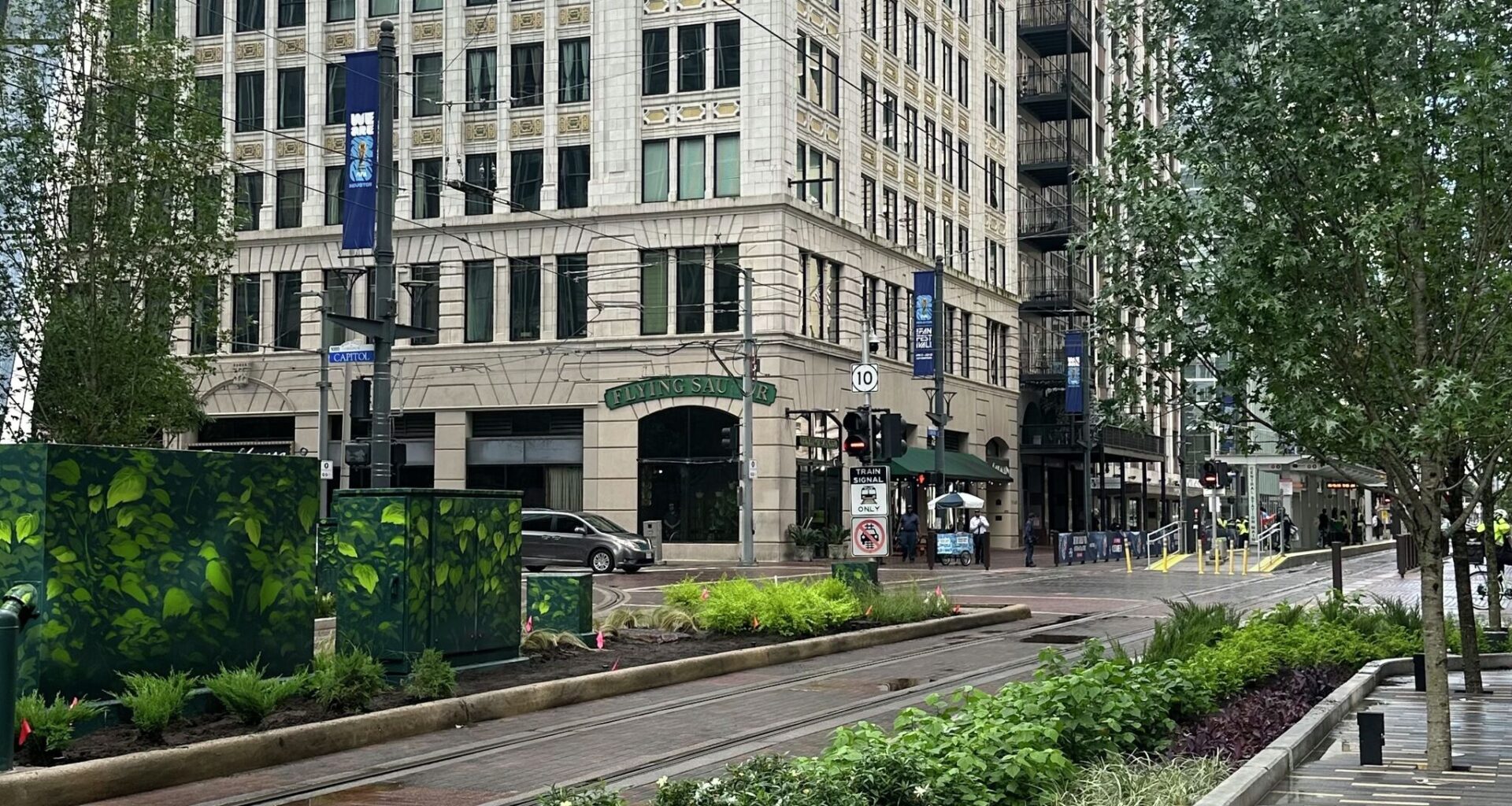
Air-quality monitors and public art displays are just two of the beautification efforts in Houston for the 2026 FIFA World Cup.
Michael Shapiro /via Chron
Soccer fans from across the globe will endure a dose of Houston’s notorious summer heat when the 2026 FIFA World Cup comes to the Bayou City this June and July. But local organizers say they’re working to make sure visitors—and Houstonians—have plenty of ways to stay cool.

On Tuesday, the FIFA World Cup Houston Host Committee unveiled a series of public works projects designed to combat the city’s sweltering temperatures ahead of the global tournament.
Article continues below this ad
The committee is spearheading the creation of the “Green Corridor” across Houston, a loop that stretches from Houston Stadium (otherwise known as Reliant Stadium) through the FIFA Fan Fest in EaDo and further past downtown through the Columbia Tap Trail. The Host Committee is in the process of completing projects along Main Street, Midtown, the Third Ward and Rice University, among others, providing visitors and Houston residents with a host of amenities to combat the high temperatures that are synonymous with Houston summers.
What exactly will be available to soccer fans and Houstonians beginning next month? Read more on the collection of public works projects below:
New-wave shade
Houston’s streets and various pedestrian pathways often bake in the summer sun, with little relief provided given the dearth of trees and green space in an assortment of areas. Combating the street-based heat was a major focus of the Host Committee in recent months.
Article continues below this ad
Downtown’s Main Street Promenade recently received a major facelift, including wider pedestrian walkways and new trees and landscaping along the busy corridor. But organizers didn’t stop at natural greenery. The Host Committee created a number of different man-made shade areas, such as rising sloped structures created to shade travelers who wait downtown for METRO. The new installations, along with the greenspace, are expected to lower temperatures by roughly five percent, per Kris Larson, President & CEO of Downtown Houston+.
The FIFA World Cup 26 Houston Host Committee will unveil a number of public-works projects in the coming weeks before the world’s biggest sporting event comes to Houston.
Michael Shapiro/via Chron
The Host Committee didn’t solely rely on public works, either. They partnered with Houston-based design firm Rootlab, which created 16 “architectural trees” that will run across Texas Avenue. The trees will stand 15 feet in height and roughly 13 feet in diameter, and they’re expected to remain in Houston past the 2026 World Cup.
Article continues below this ad
Additional shade will be created along the Columbia Tap Trail. The Host Committee partnered with the EaDo Management District to install a dozen structures armed with charging stations, which will sit adjacent to water stations, bike fix-it stations and assorted plants native to Texas. The structures will be completed in the coming weeks, and will be fully completed before the first World Cup match in Houston on June 14.
Here at the Columbia Tap Trail, where @FWC26Houston and the EaDo Management District partnered to install water stations, bike fix-it stations, new shade structures (with soon-to-be chargers installed) and assorted native plants. pic.twitter.com/A0Wg8Lhsx5
— Michael Shapiro (@mshap2) May 19, 2026
Solar solutions
New shade structures are one way to combat temperatures that could reach triple-digits in late-June and early-June. Sanjeev Raman, the CEO of Houston-based company SolarMantle, provides a more high-tech solution.
Article continues below this ad
SolarMantle will install solar paneling on restrooms at Midtown Park, as well as multiple tents at the FIFA Fan Festival in Eado. He says the solar paneling can lower a designated area’s temperature by more than 40 degrees on a sunny day, a major benefit to the Fan Festival in particular, where packed crowds are expected.
SolarMantle is now in its second year of operations. The World Cup marks its first public-works partnership, with the company’s work previously focusing on data-center cooling and private transportation.
SolarMantle will place solar paneling on Midtown restrooms and tents at FIFA Fan Festival. SolarMantle CEO Sanjeev Raman says on a sunny day the solar paneling can lower temperatures by more than 40 degrees.
Michael Shapiro/via Chron
Cool campus
Houston’s downtown and EaDo neighborhoods are two of the hottest areas of the city, with large stretches of concrete and little natural shade. The dynamic flips on the campus of Rice University.
Article continues below this ad
Rice’s campus is designated as a natural arboretum, with more than 2,000 live oak trees spread across the campus. The shade created by the trees lowers campus temperatures by 10-to-15 degrees compared to downtown Houston, and the cooler temperatures extend to Hermann Park, adjacent to Rice.
The university will unveil a dozen art installations to celebrate the campus’ trees and assorted biodiversity, highlighting the resiliency of the various vegetation in the Houston area, according to Dr. David Abraham, a lecturer at Rice. Abraham hopes Houston visitors will flock to Rice’s campus as well as Hermann Park during the World Cup, finding cool temperatures in perhaps the most serene stretch of land across Houston.
Rice University will unveil a dozen public-work structures to aid with shade and temperatures during the 2026 FIFA World Cup.
Michael Shapiro /via Chron
Houston’s World Cup Host Committee can’t control the weather in the Bayou City this summer. But they hope their collection of projects can mitigate the heat’s effects, providing plenty of shade and protection as temperatures rise.
Article continues below this ad