
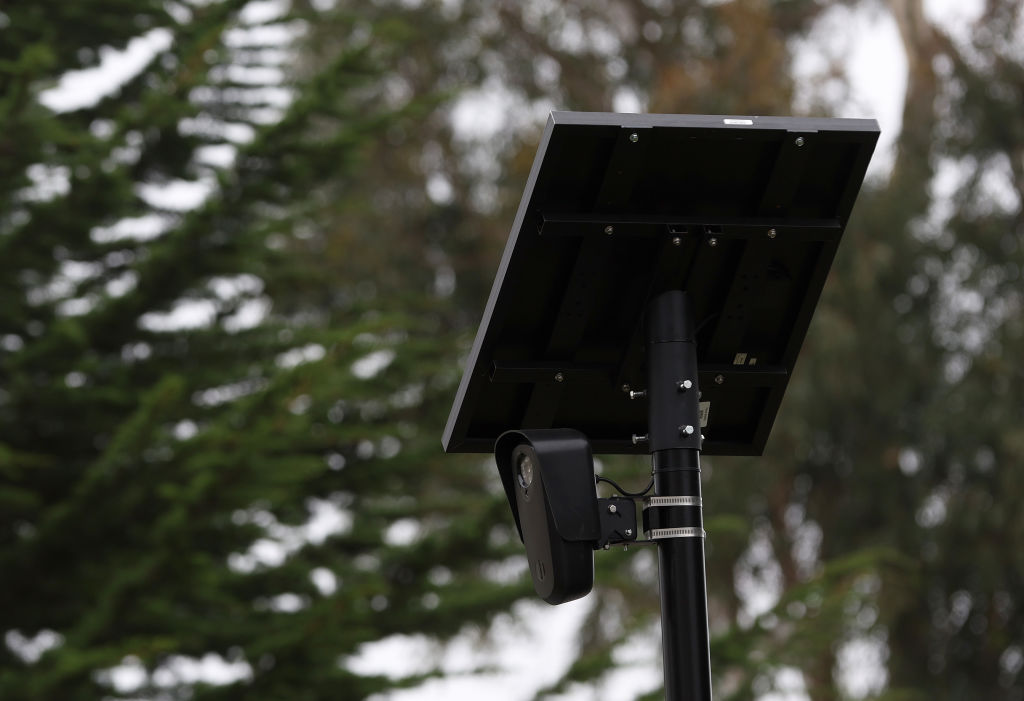
(Photo by Justin Sullivan/Getty Images)
Justin Sullivan/Getty Images
(Ricardo B. Brazziell/The Austin American-Statesman via Getty Images)
Austin American-Statesman/Hearst/Austin American-Statesman via Ge
Austin officials are weighing whether video surveillance could have shortened the over 24-hour-long hunt for three teenagers accused of carrying out a violent weekend crime spree that wounded multiple people across the city. Meanwhile, Flock Safety seized on the momement to renew its argument for automated license plate reader technology.

“When we talk about Austin being safe and people feeling safe, we need to make sure that our law enforcement has the tools that they need,” said Austin Mayor Kirk Watson.
Article continues below this ad
The teen group is accused of committing at least 12 crimes between Saturday morning and Sunday evening, including shootings, robberies and vehicle thefts. Four people suffered gunshot wounds during the spree, including one who sustained critical injuries. Homes, apartment buildings, businesses and fire stations were struck by gunfire as police scrambled to track the group’s movements across Austin.
After an alert was put out for a white Kia the group was seen driving, officials in Manor, a town roughly 14 miles from Austin, used their automated license plate readers (ALPR’s) to track down the group’s vehicle that eventually led to their arrest.
It is the same technology Austin had up until a year ago when growing privacy concerns from residents led the city to refrain from renewing their contract.
Now officials are wondering if it is the right choice.
Article continues below this ad
🚨Austin’s debate over surveillance technology is back in the spotlight after a weekend shooting spree investigation.
Austin Mayor Kirk Watson told reporters that license plate readers, such as the ones powered by Flock Safety, would probably have helped investigators locate… pic.twitter.com/ZRg1XXStzw
— Chron (@chron) May 18, 2026
“I think that the conversation is ripe to have,” said Austin Police Chief Lisa Davis. “Could [license plate readers] have helped? Yes, it could have helped.”
How License Plate Readers Work
ALPR technology uses cameras and software to capture images of car license plates. Police officers can then search that data to aid in their investigations, such as tracking a suspect vehicle or identifying stolen cars.
Article continues below this ad
Flock Safety, a private security company, has become the largest ALPR supplier for local governments, with over 5,000 law enforcement agency contracts nationwide.
However in recent years, a slew of concerns have been raised against their products.
Get the ‘Flock’ out of here
Many privacy advocates and Democratic lawmakers have argued that Flock systems give local officers vast surveillance abilities with limited oversight. Critics have also raised concerns that data collected from the cameras could be shared with Immigration and Custom Enforcement to aid in deportation tactics.
Article continues below this ad
“Austin should not be participating in Trump’s mass surveillance programs,” said Austin Council member Mike Sigel during discussions to remove Flock contracts last June.
The failure to renew Flock contracts is not exclusive to Austin. At least 30 cities across the country have canceled or deactivated their Flock Safety automated license plate reader contracts since the beginning of 2025, according to NPR.
Flock revives its pitch
Since the crime spree, Flock has seized on the moment to promote their product as a critical tool in events like this.
Article continues below this ad
In a statement issued after the arrests, Flock rejected the concerns raised about their technology as nothing more than a “public pressure campaign built on misinformation about how the technology works.”
Last year, Austin made the decision to turn off its Flock camera network following a public pressure campaign built on misinformation about how the technology works. This weekend showed what that tradeoff can look like.
For nearly 24 hours, three suspects moved through Austin in… pic.twitter.com/GZILcSCjnj
— Flock (@Flock_Safety) May 18, 2026
The company also noted that Austin police deployed extensive resources—including hundreds of officers, helicopter support and K9 units—during the manhunt, while Manor police located the suspects just using the city’s license plate reader network.
“What Manor has is an active license plate recognition network and the community support to keep it running,” the statement said.
Article continues below this ad
“Our hope is that stories like Manor’s can help inform the conversation about what these tools actually do, and what communities lose when they’re taken away, ” the statement concluded.