
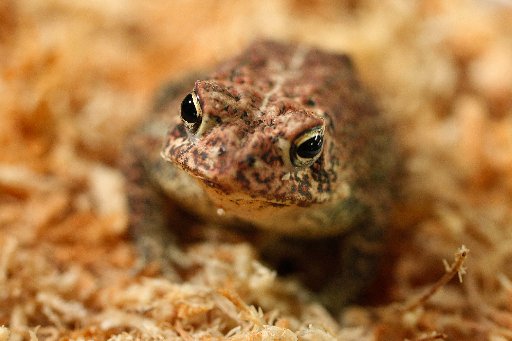
From the archives, 2012: A female Houston toad is housed in the Houston Toad Conservation Quarantine Facility located inside the Houston Zoo.
Mayra Beltran / Houston Chronicle
This month’s news that the Texas Parks and Wildlife Department had released more than 1 million Houston toad eggs at Bastrop State Park brought back a rush of memories about the endangered amphibians and reptiles of our state.

Thoughts flew back to humid East Texas evenings during the 1950s and ‘60s chasing fat toads and bottling their tadpoles, which seemed to thrive everywhere. Or arid summer afternoons on the plains and prairies placing live Texas horned lizards — which we called “horny toads” — near ant hills because we believed that’s what they wanted to devour. Or cool dips into Hill Country swimming holes hoping to spot an exceedingly rare salamander — or maybe even a newt — through our fogged and leaky goggles.
Article continues below this ad
Decades later, one can only pray that we kids did not contribute to the precipitous decline of these native reptiles and amphibians. Blame instead pesticides, urbanization, fungal diseases and invasive fire ants, which killed off their native kin, a regular tasty snack for the horned lizards.
Doesn’t it seem time for an “Archives” column about these Texas species?
Latest Houston toad efforts
Researchers with Texas State University, the U.S. Fish and Wildlife Service and the Houston Zoo toad conservation program release Houston toad eggs in Bastrop State Park in March 2019.
Michael Minasi/Reporting Texas, Austin American-Statesman
According to Texas Parks and Wildlife, the mass release of Houston toad eggs was staged in partnership with the Houston Zoo, Amphibian and Reptile Conservancy and the U.S. Fish and Wildlife Service earlier this spring.
Article continues below this ad
The toad pretty much disappeared from the park, one of its last refuges, after the disastrous 2011 Bastrop County Complex Fire. Attempts to repopulate the toad — including efforts in 2015 and 2019 — failed. Yet more than a decade of habitat recovery encouraged the conservation partners to try again zthis spring.
“We got close in 2019,” said Paul Crump, Parks and Wildlife herpetologist in a statement, “but this is the most eggs released in a single year to date in the state park.”
“This year, the overall program pivoted to releasing eggs in three sites — two in Bastrop County and one in Milam County,” said Matt Lammers, Houston Zoo’s Houston toad recovery coordinator. “Each of these sites is managed a little bit differently. Going forward, we can measure the varying success of these populations to determine what environmental factors are helping them along. Then we can try to replicate the most important of these factors in our other sites and across the state.”
Article continues below this ad
Texas State graduate student Melissa Jones holds three Houston Toad tadpoles near a pond at Bastrop State Park in 2013.
DEBORAH CANNON/AMERICAN-STATESMAN, Austin American-Statesman
Locals in Milam County told me that the Houston toad reintroduction site is just above the Little River under the shadow of Red Mountain, which the Tonkawa have reclaimed and which is slated to become a historical park.
For the big recent egg drop, a veterinary team at the Houston Zoo kept track of adult toads in the fall. They collected, sorted and transported around 200,000 eggs each week. After some time bagged in a natural, shallow pond, they were released into the water, where eggs turned into tadpoles, and the tadpoles into toadlets, which climbed up the banks and into the forested areas.
“It was really remarkable to see how quickly the toadlets developed and moved into the surrounding habitat,” said Zach Truelock, Amphibian and Reptile Conservancy private lands biologist. “During a light rain, we saw them dispersing away from the pond into the savanna.”
Article continues below this ad
A Texas Parks and Wildlife official and graduate students from Texas State University’s Aquatic Resources program drop bins with Houston toad tadpoles into a pond at Bastrop State Park in 2013.
DEBORAH CANNON/AMERICAN-STATESMAN FILE, Austin American-Statesman
According to a state wildlife report, the Houston toad was among the first amphibians to be listed as a federally endangered species, named on Oct. 13, 1970, under the Endangered Species Conservation Act of 1969, which was later replaced by the Endangered Species Act of 1973. “The toad was initially listed due to landscape fragmentation and urban development within its forested habitat,” the report reads, but “feral hogs, red-imported fire ants and drought conditions in Texas have furthered the decline in populations.”
Specific habitats for the toads were found in Bastrop and Burleson counties in 1978.
“Bastrop State Park is in the established critical habitat areas for the toad and offers prime conditions that are ideal for the ongoing Houston toad recovery program and population growth within the park,” Crump said. “Our state parks team has done an excellent job with habitat management to improve the property for all wildlife. Because of the reduction in habitat quality being one of the top threats to toad populations, the reintroduction would be doomed to failure had the management in the park not been undertaken.”
Article continues below this ad
Our resident South Austin toads
An incilius valliceps, commonly known as a Gulf Coast toad, sits on top of a limestone wall during a Capital Area Master Naturalists monthly frog monitoring session on Saturday, July 13, 2019, in Austin, Texas.
Austin American-Statesman
Once, my spouse Kip and I thought we could contribute to the effort.
When we moved back to South Austin from East Austin in 1997, we relished the rasping chirp of an adult toad that floated out from behind our house. The sound started at dusk on warm, humid evenings, especially after a rain. Where did Mr. Toad hide? The land behind the house had been scraped by the builder. Aside from a tough but ragged Rose of Sharon sapling, the yard consisted of horse herb and various types of stringy grasses.
Article continues below this ad
Over the years, we turned this outdoor space into a “back garden” rather than a yard, shaped with limestone boulders, a trail of decomposed granite, a dozen native trees — oak, red cedar, sumac, fig, cherry laurel, mountain laurel, cedar elm — along with indigenous or highly adaptive shrubs, vines, grasses and flowers, picked especially for the pollinators.
A few times, our resident toad landed in the water bowl that belongs to our retrievers. The dogs expressed only modest interest.
After years of reading about the endangered Houston toad, however, I insisted on documenting the sweet thing and sent my report and photograph to the Houston Zoo.
Nope. We enjoy the company of the much more common Gulf Coast toad.
Article continues below this ad
Still, we cherished its call, especially after we established a reading arbor with Adirondack chairs, stone ledges and an iron fire pit at the back of the garden, near its hiding place.
Years later, when we heard a second toad responding to the initial chirping, we danced like little kids. Did they reproduce? A Gulf Coast toad lives just three to five years, so some of them must have been doing what comes naturally.
This spring, we overheard the familiar chirps just before the first lightning bugs flickered through the Turk’s cap, lantana, flame acanthus, blue butterfly bush, esperanza and other flowering shrubs.
Hope for the Texas horned lizard
A Texas horned lizard opens its mouth to cool down after being released.
Austin American-Statesman
What about our other at-risk reptiles and amphibians?
Article continues below this ad
Just as the American-Statesman followed the travails of the Houston toad through the 1970s to the present — prolific Texas historian Mike Cox filed the first story found in the archives — our outdoorsy reporters did not stint on tracking other beloved species.
Over the years, for instance, the American-Statesman published dozens of stories on the decline of horned lizards. This one from sports writer Mike Leggett is my favorite.
“There’s probably not much chance that if you grew up in Texas and are of a certain age that you didn’t catch and keep a horned lizard as a pet,” Leggett wrote in a story updated in 2024. “Of course, you called it a horny toad because that’s what everybody thought they were. TCU improperly named its sports teams the ‘Horned Frogs,’ and after 100 hundred years or so, it’s not worth renaming everything just to be taxonomically correct.”
Leggett duly reported that the prehistoric-looking horned lizards had become fairly rare throughout much of their traditional range, especially in Central Texas. Habitat loss is the main culprit here and in South Texas.
Article continues below this ad
“Anyway, the opening weekend of dove season, I was in a UTV riding with my nephew Adam Leggett, touring the nearly 600 acres he’s bought just outside the city limits of Stamford,” Leggett wrote. “The place is close to Interstate 20 and during a rain is virtually cut off from the outside world as the sandy red soil carries tons of water off the hill where his headquarters is located.”
Vicky Poole, assistant curator of ectotherms at the Fort Worth Zoo, releases Texas horned lizard on Oct. 4, 2019, at the Mason Mountain Wildlife Management Area.
Austin American-Statesman
They were out on a tour of the ranch when Adam exclaimed, “Did you see that horny toad?” and backed the machine to show everyone in the UTV the lizard.
“I was kind of shocked to see a very large specimen sitting up on a rock above the runoff from a night and day of rain,” Leggett recalled. “He was catching some late afternoon sun while he could.”
Article continues below this ad
The group saw another half-dozen large horned lizards during their drive around the ranch.
“It made me happy to know there was still some range land in Texas that hadn’t been wiped clean of the prehistoric looking reptiles. They would seem to be a sign of a healthy habitat.”
Leggett hadn’t seen so many of them anywhere for 20 years, once while dove hunting on a ranch close to Santa Anna west of Brownwood and at a ranch southwest of Uvalde.
“I’m sure there are still other populations of horned lizards around Texas,” he wrote. “They’ve just been isolated or lost through the years. He is known as the Texas horned lizard, after all, with a reach that runs from northern Mexico up through Texas and on up northward toward northern parts of the country.”
Article continues below this ad
They are famous for the spikes that grow above their heads and for being able to force blood out of their eyes to ward off predators.
“There are a couple of kinds of horned lizards in Texas that are threatened and are listed as protected here, so it would be best not to grab any to try to hold as pets,” Leggett wisely wrote. “Leave them out there to prey on the ants.”
How salamanders altered Austin history
A Barton Springs salamander.
Austin American-Statesman
Several species of rare salamanders have played an outsized role in Central Texas because of their presence in caves, springs and natural pools. Environmentalists have not shied away from using their vulnerable conditions to block development. Lovers and haters of the tiny creatures hold their collective breaths each time a salamander count is conducted in and around Barton Springs, for instance.
Article continues below this ad
Here’s part of a 2019 report by Megan Menchaca.
“Amid the release of the U.N. report documenting ‘accelerating’ extinction rates, biologists say Texas salamanders are also at risk. There are one million species threatened with extinction worldwide, including 40% of amphibians, according to the U.N.’s report on how humanity continues to affect the world’s biodiversity”.
Some of the endangered amphibians in Texas include two salamanders native to Austin — the Austin blind salamander and the Barton Springs salamander.
The Barton Springs salamander (pictured) is one of the endangered salamanders in Austin.
Austin American-Statesman
“We have these beautiful and unique organisms that live in the aquifers and springs of the Texas Hill Country area that’s beloved by Texans and that’s part of what makes it special,” said David Hillis, director of UT-Austin’s Biodiversity Center.
Article continues below this ad
Hillis said the loss of species diversity worldwide is not a surprise — especially for amphibians like salamanders — because of ongoing habitat loss, habitat destruction and major diseases spread by humans.
“Our genetic analysis of the salamanders shows they been living and diversifying here in Texas for tens of millions of years and yet just over the course of a few decades, many of the populations have been lost as we’ve lost springs,” Hillis said.
Donelle Robinson, an environmental scientist with Austin’s Watershed Protection Department, said that Austin salamanders can be exposed to pollutants in the runoff water whenever the area surrounding Austin’s springs changes.
The salamanders are the first ones that will notice but there are bigger issues that are happening, Robinson told KXAN.
Article continues below this ad
“They require clean water quality,” he said. “We require that too if we’re going to swim in or drink that water.”
While Robinson doesn’t expect a population decline outside of “a major disaster” because Austin’s population of salamanders is relatively stable, KXAN reported the Austin Salamander Conservation Center holds onto 300 Barton Springs salamanders and 50 Austin blind salamanders that would be released if the wild ones go away.
Prevention measures like these are needed because current responses globally to these dangers are “insufficient”, according to the U.N. report.
“It’s not a case of salamanders versus people,” Hillis said. “In fact, the salamanders and the people are on the same side of this equation. If we work to protect the salamanders, we work to protect human populations, so really it’s a win-win situation for both sides.”
Article continues below this ad
Three recent stories in this series
Please send tips and questions to mbarnes@statesman.com.
Article continues below this ad