
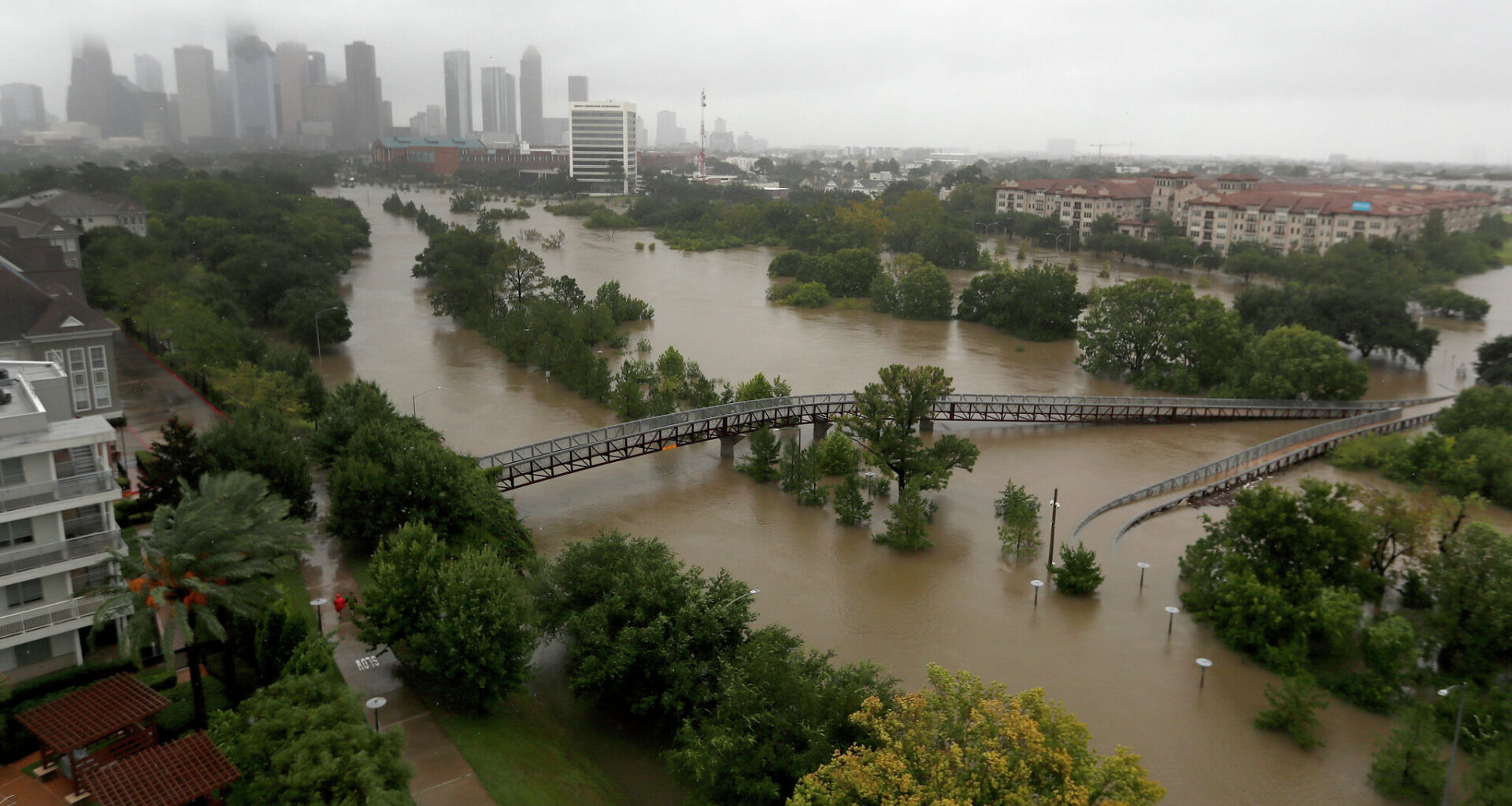
Buffalo Bayou flooded out of its banks onto Memorial Drive and Allen Parkway, as heavy rains fell from Hurricane Harvey in 2017.
Karen Warren/Staff photographer
A blue heron stands in shallow water as the sun sets at Willow Waterhole, where the parks six lakes form a detention basin to help prevent Brays Bayou flooding.
Mark Mulligan/Staff photographer
Sailboats were washed ashore in 1983, when Hurricane Alicia blew through the Houston Yacht Club on Galveston Bay in Shoreacres.
John Everett/Houston Chronicle
A house is totally engulfed in flames as floodwaters and crashing waves inundated beach homes on Galveston Island as Hurricane Ike approaches the Texas Gulf Coast, Friday, Sept. 12, 2008. ( Smiley N. Pool / Chronicle )
Smiley N. Pool, Staff / Houston Chronicle
Through the past century and a half, storms and hurricanes – their wind and their water – have wreaked havoc on the Houston area. No storm has had a bigger long-term effect on Houston than the Great Storm of 1900, a hurricane still considered America’s deadliest natural disaster.
Houston wasn’t even the primary target of that hurricane – it would be a Category 4 under today’s Saffir-Simpson Hurricane Wind Scale rating system. Its 145 mph winds caused untold damage on Galveston Island, destroying thousands of homes and buildings, leaving 8,000 people dead and 10,000 homeless.
Hurricane Carla, Sept. 1961: The largest hurricane ever recorded, it took 34 lives. It created 18 tornadoes, two of which struck Galveston and killed eight people.
Tropical Storm Claudette, July 1979: Claudette caused more than $700 million in damages and dropped a record 43 inches of rain in Alvin, a national record.
Hurricane Alicia, Aug. 1983: Alicia caused at least $1 billion in damages, mostly due to wind. The Category 3 hurricane decimated more than 2,000 homes and apartments and damaged 16,000 other structures.
Tropical Storm Frances, Sept. 1998: Frances caused more than 1,300 structures to flood, and hit areas such as White Oak Bayou the hardest.
Tropical Storm Allison, June 2001: The storm shut down the Texas Medical Center and inundated the city after it returned twice over a span of four days. The storm caused $5 billion in damages and took 22 lives.
Hurricane Ike, Sept. 2008: Ike was the third costliest storm in U.S. history, causing $28 billion in damage. The storm devastated Galveston Island, claiming 11 lives.
Memorial Day Flood, May 2015: Seven people died and more than 6,000 structures flooded during this two-day flooding event.
Memorial Day Flood, May 2016: More than 400 structures flooded in Harris County during this repeat storm.
Tax Day Flood, April 2016: Nearly 10,000 structures flooded in Harris County during this two-day flooding event that resulted in record levels in the Addicks and Barker reservoirs.
Hurricane Harvey, Aug. 2017: Harvey made landfall as a Category 4 hurricane before stalling over the Houston region for four days with nonstop rains. It caused $125 billion in damages, took 36 lives and flooded at least 154,000 homes and 300,000 vehicles.
Tropical Storm Imelda, Sept. 2019: Imelda flooded nearly 4,000 homes in Harris County and dropped nearly 30 inches of rain within a 48-hour period in northeast Harris County.
Rebecca Hennes
That time was Galveston’s Golden Era, its financial district on The Strand was dubbed the “Wall Street of the Southwest.” Its deep-water shipping port was considered more important than Houston’s, and its population was booming, having grown 30 percent in the prior decade.
Article continues below this ad
Few on the island thought that a devastating hurricane was even possible, so on Sept. 8, 1900, when the storm blew through, few had evacuated. The island was decimated. Even today, just 700 homes that survived the storm still stand, bearing a “1900 Storm Survivor” plaque to mark their resilience.
So when the storm left Galveston in a shambles, Houston stepped in and took over economically. Already in a shipping port contest, it wasn’t hard for Houston to pick up the extra ship traffic.
Visual essay: Major storms that devastated the Houston area
It took years for Galveston to recover, and when it did, it was to present itself as a center of tourism and recreation – not the level of commerce it had already enjoyed. Four months after the hurricane struck, the Spindletop oil gusher made Houston the center of oil commerce in Texas.
Stung by the sheer quantity of rebuilding the island would need, investors turned to Houston.
Would Houston have overtaken Galveston anyway? Probably, say experts. But the storm cemented the two cities’ fates.
Article continues below this ad
“You had the great storm in 1900 and Spindletop in 1901, and Houston benefitted from both of those events,” said Guy Hagstette, a native Houstonian and senior vice president of parks and civic projects at the Kinder Foundation. “You factor in the longtime effort of Houston to become a major port … and you’re off to the races. The production of oil and refining along the ship channel, that created what Houston is today.”
Storms, droughts have left their mark
The 1900 Storm may have been a pivot point for what both Houston and Galveston would be known for, but it was far from the only storm or natural disaster to affect the Gulf Coast.
Hagstette says that droughts, a very different kind of weather event, also have had a dramatic effect, too. He noted the drought that devastated trees in much of Texas 15 years ago and another that occurred in the 1950s.
If a Houstonian was asked today about rough storms, they’d likely mention Hurricane Harvey in 2017, along with the storms that preceded it: what has come to be known as the Tax Day storm of 2015 and the Memorial Day flood of 2016. All three left the city with devastating floods. Harvey alone dumped more than 4 feet of rain on many parts of Houston and its suburbs. The rain was so bad on the city’s west side that both the Addicks and Barker Reservoirs were in danger of overflowing and the Army Corps of Engineers opened the gates to release some water, hoping to minimize damage but causing thousands of homes to flood.
Article continues below this ad
Stung by three successive years of floods, city and county officials established new flood plain maps along with codes that required new homes be built several feet above the land’s elevation.
Before Harvey there was Hurricane Ike in 2008, a fierce storm that devastated Galveston Island before blowing into Harris County.
Every few years, it seems there have been tropical storms or hurricanes sending wind and rainfall across the Gulf Coast. There was Tropical Storm Allison in 2001 and Tropical Storm Frances in 1998. Hurricane Rosa stalled over Houston in 1994, dropping more than two feet of rain in a matter of hours. Longtime residents likely remember Hurricane Alicia in 1983 and Hurricane Carla in 1961.
Michael Ellis, now 82 and living in The Crossings Retirement Community in League City, spent many years in Galveston while working at University of Texas Medical Branch, first as a pharmacist and then as director of its Poison Control Center.
His offices were in the basement so he couldn’t watch storms as they were happening, but before any storm, he packed up his wife and children and sent them to a hotel in Brenham. (Once told the hotel had a swimming pool, they were all happy to go.)
Article continues below this ad
After Hurricane Alicia, he returned to his home to find a line of sand where floodwater had washed in and then back out. After Hurricane Ike, he recalls what felt like an era of urban renewal with everyone getting work done to repair flood and wind damage.
“The thing I remember about Ike is the destruction. People would just take everything on their first floors and move it to the curb at every house. I remember seeing pictures of Bolivar Island and there was just nothing left except maybe one house here and there,” Ellis said, noting that even though most patients had been evacuated, hospital staff lived at the facility, working around the clock because no one else could get in.
Parks now serve as flood control
It’s hard to talk about a storm’s silver lining while neighbors suffer financial loss and post-traumatic stress disorder, but as officials looked for new ways to hold stormwater, they came up with a brilliant idea: parks.
“The whole community’s mindset and view of natural landscape has changed. It has only been in recent years, since Buffalo Bayou Park was developed into the Bayou Greenway system that we’ve seen them as precious natural assets while also serving an important flood control function,” Hagstette said.
Article continues below this ad
Two in particular are Willow Waterhole on Houston’s southwest side and Exploration Green in Clear Lake not far from NASA.
Willow Waterhole – which took 20 years from concept to completion — was a combination of unused land or land with derelict buildings that was turned into a 291-acre park with six lakes that always hold some water. During storms, these ponds can hold 600 million gallons of water – the size of nine Astrodomes. The park cost more than $75 million, with much of it paid by the federal government and county commissioners with thousands of trees donated by Trees For Houston. Nancy and Rich Kinder, benefactors of many area parks, donated $2 million.
Exploration Green turned an unused golf course into a 200-acre park with five lakes that can, when storms hit, hold 500 million gallons of stormwater. This park, a $43 million project paid with bond revenue, took 2,000 homes out of a 500-year flood plain and gave area residents a place to walk and enjoy nature every day.
Developers have gotten smarter about flood detention, too. Many install shallow water features because they look nice and provide homeowners with a pretty view.
Now, though, they know that if they dig them deep enough, they do a lot more work.
Harry Masterson, managing director at EMBER Real Estate Investment and Development, is the developer of The Grand Prairie in Hockley. That neighborhood’s amenities include walking trails and parks, but also a 70-acre lake that can hold 10-12 feet. This plan is a unique public-private partnership for floodwater storage for Cypress Creek, which overflows toward the Addicks and Barker Reservoirs.
John Branch, who during planning was the president of the Clear Lake City Water Authority, guided volunteers through the process of getting funding and launching the work.
Branch said that the group called on a hydrologist to analyze the land for flooding potential because a developer was eyeing it for high-density housing. The report came back with the recommendation that the land be used for flood mitigation.
“The paradigm at the time was that a detention pond was a hole in the ground with a fence around it and then you forget about it. We said ‘we should do more.’” Branch said.Volunteers held a series of town hall meetings asking residents what they’d like to see.
“Their ideas exceeded our wildest expectations. Barry Ward (of Trees For Houston) was there and told us he’d donate 5,000 trees and help us set up a tree nursery. Another person worked on a watershed project and said there was money from the BP oil spill to invest in wetlands and said he could help us incorporate wetlands,” Branch said.
Naturalists brought ideas for recreation, plants and native plants. Bird watchers asked for natural habitats in the middle of the lakes for birds to nest.
They hired a landscape architect to turn the input into a master plan, then got a bond issue passed by voters.
“Getting through it I felt like I earned a whole new college degree,” Branch quipped. “Phase 1 was under way and able to hold water when Hurricane Harvey hit. That phase was 80 percent complete. The hole was dug and it filled up with water. It was a good feeling that it was going to work.”