
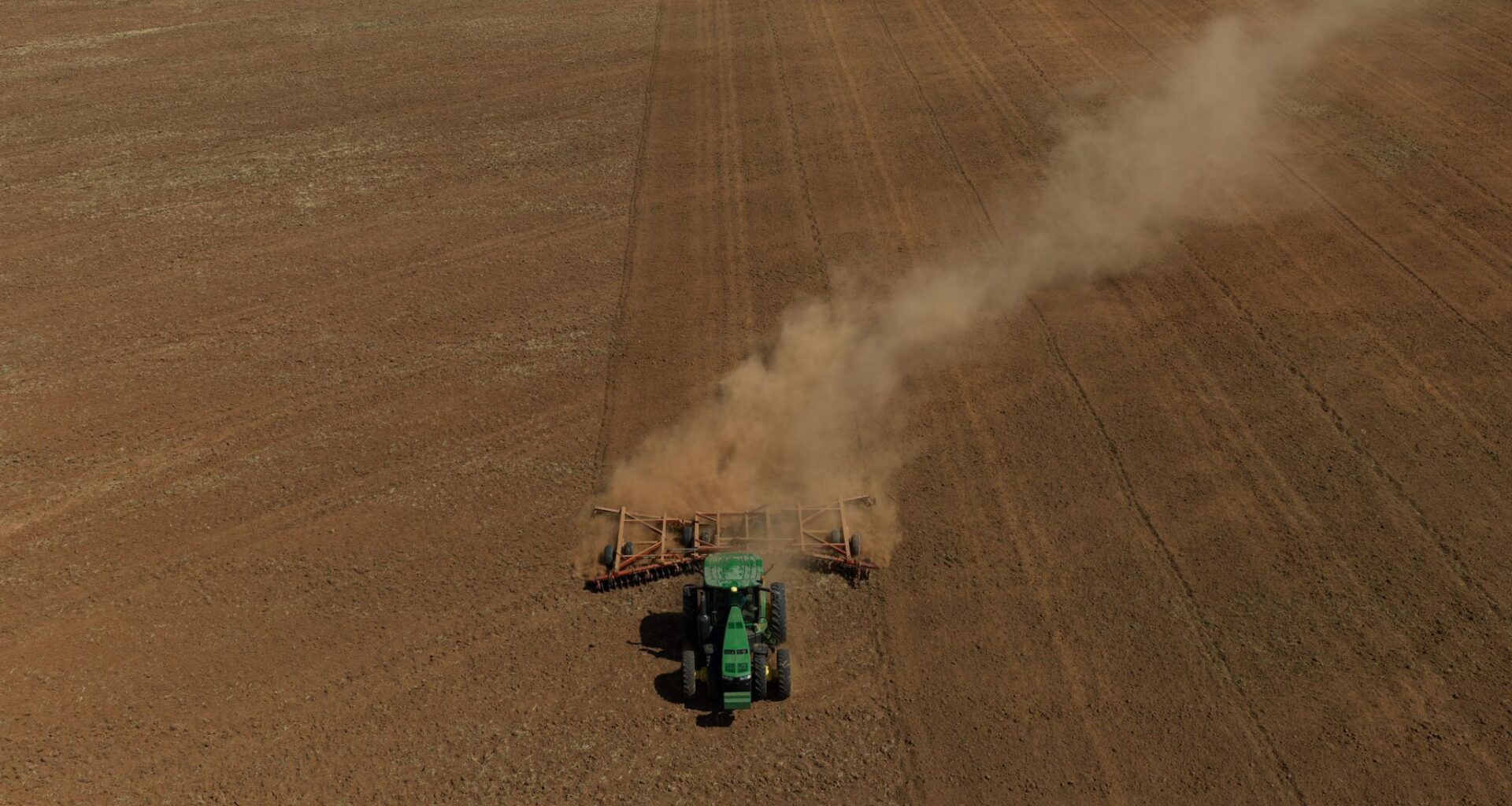
Allen O’Neal plows his field as he prepares to plant cotton amid a drought near Quanah, Texas, Saturday, April 25, 2026. He said he irrigates his crops with water from a well. “That little ‘ol ice storm we had was about all the moisture we had,” he said. (AP Photo/Jon Shapley)
Jon Shapley/Associated Press
Memorial Day weekend is almost here, which means it’s time to break out the sprinklers and slip-and-slides for summer — but not in Corpus Christi, whose headline-grabbing crisis is just the latest example of water stress in Texas.
Texas’ rain patterns can be described as epic droughts punctuated by biblical floods. The 2011 drought caused over $7 billion in agriculture losses. That drought was followed six years later by Hurricane Harvey’s floods, bringing another $100 billion or more in damages, much of it in Houston.
A 2024 article in the satirical news site The Onion declared that “every place on earth currently has the wrong amount of water.” That article neatly captures Texas’ relationship with water: We either have too little or too much, but never the right amount where and when we need it.
Article continues below this ad
That water is important for our personal uses and also for oil and gas production, refining, chemical manufacturing, agriculture and a whole host of other Texan activities. When the water is not available in the right quantity, location or time, our growth is stifled and the ecosystem suffers.
Several factors compound our water woes: population and economic growth, shifting development patterns and changing climate.
The story of Texas is more people and more money. But stress on resources is that story’s undesirable companion. The 1950s drought of record — the benchmark drought that Texas generally uses to plan for future droughts — was severe enough to trigger lasting change and the creation of the Texas Water Development Board. But the Texas population in the 1950s never exceeded 10 million people, which is to say, it was less than a third of our 30 million-plus residents today. If a similar drought strikes again, the strain will be much worse.
Urban and suburban development is another factor. The fraction of Texas land blanketed with impervious cover — impenetrable surfaces like pavement, concrete and asphalt — increases year after year as population growth and urban sprawl bring more roads, parking lots and buildings. This trend makes it harder for aquifers to recharge and for soils to soak up water when it rains, exacerbating floods.
Article continues below this ad
And a changing climate doesn’t help. More than a century of accumulating greenhouse gases is amplifying the Earth’s water cycle. For Texas this means more intense and frequent rainstorms while deserts expand and summers become increasingly hot and dry. It also means pushing the “climate line” — the 100th meridian that is considered the boundary that divides the dry west and wet east — eastward. That line has already moved an estimated 140 miles closer to Houston, which means precipitation falls east of the reservoirs Texas built decades ago to catch the rain.
To their credit, today’s Texas leaders are responding to the moment by doing more than praying for rain.
Governor Abbott, the Texas Legislature and voters created the Texas Water Fund in 2023 and seeded it with $1 billion to create a vehicle for water infrastructure investment. Proposition 4, which was approved overwhelmingly by voters in 2025, invests another $1 billion annually for 20 years.
Dedicating $20 billion over 20 years for water projects is a step in the right direction. But it’s also nowhere close to sufficient.
Here are some other things we can do.
Article continues below this ad
Farmers can improve irrigation efficiency to get more crop per drop of water.
We can shut down thirsty coal-fired power plants and replace them with combined-cycle natural gas power plants, which use significantly less water. Even better, we can use wind and solar when available. They do not need water cooling at all.
Cities can develop building codes that promote water efficiency through xeriscaping and native grasses to reduce household irrigation uses. Those summer sprinklers may be fun for the kids, but it’s a waste to spend water on little more than ornamental grass.
The state can also incentivize oil and gas companies to work across industries and invest in water efficiency for farmers and ranchers, freeing up more water for oil and gas use — and also for municipalities and ecosystems.
And then there are the data centers. These hubs for the artificial intelligence future are on track to use between 3% and 9% of Texas’ water by 2040, eclipsing the amount used by manufacturing statewide. But they don’t have to operate that way. The waste heat from hard-working computer chips in data centers can be used to produce freshwater resources by powering desalination or atmospheric water harvesting. Data center developers can also work with local stakeholders to increase overall water availability through stewardship programs and investments, as Meta has proposed in El Paso.
Article continues below this ad
Finally, we can work on reducing the cost of desalination. That isn’t a new challenge for Texas.
On June 21, 1961, President John F. Kennedy remotely activated a new desalination plant in Freeport, Texas, from the White House. In his accompanying speech, he declared: “There is no scientific breakthrough, including the trip to the moon, that will mean more to the country which first is able to bring fresh water from salt water at a competitive rate.”
Just as Texas helped make Kennedy’s moon shot a reality, we can do it again for water.
Corpus Christi is grappling with a water crisis because it failed to plan for a long-foreseen shortage. For the rest of Texas, we need to get to work. Our farmers need to water their crops. Our industries need to cool their facilities. And our kids should be able to run down their slip-and-slides.
Article continues below this ad
Michael E. Webber is the Sid Richardson Chair in Public Affairs, Cockrell Family Chair #16 in Engineering, and Engineering Academic Director of the Senator Kay Bailey Hutchison Energy Center at the University of Texas at Austin. His book “Thirst for Power: Energy, Water and Human Survival” was published in 2016 and turned into a PBS special in 2025.