
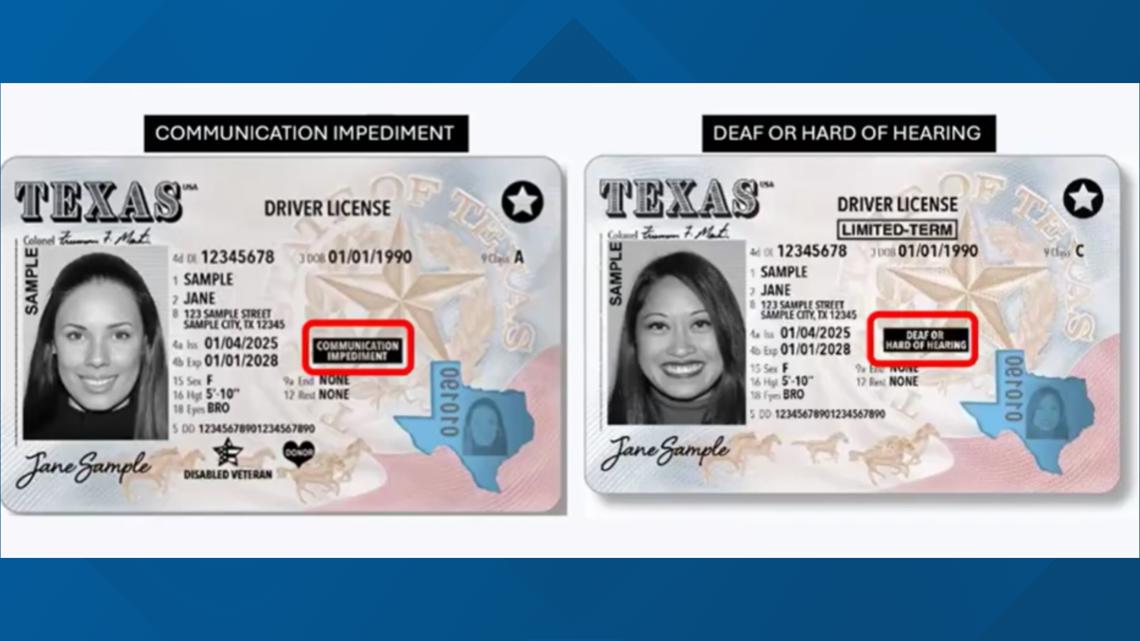
The changes apply to driver’s license and identification cards issued under the Texas Driving with Disability Program.
AUSTIN, Texas — Texas residents with a hearing impairment or communication impediment can now list those disabilities on their state-issued driver’s license or ID card.
The Texas Department of Public Safety (DPS), in partnership with the Governor’s Committee on People with Disabilities (GCPD), said the changes to driver’s licenses and ID cards issued under the Texas Driving with Disability Program aim to improve communication between law enforcement officials and Texans with certain disabilities and health conditions.
Those who voluntarily participate in the Texas Driving with Disability Program now have the option to include the “Communication Impediment” or “Deaf/Hard of Hearing” indicator on the front of their driver’s license or card. DPS said previously, only the Communication Impediment option was available.
To participate in the program, Texans must bring a Physician/Psychiatrist’s Statement Form DL-101, signed by their healthcare provider, along with the other standard documentation DPS requires for driver’s license or ID card transactions, to an in-person appointment at a DPS office. Appointments can be scheduled online, and the required documentation is listed here.
The following disabilities or health conditions qualify under the Texas Driving with Disability Program: autism, brain injury, cerebral palsy, deaf, Down syndrome, hard of hearing, mild intellectual disability, Parkinson’s disease, Post Traumatic Stress Disorder, and speech and language disorders, including mutism, stuttering, speech delay aphasia and spasmodic dysphonia.
For more information on how Texans can access all the Texas Driving with Disability Program features, check out this webinar hosted by the DPS, GCPD and the Texas Department of Motor Vehicles.