
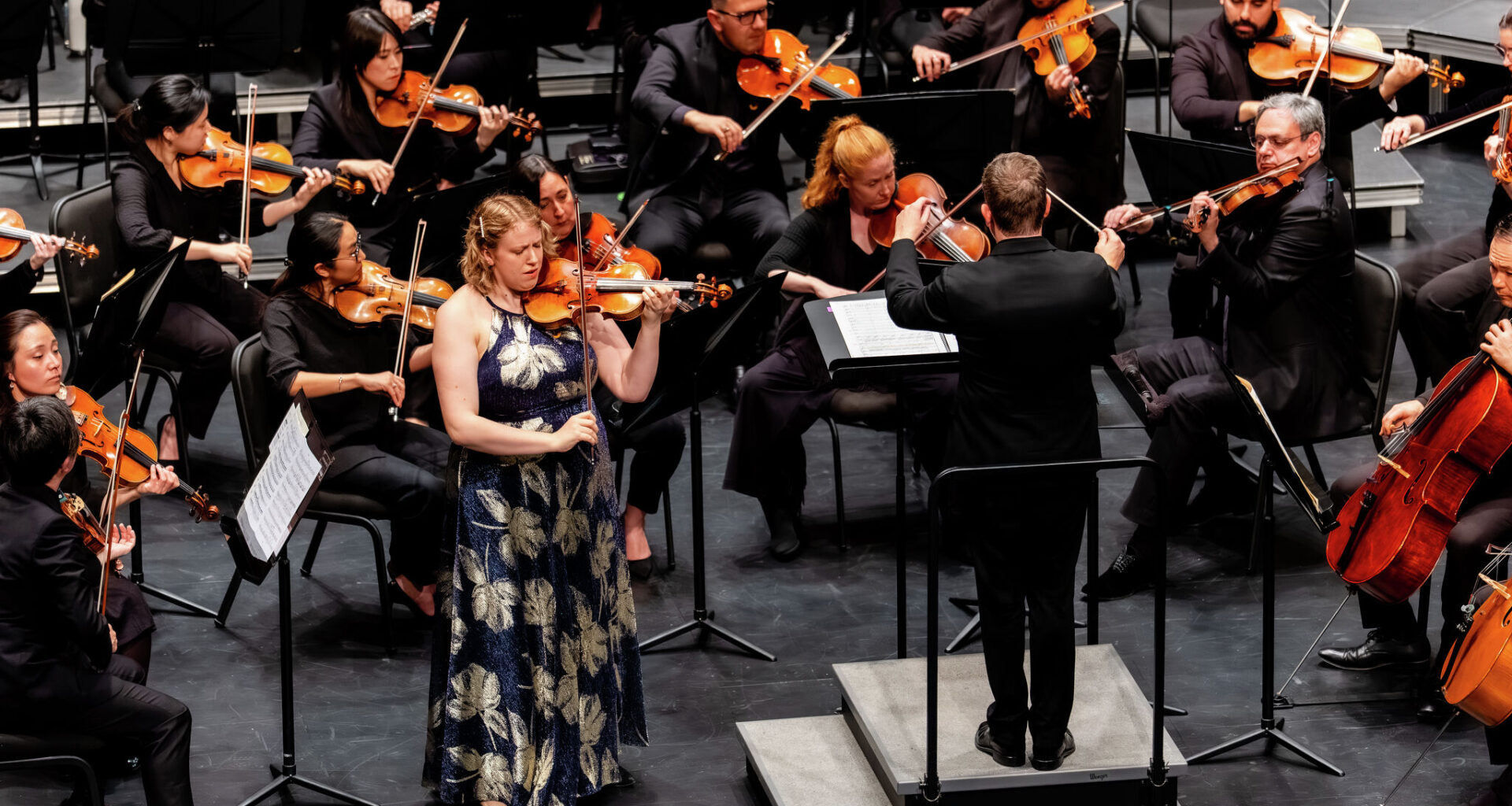
Although the three pieces on the Dallas Chamber Symphony’s Tuesday night concert were composed within a mere dozen years, between 1884 and 1896, they couldn’t have been more different. Earliest of the three, performed in the concert’s second half, was the last of Brahms’ four symphonies. The first half was all fin de siècle French: Debussy’s Prelude to the Afternoon of a Faun and Ernest Chausson’s Poème, for violin and orchestra.
The Debussy was the concert’s exquisite opener, starting with Helen Blackburn’s dreamy flute solo. Music director Richard McKay savored the score’s sensuous sonic pastels and delicate textures, letting it stretch and contract and breathe in just the right places. Apart from a too-loud horn entrance, the orchestra played with finesse, enhanced by the warm acoustics of Moody Performance Hall.
The Chausson, dating from 1896, betrays harmonic influences from the composer’s teacher César Franck, himself influenced by Wagner. But there are also whiffs of nascent impressionism, and a dancelike episode seems to have drifted in from Spain. The piece doesn’t speak to me, but it has its devotees, and Laurel Gagnon played it as beautifully as could be wished.
With full complements of trumpets, trombones, horns and tuba, though, balances were too often brass-heavy for the music at hand.
This was a problem, too, in the Brahms, although it could have been ameliorated by much more dynamic control from the podium. Brahms himself conducted premieres of his First and Fourth symphonies with chamber orchestras of 49 players, although performances in his lifetime were also given by orchestras twice as large. With smaller numbers of strings, interplays of inner voices can emerge with delightful effect.
To work, though, a chamber orchestra performance needs strategic restraint of winds and brasses, to keep them partnering, not overpowering, the strings. There were some lovely quieter moments Tuesday, with telling contributions from the winds, but too much of the time McKay whipped the whole ensemble into playing as if in a full symphony orchestra in a hall far larger than the 750-seat Moody.
Tempos were agreeably purposeful, apart from a scherzo that felt a little more frantic than the prescribed giocoso (Italian for playful). But the music kept getting too loud, climaxes in the finale equipped to storm Leningrad.
Again, McKay’s spoken introductions went on too long, and applause after every movement of the Brahms suggested this audience was not helped by mentions of sonata form and Phrygian mode. More useful to have said, “The four movements of the Brahms are best enjoyed if heard without interruption, so would you be so kind as to hold applause until after all four have been played?” And maybe have the orchestra demonstrate the theme of the finale’s variations.