
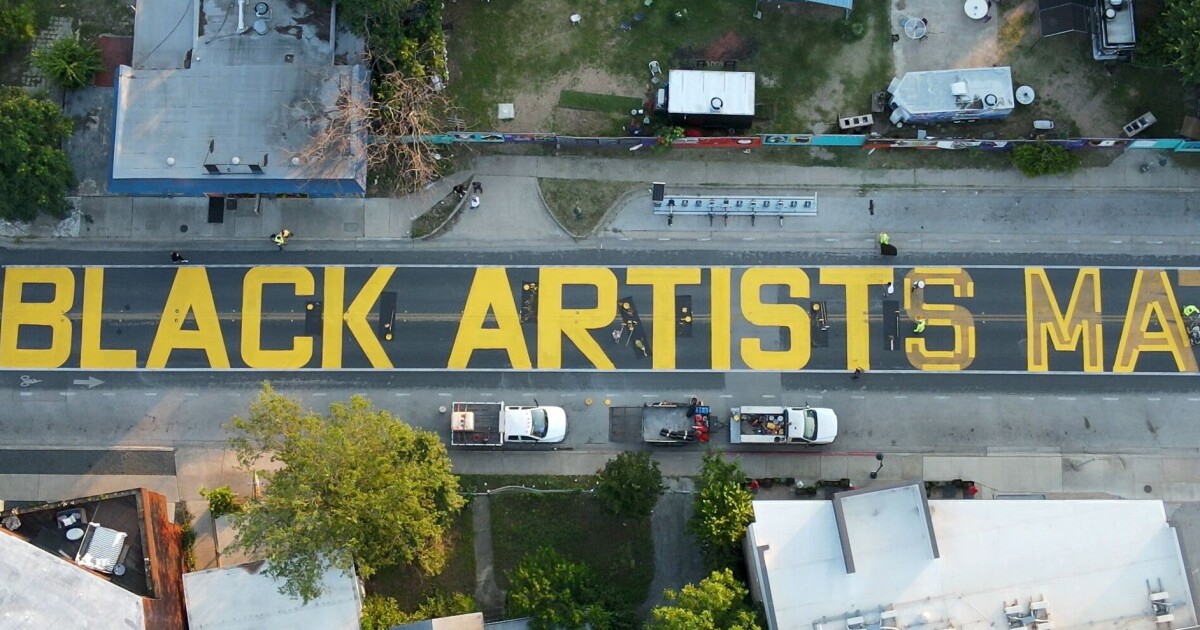
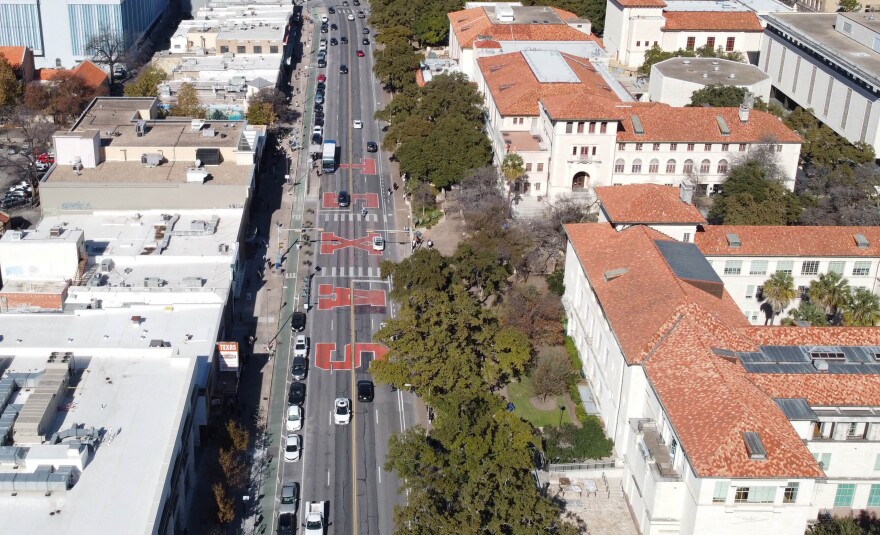
The state of Texas is rejecting Austin’s request to keep some of the city’s most recognizable painted street markings, including the “Black Artists Matter” mural on East 11th Street, the downtown Pride crosswalks and the giant burnt orange “TEXAS” painted along Guadalupe Street in front of the University of Texas at Austin campus.
In a May 18 letter to Richard Mendoza, the director for Austin Transportation and Public Works, the Texas Department of Transportation said several of the city’s painted crosswalks and street murals are “not acceptable” under state and federal rules on road markings.
TxDOT gave the city until June 22 to submit an action plan for bringing the locations into compliance.
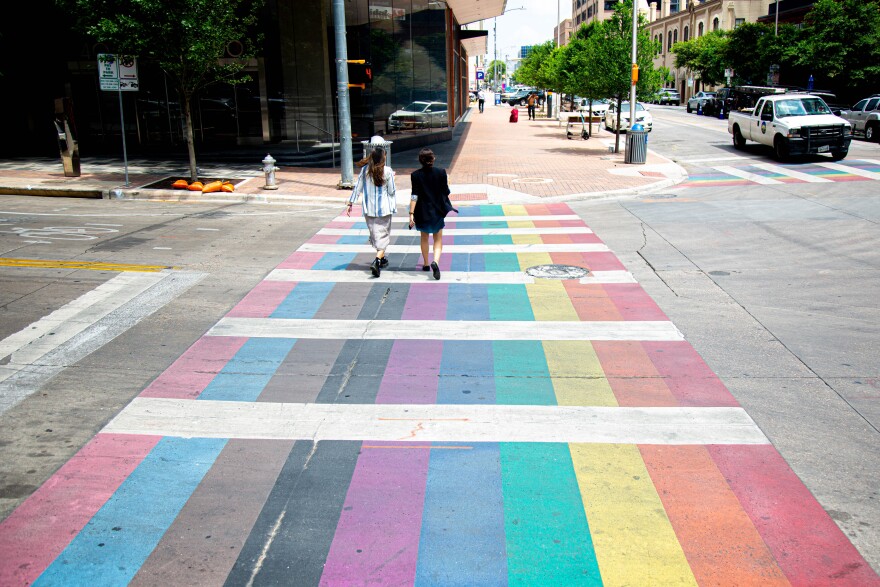
In 2021, the city installed rainbow crosswalks at Fourth and Colorado streets, a neighborhood that has long served as a hub for LGBTQ+ nightlife in Austin.
Failure to do so could lead to the “withholding or denial” of state or federal transportation funds. TxDOT also threatened to suspend agreements with Austin. Those agreements cover things such as road maintenance, utility relocations for highway projects and potentially a $25 million boardwalk on Lady Bird Lake.
A city spokesperson confirmed receipt of the letter, and said the staff were preparing a memo to update Mayor Watson and the City Council no later than Thursday.
The markings TxDOT refused to allow also include a river-themed crosswalk on Lake Austin Boulevard and two painted neighborhood traffic circles: a sunflower design at East 22nd and Salina streets installed in 2015 and a smaller traffic circle at 53rd Street and Avenue H.
Austin Transportation and Public Works
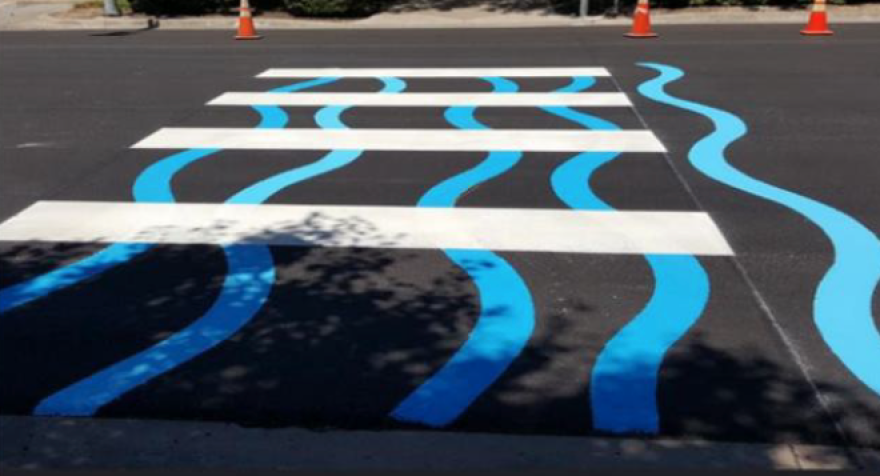
The “River” crosswalk was installed in 2016 on Lake Austin Boulevard as part of the city’s “Creative Crosswalk Pilot Program.” This week, TxDOT officially denied a request by the city to keep it.
The letter doesn’t require the same response for every painted marking the city flagged for review. TxDOT accepted Austin’s plan to address three locations by “installing curbing and other improvements.”
The state agency also said three artworks, including “Fairy Alley” between Treadwell and Dexter Streets and two crosswalks decorated by children would be allowed to fade away.
City of Austin Neighborhood Partnering Program
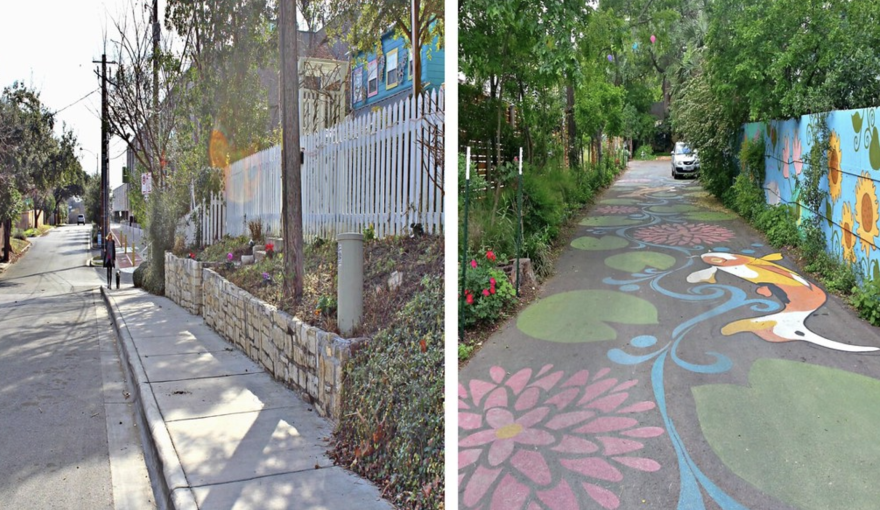
TxDOT says “Fairy Alley” between Treadwell and Dexter streets in the Zilker neighborhood can be allowed to fade away in the interest of “maintaining safety and minimizing unnecessary disruption.”
Jean-Pierre Verdijo, an artist and human rights advocate who helped paint the “Black Artists Matter” mural in 2020, said TxDOT’s decision was pretty much what he expected.
“It’s not surprising considering the growing movement toward authoritarianism that mixes so well with racism and homophobia,” Verdijo said. “Having artwork that celebrates the diversity of the human experience in public view is one way to assure that human rights for vulnerable communities are being considered.”
TxDOT framed the decision as a safety issue, emphasizing “uniformity and predictability” in road markings. The letter points to U.S. Transportation Secretary Sean Duffy’s SAFE ROADS Initiative announced last July and Gov. Greg Abbot’s directive that followed.
In October, Abbott ordered TxDOT to enforce a ban on roadway markings that do not direct traffic, saying taxpayer money should not be used to “advance political agendas on Texas roadways.”
Nathan Bernier
/
KUT News
UT-Austin installed the “TEXAS” mural in front of the UT Mall in August 2024. TxDOT says it must be removed.
The decision from TxDOT follows a separate federal directive that forced Austin to remove three experimental crosswalks earlier this year.
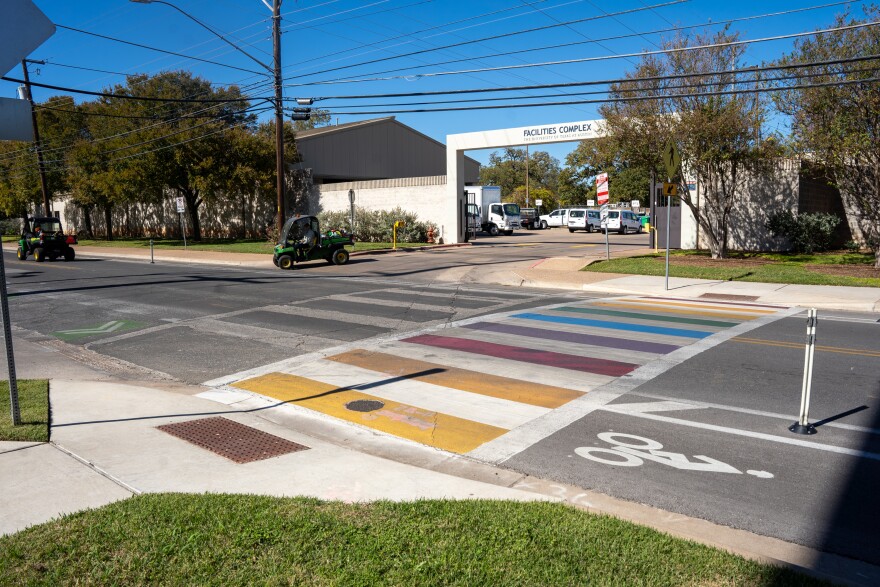
Those crosswalks — at Morrow and Watson streets, Manor Road and Leona Street, and Pedernales Street and Webberville Road — were part of a Federal Highway Administration study testing whether colorful or patterned pavement markings affected pedestrian safety.
Kennedy Weatherby
/
KUT News
A rainbow crosswalk on Manor Road at Leona Street was among three creative designs studied under a federal pilot project launched in 2024. The Federal Highway Administration canceled the project in November. In February, the city repainted all three crosswalks with the standard white lines.
Citing “adverse safety concern,” the FHWA terminated that study and ordered the city to restore the sites to standard markings. City progress reports to the federal government, obtained by KUT News under the Texas Public Information Act, described the findings as mixed.
Other Texas cities have already removed similar street markings. San Antonio covered up rainbow crosswalks in January, and in March unveiled new rainbow sidewalks.