
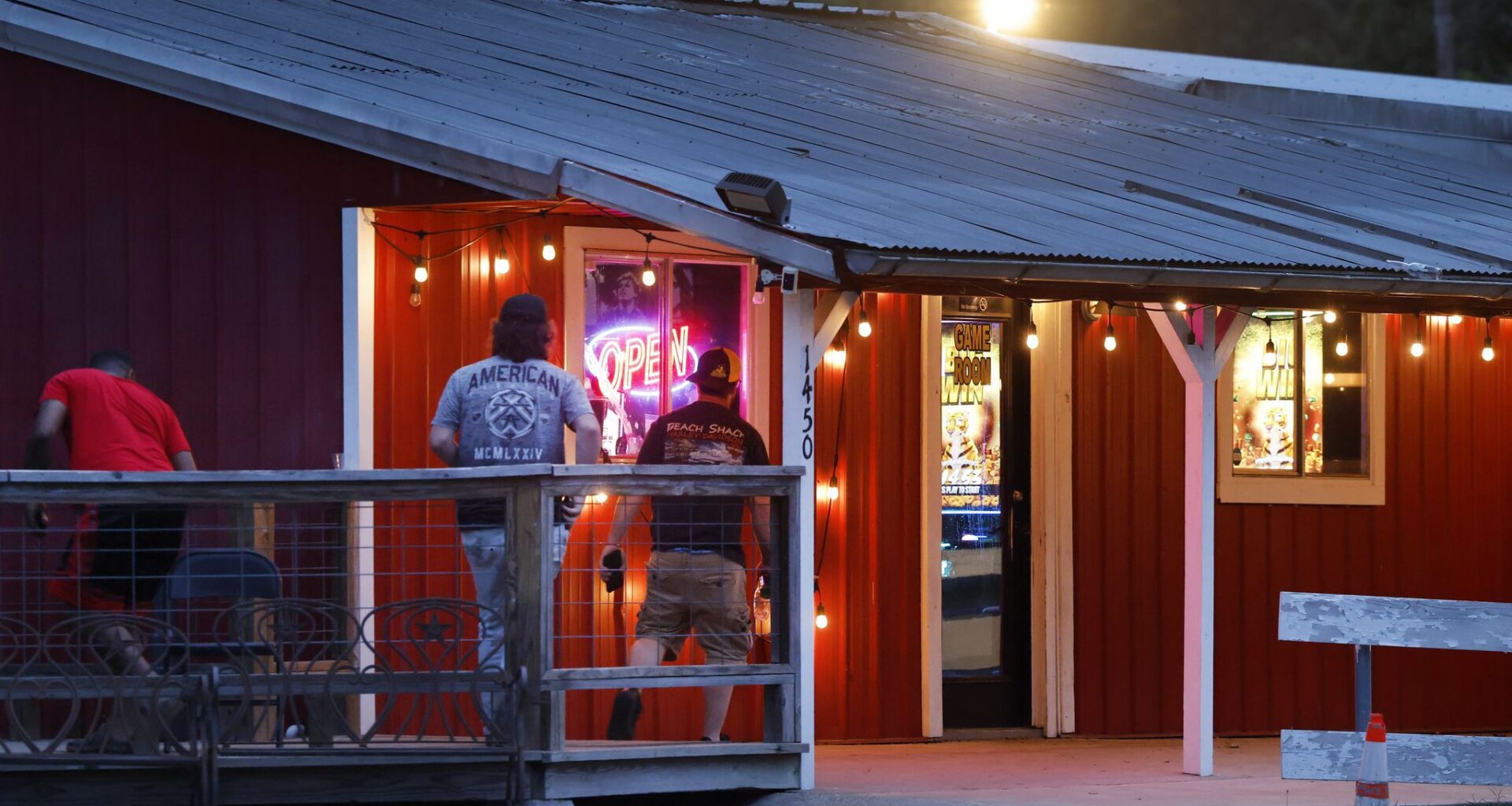
For decades, Texas’ gambling opponents have demanded strict enforcement of the state’s gaming laws, prompting local prosecutors to crack down on the spread of slot machines known as eight-liners.
Now, a new generation of bell-ringing slots are popping up across Texas like bluebonnets in spring. You’ll find them in a small taco shop in Oak Cliff, a roadside game room east of Dallas and a sports bar near Mesquite.They go by names such as “Ultimate Fire Link,” “Fusion Lightning Edition” and “King Kong.” They beckon players to pony up and push the button in the hopes of hitting a jackpot.
And, according to a legal decision in east Texas, they are perfectly legal – a game-changing ruling that could alter the landscape of gaming in Texas and has reignited the battle between anti-gambling and pro-gambling forces.
How are these slot machines not gambling? They include memorization elements similar to the vintage Simon game that was a symbol of 1980s pop culture. As such, former 336th Judicial District Court Judge Laurine Blake, who retired Dec. 31, 2024, determined they are games of skill, not games of chance.
That decision was affirmed last year by the state’s Sixth Appellate District. The three-judge panel spilt 2-1.
The ruling has emboldened game operators and local businesses.
“They’re kind of waving this in the air now and saying their machines are not gambling devices and therefore legal,” said Shannon Edmonds, executive director for the Texas District and County Attorneys Association, the state’s largest nonprofit organization dedicated to Texas prosecutors and their employees.
Within a year, Edmonds predicted, these new devices likely will be fixtures across Texas in grocery stores, gamerooms, convenience stores, gas stations and just about anywhere they can find an outlet and a welcome home.
“They’re going to start pushing more aggressively and putting these machines all over,” Edmonds said.
In Dallas, they’re already here, said Allison B. Hudson, spokeswoman for the Dallas Police Department.
On average, police have approximately 40 to 50 ongoing investigations related to gambling devices. Some of those devices qualify as legal, Hudson said, because they are identified as games of skill. The bulk of the devices, she said, are determined after those investigations to be illegal.
“We focus our enforcement efforts on devices that clearly meet the definition of illegal gambling under state law,” Hudson said.
The court ruling provides some guidance on which machines are legal, but without new state legislation the matter is largely in the hands of individual police agencies and prosecutors.
The ruling aside, Kevin Palmer says he knows gambling when he sees it.
Palmer, the Van Zandt County Fire Marshal, inspects the devices in bars, gamerooms and other parts of a community east of Dallas.
“If I go sit at this machine and just keep hitting the button,” Palmer said, “I’m doing nothing but 100% gambling, OK?”
Operators disagree.
“Our games have been ruled legal in Texas as they meet the standard to qualify as games of skill as set forth in statute,’’ said Rachel Albritton, spokeswoman for the Atlanta-based Pace-O-Matic, the devices that were the subject of the lawsuit.
The devices are in “total compliance with the law,” and she said her company aims “to preserve the right of small businesses and fraternal clubs to benefit from the supplemental income our skill games provide.”
In Canton, a city east of Dallas best known for its indoor flea market, the spread of the gaming devices has fueled a bitter dispute in a runoff in the district attorney’s race.
Incumbent Tonda Curry asserts the devices are not gambling machines and has permitted businesses to feature them in their establishments. Challenger Richard Schmidt disagrees with that assessment and is being backed by residents who are pushing to unseat her, including state Sen. Bob Hall, R-Edgewood.
Hall, who is one of the most outspoken critics of gambling in the legislature, is determined to eradicate the devices from the region he represents.
The law is clear, Hall said. Gambling devices are illegal in Texas. It doesn’t matter if the devices include skill, he said, “even 1% chance means the games are illegal.”
It’s become a disturbing situation, he said, that could lead to a different application of the law depending on the jurisdiction.
“We have two kinds of DAs in the state,” Hall said, “those who enforce the law and those who choose to overlook it.”
Curry did not respond to questions provided in three emails and a call.
But in comments and a video on her Facebook page, “Tonda is Tough,” she said that up until now, all businesses that featured gaming machines had been found legal under Texas law. Game manufacturers changed the technology of their games to comply. And in consultations with other prosecutors and legal experts on the matter, they agreed that “it would be very difficult under Texas law as it is written to prosecute these gamerooms.”
In a recent post, she said she had submitted a request to the Texas Attorney General’s office to seek clarification.
That request, she said, is now pending review. “The process takes time,” she wrote, “and it may be a couple of months before an opinion issued.”

The Wild West
Texas was once a gambler’s paradise.
Beginning with its frontier heritage well into the early decades of the 20th Century, Texas’ wild west image carried over into red-light or “vice districts” established in cities such as Dallas, Fort Worth, San Antonio, Houston and particularly Galveston, said Cal Jillson, professor of political science at Southern Methodist University.
A precinct in downtown Fort Worth was known as “Hell’s Half-Acre.”
By 1903, gambling had been outlawed, Jillson said, and there was a widespread moral denunciation of those districts.
Still, communities were not able to fully confront those highly visible profitable districts, Jillson said, that featured saloons, gambling and prostitution.
It wasn’t until the 1950s that enforcement became stricter, and Texas’ most notorious gamblers left for Las Vegas. That included Dallas gambling kingpin Benny Binion, who began his career as a dice dealer for Diamond’s St. George Hotel casino on Commerce Street in Dallas; and Jake Freedman, the Houston oil man and gambler who helped establish the Sands Hotel and Casino, the predecessor to the Las Vegas-based Sands Corp., which is working so hard to get back to Texas.
By the 1960s and beyond, social conservatism was rising as a result of the influence of Mel and Norma Gabler, the well-known Longview couple that pushed for textbook reforms and over four decades influenced a wave of elected officials in local communities and at the statehouse.
And so, the anti-vice legislation that passed, Jillson said, “was an attempt to keep people on the straight and narrow so that they’re better, more productive citizens.’’
And that’s exactly where state leaders who oppose any form of gambling expansion currently sit on the issue.
Skill vs. chance
In Texas, a gambling device is defined as a mechanism that allows a player an opportunity to win anything of value solely or partially by chance. Even if there’s some skill involved, if there’s chance, then it’s a gambling device, said Edmonds, who led former Lieutenant Gov. Bill Ratliff’s gambling crackdown in the early 2000s and was a prosecutor in Travis County.
The law also stipulates that a machine that awards novelty prizes and is made solely for “bona fide” amusement purposes is not a gambling device.
“One thing we have to argue about,” Edmonds said, “nobody really knows what that means.”
Another gray area in the law is that sometimes you can’t tell if a device is legal or not from the outside. In other words, you have to crack open the machine to see how it works and how it determines payouts.
Amusement devices were deemed to be generally legal when they were set to have payouts of cheap toys or novelties. So, for a long time, there was little controversy with game devices as long as they provided payouts of no more than $5.
A player could be awarded a non-cash prize or toy that has a value from a single play of less than $5 or less than 10 times what it costs for them to have one play. In other words, if it cost a player 25 cents each time he or she hit a button, the maximum prize value he or she could win was 10 times that — $2.50 — or up to $5 — whichever was less.
Entertainment venues such as Chuck E. Cheese and Dave & Buster’s, which allow players to redeem coupons for candy, toys and similar prizes, advocated on behalf of such laws.
Things began to change when operators discovered they couldn’t make any money if their payouts were capped at $5.
So, they decided to award more than the law allowed. This happened in various forms. Sometimes, they would hand out individual coupons that could be accumulated to draw large payouts.
All of a sudden, the devices became illegal.
Even then, it wasn’t easy to enforce.
“You basically had to catch them in the act, paying out substantial funds,” Edmonds said.
Canton isn’t the first city that has sparred over the topic.
In 2013, Fort Worth was up in arms over old-school eight-liner slot machines. They had been allowed, in part, under state law that regulates “skill or pleasure coin-operated machines.”
The devices were springing up all over town — inside bars, convenience stores, gas stations and gamerooms across the city, said Dana Burghdoff, assistant city manager in Fort Worth.
The city passed an ordinance to try to stop the spread of the machines. But as soon as the ordinance took effect Jan. 1, 2015, several game room operators sued Fort Worth, resulting in 10 years of litigation. The city lost its battle when a district court agreed with machine operators that the ordinance was invalid and conflicted with state law. However, in 2022, an appeals court determined the machines were illegal because they provided prizes based on chance, not skill. The city banned them citywide.
Game room plaintiffs had argued their devices complied with exceptions under state law that allowed games that provided payouts of under $5.
It didn’t matter, said Chris Mosley, senior assistant city attorney and section chief for the general litigation division of the city of Fort Worth.
“At the end of the day,” Mosley said, “the eight-liners, as determined by the court, were unconstitutional machines because they were games of chance.’’
The devices required “no skill or very little skill,” he said, “even mixed skill and chance, it still equals a game of chance.”
Skill or chance?
The latest controversy over the new generation of slot machines arose out of a handful of rulings from mostly north and east Texas.
Roughly three years ago, law enforcement in Fannin County, which is about an hour northeast of Dallas, seized five machines and cash from a local Quick Stop Food Store.
That’s the case in which Blake determined they were games of skill, not games of chance.
Blake also ordered the return of the gaming devices, as well as the return of the cash seized, to defendants S&M Inc., the owner and operator of the Quick Stop Food Store in Savoy and Pace-O-Matic, the software manufacturer of the seized machines, and Republic Amusement LLC, the Texas operator for Pace-O-Matic, according to court records.
The state appealed, but the court affirmed the trial court’s judgment.
Three legal experts who reviewed the case at the request of The Dallas Morning News said the outcome could have been very different if the appeals court had been privy to more details.
The state did not provide the appellate court with a standard overview of the case. It’s not clear why. Nathan Young, first assistant criminal district attorney for Fannin County, did not return two emails and a phone call.
“The trial court heard the evidence in person,’’ Justice Jeff Rambin wrote on behalf of three-member Court of Appeals for the Sixth Appellate District of Texas at Texarkana. “We did not. That matters.”
Playing Time
On a lazy Sunday afternoon in late April in Oak Cliff, a pair of cooks were behind the stove at the taco shop inside the convenience store of the gas station on the corner of Hampton Road near Illinois Avenue.
On the other side of the cooking station were two machines that displayed rolling balls of fire on their screens.
Within minutes, a man limped over to a stool in front of a machine and inserted a $20 bill. In Spanish, he said, he plays to pass the time, but he doesn’t expect to win. He often loses money so he stops.
About 60 miles east in Canton, the smoke-filled Rowdy’s Gameroom offered 35 slot machines with similar but larger machines. “Cash out on the spot as we are legal and permitted,” read a post on Rowdy’s Facebook site. The establishment, the post continued, is “setting the standard for skill slot gaming in Texas.”

Rowdy’s Gameroom, located about 60 miles east of Dallas, offers a new generation slot machine that operators say is skill-based, not chance, and therefore legal. in Canton, Texas, May 15, 2026.
Visual by Tom Fox | The Dallas Morning News.
“They look like slot machines,” owner Rowdy Jake Heddin said, “but these are skill games.”
This afternoon, only a handful of players lounged on stools. But on a recent Friday afternoon, the activity in the gameroom was brisk as people got off work and started the weekend.
One player, who would not give her name, said she had an allowance to spend about $100 each month, which lasted about three hours gaming.
She liked to have a gameroom a short distance from home, which saved her a one-hour drive to the Choctaw Casino in Durant.
Test the law
Hall, the lawmaker who represents the area, says he is likely to introduce legislation to close loopholes that may exist.
That will be difficult, said Palmer, the fire marshal who inspects the machines at Rowdy’s and other businesses across Van Zandt County. The law, he said, is always playing catch up with technology evolving so quickly.
For example, he said, the feature on the machines that allow a player to choose the memorization game has become increasingly harder to find.
A player has to choose to play the memorization game, he said. The player can do that by tapping the “follow me” feature.
Otherwise, he said, the player will hit the button again and again and it keeps going as a game of chance.
For now, Palmer says his hands are tied.
It won’t help the county if law enforcement conducts a raid to close the businesses, he said, because those businesses will sue the county based on case law that protects them – and likely win “millions of dollars that we don’t have in Van Zandt County.”
If it were just him assuming the liability, he’d close them down.
“But when I’m putting millions of dollars of other people’s money on the line,” Palmer said, “I just don’t think that’s the right thing to do.”
At least one resort casino operator – Sands Corp. — as well as Native American tribes that operate casinos in Texas and just over the Oklahoma border, will be keenly interested in how this battle unfolds.
Lawmakers are expected to take up the issue when they reconvene in January.
If the legislature does not act – and the court ruling stands — those who would like to see casino gambling expand in Texas could likewise be emboldened to test state law.