
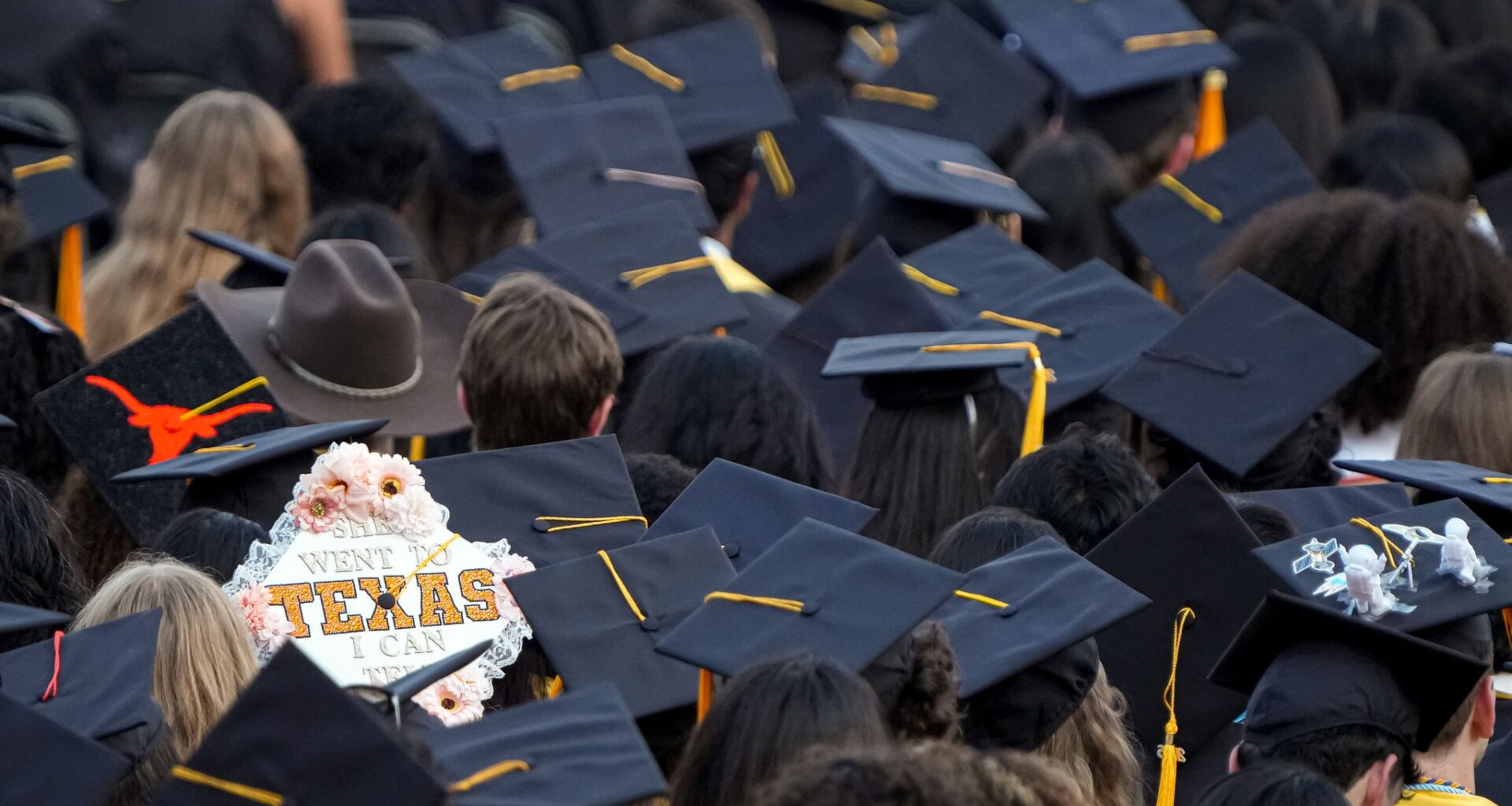
Graduates attend the University of Texas at Austin’s 2026 Commencement Ceremony at Darrell K Royal–Texas Memorial Stadium on Saturday, May 9, 2026 in Austin.
Aaron E. Martinez/Austin American-Statesman
Higher education is in trouble — and grades are losing their meaning.

That’s the verdict a committee from Yale University reached last month in a report that said universities have strayed from their purpose and violated the public’s trust.
Article continues below this ad
Committee members said the most common grade at Yale University and at colleges nationwide has been an A for at least the last 10 years. Nationally, 43% to 50% of grades are A’s, according to EdTech company Scholaro, which cites data from the National Center for Education Statistics.
The University of Texas at Austin is no exception. An American-Statesman analysis found that the trend is even more pronounced at the Forty Acres, where two-thirds of grades recorded were A’s, and 87% of grades were a B- or better in fall 2025.
UT spokesperson Mike Rosen said university calculations — which include small courses and late grades — show a lower percentage of A and B grades for the 2025-26 academic year at 82.4%, including data from both fall 2025 and spring 2026 semesters. The Statesman did not have access to the small course or late grades data for its analysis.
Article continues below this ad
Still, both percentages of A’s and B’s represent an increase from the 2015-16 academic year, where just under half of all grades awarded were A’s and about 80% were a B- or better. Rosen said the university is aware of the grade distribution data and is “assessing it.”
“Like other leading universities, we will address the matter as we continue with our assessment and gain a fuller understanding,” Rosen said.
The 2026 Report of the Yale Committee on Trust in Higher Education’s grade findings garnered national media attention and calls for action to limit the number of top scores.
Article continues below this ad
Harvard University faculty voted Wednesday to cap A’s given in a course to 20%, not including A- grades, in a decision they hope will strengthen academic culture and serve as a model to peer institutions. In responses to questions, Rosen did not specify how UT plans to address their own grade share.
In Texas, a researcher at a conservative think tank has been concerned about rising grades for more than a decade.
“A’s and B’s are supposed to mean above average,” said Thomas Lindsay, a senior policy expert at the Texas Public Policy Foundation. “So when we tell parents and students that a certain percentage are performing above average, it’s a mathematical and a moral impossibility.”
Lindsay said the trend makes GPAs a less valuable predictor of a student’s potential for employers, and college a less rigorous experience for an increasingly-highprice. Inflation disadvantages high-performing students from colleges without UT’s prestige, who aren’t rewarded for doing well, Lindsay said.
Article continues below this ad
Recent data supports his prediction: A 2025 job outlook report from the National Association of Colleges and Employers found that less than half of surveyed employers screen candidates based on GPAs. University of Iowa researchers measuring job and academic performance of students found in 2024 that GPA is a less valuable predictor of career readiness as grade inflation rises.
Why are faculty giving out more As?
Data from UT mirror trends at other elite universities and correspond with a sharp increase in selectivity in admissions. The number of applicants to UT doubled from 43,600 in 2015 to 90,700 in 2025.
Regardless of the selectivity of graduates, Lindsay said grade inflation — a trend where the average student grade is an A or B+ — dilutes the value of an elite grade.
Article continues below this ad
Grade inflation started in the 1960s, Lindsay said. Then, C was the most common grade nationwide, according to his own research. But by 1965, it was a B and by 2011, 43% of students nationwide earned an A.
The phenomenon isn’t because of an increase in intelligence nationally, Lindsay said. College standardized test scores on exams like the ACT haven’t risen at the same pace, he noted, suggesting grade inflation isn’t a result of students actually performing better than students in the past.
It’s also getting worse — including at UT. For the past 10 years, the most common grade given in UT classes every semester has been an A. But since the 2015-16 academic year, the share of A’s awarded to students jumped nearly 18 percentage points.
In a U.S. Department of Education blog post last September, the director of the department’s higher education reform initiative blamed grade inflation on “‘consumer demand’” for high grades, compounded by websites like Rate My Professors where students can post their grievances with grading publicly.
Article continues below this ad
Students may avoid the classes of professors perceived to be tough graders. If universities have a reputation for harsh grading, students may drop out, Lindsay added.
“On the one hand, you want to have meaningful standards, because it’s dishonest (not to),” Lindsay, who was a professor, dean and university president at Shimer College in Illinois in 2009, said. “On the other hand, you want to keep the doors open and you want to keep the seats filled.”
How do you fix it?
It’s a problem Lindsay has tried to solve since 2014. Last year, the Texas House passed a bill Lindsay supported that would have printed the average course grade on transcripts to better contextualize student performance. The legislation later stalled in a Senate committee. A similar attempt failed in 2013.
Article continues below this ad
But appetite for action may be increasing. In late July, Texas A&M University’s student body president joined five other student government leaders at schools across the country in asking President Donald Trump to issue an executive order addressing grade inflation.
The move shocked Lindsay and was a testament to the urgency of the issue, he said.
“It’s the prisoner’s dilemma,” Lindsay said. “Everybody knows what the problem is. Everybody knows what the right thing is. But no one wants to jump in the water first.”
The 2026 Yale University report concluded Yale should adopt a 3.0 median GPA. The University of Austin — UATX — caps a class’s average grade at a 3.2 GPA, or a B grade.
Article continues below this ad
In Texas, Lindsay thinks there may be more incentive for lawmakers to pass a transparent transcript bill next session. As a large state with prestigious universities, Texas would be the perfect place to start addressing the problem, he said.
“This was more a Republican issue, but now it’s a bipartisan issue,” Lindsay said. “And that is really encouraging to me.”
Article continues below this ad
The Statesman analyzed publicly available UT course grade distributions going back to the 2015-16 academic year. Fall 2025 is the most recent semester of publicly available data. In a statement, the University of Texas at Austin referenced its own internal database for grade distribution, which includes small classes that are FERPA-protected and redacted in public data.
To get the share of letter grades, the Statesman combined all grades given in every course available in the data and calculated the share of each grade and median scores to see change over time.