
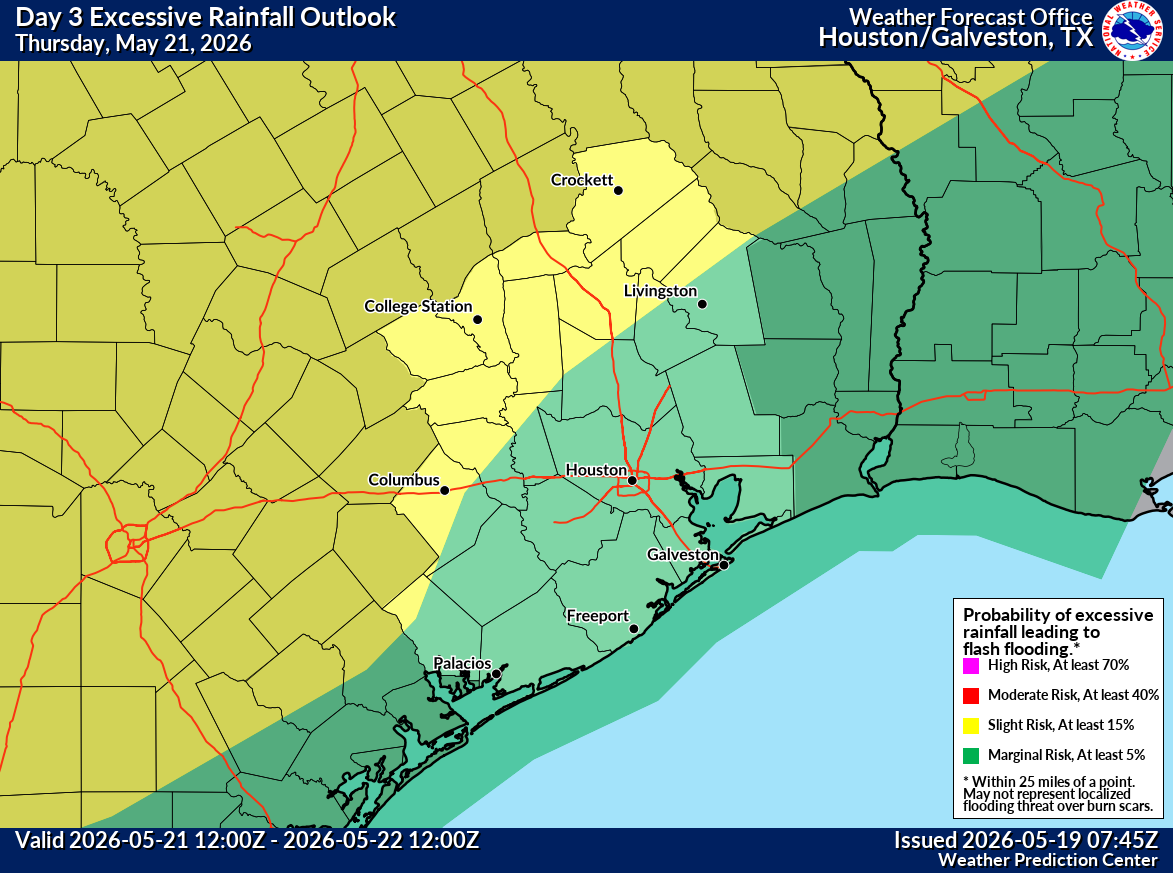
NOAA’s Weather Prediction Center expects several inches of rainfall to accumulate across Southeast Texas through Memorial Day.
NOAA’s Weather Prediction Center / Pivotal Weather
Houston is in for an occasionally stormy Memorial Day weekend and the rain threat could linger into the unofficial start of summer.
Round after round of storms over the next seven days could lead to delayed cookouts and interrupted pool time, but wet weather in late May is not uncommon across Southeast Texas. The days leading up to Memorial Day historically have been a wetter stretch of May than normal in Houston, with the holiday weekend in various years producing multiple inches of rain.
CLIMATE CONTEXT: The eastern Pacific remains in an El Niño watch. Is this emerging climate pattern responsible for Houston’s wet weather?
Article continues below this ad
This weekend’s setup appears capable of producing multiple waves of showers and thunderstorms as moisture from the Gulf of Mexico streams into the region.
Daily storms possible through Memorial Day
The current weather pattern is likely to frustrate people trying to plan outdoor events this weekend.
Forecast confidence remains low when it comes to the exact timing and location of storms. What can be said with more confidence is that each day through Memorial Day is expected to bring at least scattered showers and thunderstorms.
Article continues below this ad
“The weekend is really not looking good. It seems to be trending worse,” said Matt Moreland, meteorologist-in-charge of the regional National Weather Service office for Houston and Galveston. “We think the heaviest rain of the whole event will be over the weekend.”
Localized flooding will be the primary concern through the holiday weekend, especially in low-lying or flood-prone areas that receive repeated heavy downpours.
The risk of flooding spikes Thursday across portions of Southeast Texas, as shown in areas highlighted in yellow on this map from NOAA’s Weather Prediction Center.
NOAA’s Weather Prediction Center
Friday’s risk of flooding continues across Southeast Texas as more rounds of heavy rainfall are expected to occur.
NOAA’s Weather Prediction Center
Repeat waves of showers and thunderstorms could prolong the flood risk into the first half of the Memorial Day weekend, as shown by this map of Southeast Texas.
NOAA’s Weather Prediction Center
“We have a forecast that shows rainfall totals Thursday through Sunday of 4 to 6 inches,” Moreland said, adding that those totals ultimately might need to be increased as more forecast guidance becomes available.
Why the holiday weekend forecast is tricky
Forecasting holiday weekends like this one can be especially difficult because late-spring thunderstorm clusters constantly reshape the atmosphere as they move across Texas. “Where the storms form is all driven by where you get an outflow boundary set up,” Moreland said.
Article continues below this ad
In simpler terms, one batch of storms can leave behind boundaries that later become the focus for the next round of thunderstorms. That makes it difficult for forecasters to pinpoint exactly when and where storms will develop more than a day in advance.
“We know we’re going to get these rounds of storms,” Moreland added. “We’ll have storms for a few hours, then a break, then another round, then a break.”
Houston’s pattern of wet Memorial Days
Memorial Day week has a notable history of heavy rainfall in Houston.
Article continues below this ad
Looking at the seven-day period from May 25 through May 31 — spanning the earliest to latest possible Memorial Day dates — Bush Intercontinental Airport has recorded at least 2 inches of rain during that stretch in 24 different years. Several years produced extreme rainfall totals, including more than 9 inches in 1907 and more than 7 inches multiple times over the years.
More recently, that same period delivered 4.45 inches in 2016 and 3.94 inches as recently as 2024. For perspective, Houston normally records 5.01 inches of rain during the entire month of May, meaning some Memorial Day holiday periods alone have produced an entire month’s worth of rainfall — or more.