
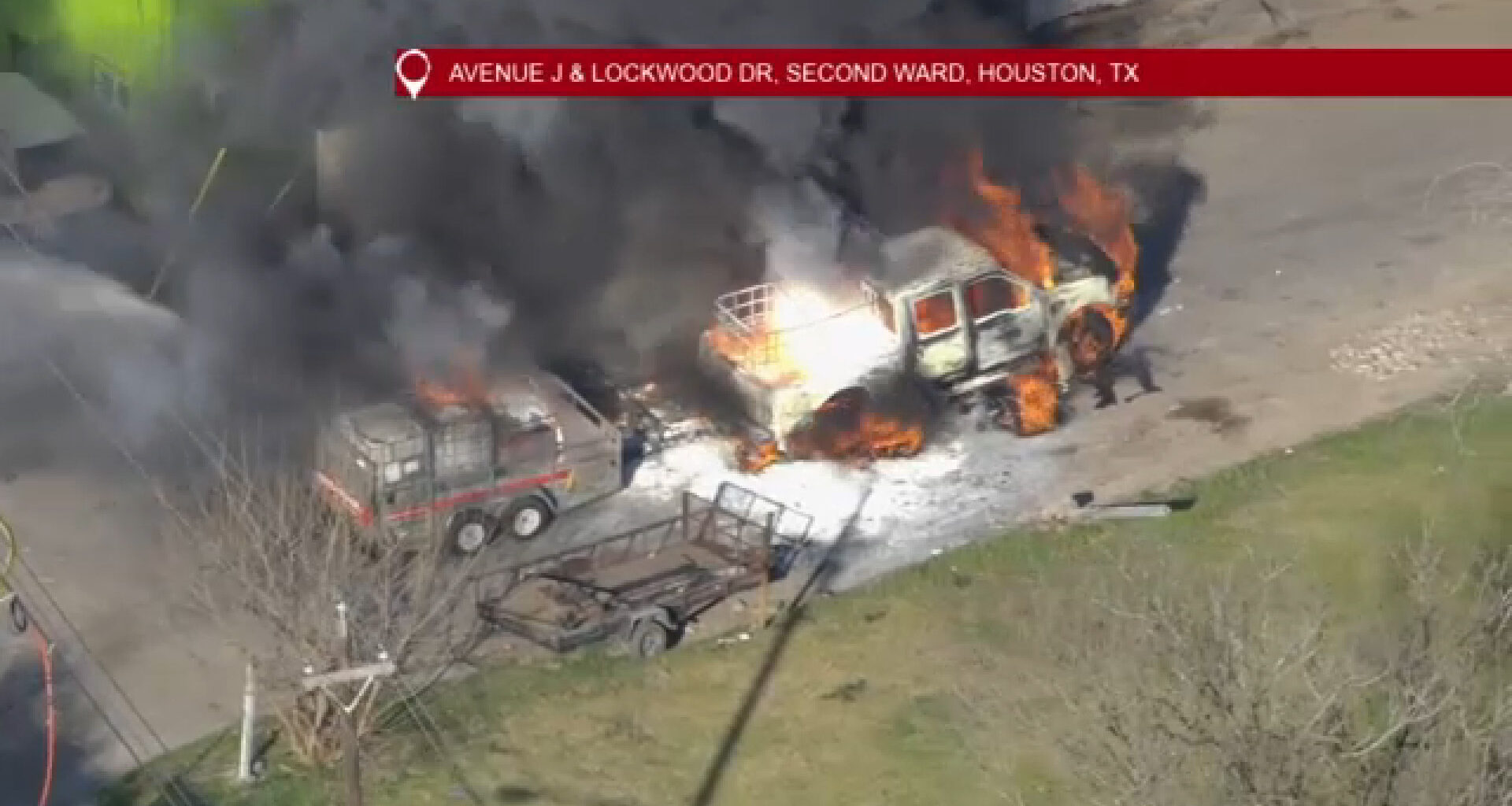
When a pickup truck carrying scrap materials caught fire in Second Ward on March 2, severely injuring four people, first responders sprayed water on the charred chassis — only to watch the flames intensify into a fireball that shot burning debris into the air.
Now, the Houston Police Department’s environmental investigations squad is probing whether hauled debris that caused flames to “violently react” to the water could be traced to a pattern of improper handling of hazardous materials at G&H Diversified Manufacturing, also known as Yellow Jacket Oil Tools.
RELATED: Houston’s housing authority fined $175K for toxic ash near affordable housing complex
The department named the oil drilling tool manufacturers in a May 6 affidavit requesting a search warrant for the company’s properties on Brittmoore Park Drive. The affidavit says the truck that caught fire had been hauling magnesium shavings.
Article continues below this ad
“Magnesium is classified as a hazardous waste due to its high reactivity and flammability. It can ignite readily in air and reacts vigorously with water, producing flammable hydrogen gas,” Sergeant Patrick J. Morrissey said in the affidavit obtained by the Houston Chronicle.
Morrissey wrote that G&H Diversified Manufacturing’s hazardous waste was improperly handled, missing documentation, lacking required notifications to environmental regulators and subject to an apparent “attempt to conceal the identity of the magnesium waste” during disposal. Harris County Judge Lionel J. Castro signed off on the warrant to search the properties.
G&H Diversified Manufacturing executives did not answer multiple requests for comment on the search or investigation.
In a May 11 response filed in a separate personal injury lawsuit over the same incident, the company said it followed all regulations for its waste disposal process and “did not breach any legally owed duty.”
Article continues below this ad
Missing manifests
Under Texas law, hazardous waste is supposed to be tracked from “cradle to grave.” The company that created the waste remains liable for its disposal at every step in the process. A document called the Uniform Hazardous Waste Manifest is signed by the waste generator, transporter and disposal facility, and then the manifest is returned to the original company for confirmation.
Houston police said that they obtained records from Randall Hutchison and his small transporter firm, Golden Boy Waste Recycling, through a grand jury subpoena. The records showed that the business had picked up multiple hauls of magnesium shavings from G&H. Still, police said the hazardous material was missing from the manifests entirely, which instead refer only to the misspelled “recyable metals shaving.”
The Texas Commission on Environmental Quality is able to assess penalties up to $250,000 for companies that violate hazardous waste disposal rules. Attorney General Ken Paxton also regularly sues companies over hazardous material mismanagement. In a statement about a recent lawsuit against a West Texas firm, Paxton said he would “not allow any company to threaten the health of Texas communities.”
MORE COVERAGE: Which Houston suburbs are sinking the most? View our map.
Article continues below this ad
Asked for the status of any state probes into the magnesium fire, TCEQ spokeswoman Laura Lopez said the agency “cannot comment on ongoing investigations.”
The Houston Police Department did not respond to requests for an update on their investigation’s status.
Lawyers for the three waste haulers injured in the fire said they are cooperating with officials. The fire broke out after the employees drove a pickup truck lugging several drums of the flammable shavings to a scrap yard where they hoped to dispose of the materials. While they have yet to file suit, the lawyers described their clients’ injuries as “catastrophic.”
“This event raises serious public-safety concerns about how dangerous materials are identified, handled, and transported. The public has a right to expect that hazardous materials will be managed responsibly,” said Ali Mokaram, the firm’s lead attorney.
When firefighters doused a blazing pickup truck at a Second Ward scrap yard with water March 2, 2026, the flames grew. Officials are now investigating the incident they say was triggered by mismanaged hazardous materials.
Frame grab courtesy of ABC 13 Houston/ABC 13 Houston
When firefighters doused a blazing pickup truck at a Second Ward scrap yard with water March 2, 2026, the flames grew. Officials are now investigating the incident they say was triggered by mismanaged hazardous materials.
Frame grab courtesy of ABC 13 Houston/ABC 13 Houston
When firefighters doused a blazing pickup truck at a Second Ward scrap yard with water March 2, 2026, the flames grew. Officials are now investigating the incident they say was triggered by mismanaged hazardous materials.
Frame grab courtesy of ABC 13 Houston/ABC 13 Houston
When firefighters doused a blazing pickup truck at a Second Ward scrap yard with water March 2, 2026, the flames grew. Officials are now investigating the incident they say was triggered by mismanaged hazardous materials.
Frame grab courtesy of ABC 13 Houston/ABC 13 Houston
Court battle
Jarobi White, who owned the now-incinerated pickup truck, was hospitalized for weeks after the fire. Fellow haulers named by police, Oscar Wattell and Kenneth Jones, were also injured in the blaze. The affidavit doesn’t mention burn victim Guillermo Garcia, who was working at his family-owned recycler Scorpion’s Metal the day the others pulled up.
Article continues below this ad
Garcia filed his own lawsuit two days after the fire. It said the waste haulers “provided no warning as to the dangerous materials or their condition” when he approached the truck with other employees to inspect it.
“It was at this time that Plaintiff noticed that Defendants’ truck was generating smoke,” the court petition said. Then, “the dangerous materials combusted, causing the immense explosion.”
Garcia’s lawsuit sought compensation for his “severe injuries” requiring surgery and his lasting physical impairment from the fire, alongside less tangible damages. His legal claim initially targeted Hutchison and Golden Boy Waste Recycling, the company that initially picked up the metal shavings, only later adding G&H, Yellow Jacket and others whose manufacturing processes generated the waste.
The lawsuit alleged that the haulers “knew, or should have known,” of the threat. It claimed they had visited four other facilities on March 2 before trying Scorpion’s Metal, all of which refused to accept the dangerous material. It also alleged that Golden Boy had previously been banned from similar facilities for starting a fire from improper disposal of metal shavings.
Article continues below this ad
Garcia’s legal filings said Hutchison himself drove to the junk yard to drop off the shavings, an allegation the owner denies.
Reached by phone, Hutchison told the Chronicle he was “not at liberty to talk about it” given the open investigation. But in a personal letter to the court, Hutchison wrote that he was “not present at the scene of the alleged incident” and “no vehicle, truck, equipment or any other asset belonging to Golden Boy Waste Recycling LLC was present at or involved in the incident.”
According to the police affidavit, Golden Boy’s ex-employee Oscar Wattell — one of the injured haulers — picked up the shavings from Hutchison’s property. Wattell had worked for Hutchison until last year, and used to routinely pick up drums of similar metal shavings from G&H. Wattell told officials that he did not receive “any paperwork, manifests, or bills of lading” on such trips, only envelopes with payment for Golden Boy.
In February, a week before the fire, Wattell said his former employer offered him the metal shavings without payment, but allowed him to keep any money he received from the scrap yards for its disposal.
He said he took the offer willingly, but thought it was “just metal like aluminum and not magnesium.”