
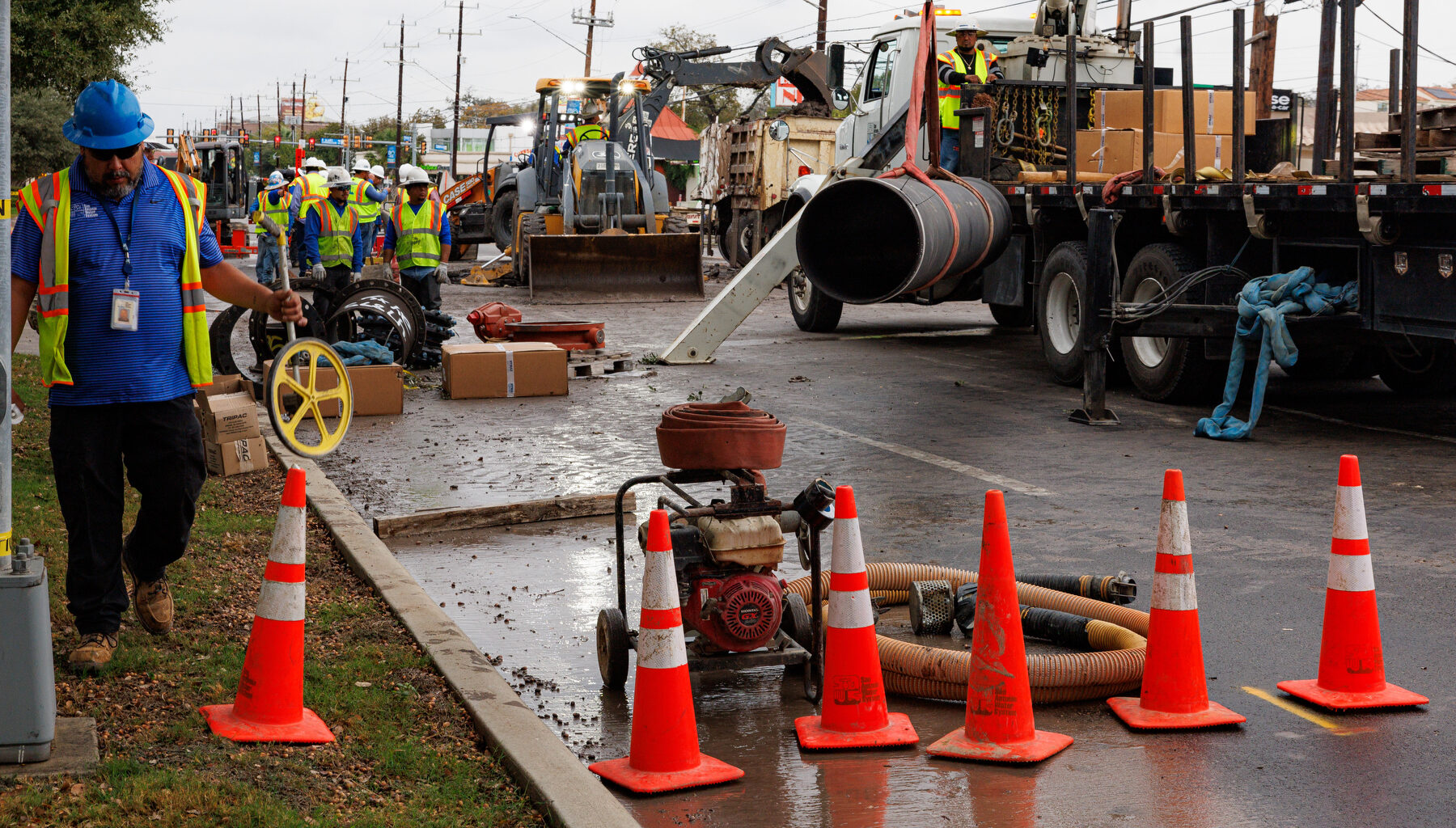
San Antonio Water System workers repair a broken water pipe along Broadway last year. It’s the wrong time for SAWS to ask ratepayers for an increase, City Council Member Marina Alderete Gavito writes.
Sam Owens/San Antonio Express-News
San Antonio City Council Member Marina Alderete Gavito represents District 7.
Carlos Javier Sanchez / Contribu
The cost-of-living crisis is top of mind for nearly everyone these days. From increasing prices at the grocery store, gas topping $4 per gallon in many places and an economy that is precarious, just getting by is a struggle for many people.

It is at this moment that San Antonio City Council, where I serve as District 7 representative, is being asked to vote on the San Antonio Water System’s proposal to spike utility rates by 33% over the next four years. It brings me both dread and frustration to consider what another cost-of-living increase would mean for residents.
Article continues below this ad
Headlines about SAWS President and CEO Robert Puente’s recent $132,000 bonus have not helped. When families are struggling to make ends meet while facing a sharp increase in their water bills, a payout to the top executive feels like a slap in the face.
There are two ways to view SAWS’ proposal to raise utility bills:
One is that the water utility is finally asking for the investment it needs after years of kicking the can down the road, and the need is urgent.
Alternatively, San Antonio ratepayers are being asked to absorb the cost of business decisions that were not made during a healthier economy.
Article continues below this ad
On San Antonio’s West Side, part of which I represent, the politics of water and infrastructure run deep. Our communities on the West Side have disproportionately dealt with the environmental and financial impacts of flooding.
That legacy continues with water leaks.
For decades, our neighborhoods have faced underinvestment. But now, just as we are finally seeing the benefits of equitable investment in the repaving of our roads, millions of gallons of water are flooding our streets and tearing up the infrastructure we fought so hard for.
In 2023, SAWS lost more than 21 billion gallons of water to leaks and main breaks. That’s roughly 430 Woodlawn Lakes. It’s hard to justify a rate hike when residents are watching their water run down the street.
Article continues below this ad
Water is SAWS’ inventory. When any business hemorrhages its inventory at that scale, the answer isn’t to charge customers more. It is to fix the operation.
We needed an aggressive plan to address this yesterday, not all at once as residents face higher costs in every aspect of their life.
More money is not the solution, and we cannot normalize utilities offsetting their costs onto residents, especially in a time of increasing disparity. We need accountability.
It is not an understatement to say SAWS has an imperfect relationship with the community. Just in the last few years, the utility has shut off water to paying tenants over landlord debts — I fought the utility on this issue.
Article continues below this ad
SAWS has also faced widespread complaints over its smart meter rollout and has kept its CEO among the highest-paid public utility executives in the country.
At a recent town hall I hosted, residents made their distrust clear, expressing how in interactions with SAWS they have walked away feeling brushed off. Now, they are being asked to pay more for the same treatment.
The question is not whether to invest, but who should be asked to absorb the cost of decades of deferred maintenance and, ultimately, what will be different going forward. Complacency leads to projects not progressing. We cannot ask ratepayers to fund another round of it.
Article continues below this ad
Approving this rate increase should be seen as a vote of confidence in SAWS. After years of SAWS consistently failing to address water leaks and poor decisions that put the community last, I cannot say I am ready to do that.
San Antonio City Council Member Marina Alderete Gavito represents District 7.