
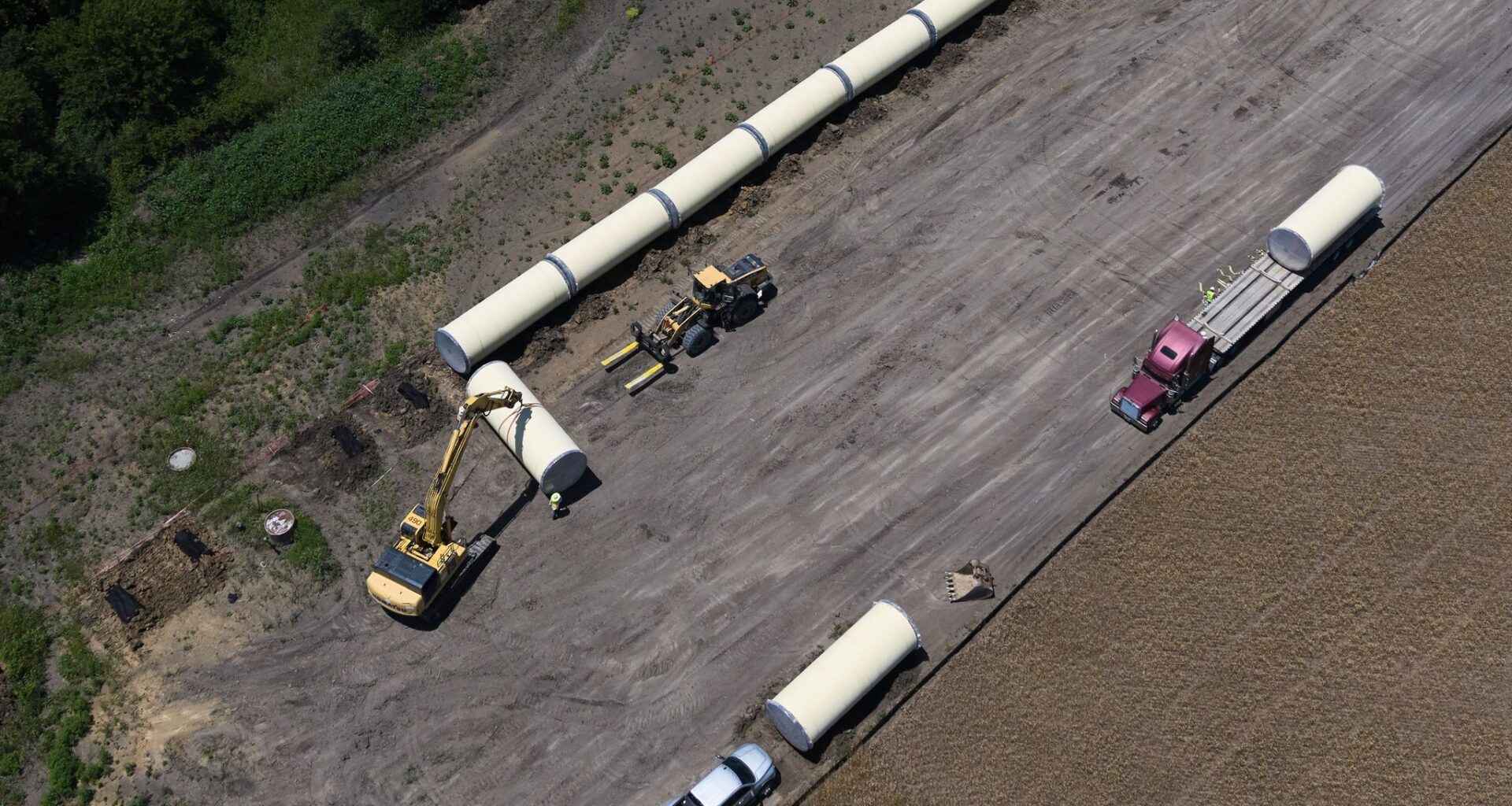
Crews line up pipes as part of the 150-mile joint Integrated Pipeline project designed to move water from three East Texas reservoirs into the Dallas Fort Worth Metroplex, Wednesday, May 13, 2026, in Midlothian, Texas. The price of creating freshwater and keeping the economy growing will leave consumers with sticker shock, state lawmakers recently acknowledged. A draft of the 2027 State Water Plan says Texas will need to spend $174 billion to meet the water needs of the next 50 years, double 2022 estimates.
Julio Cortez/Associated Press
A cow walks along the edge of a pond amid a drought in Foard County, Texas, Saturday, April 25, 2026. The price of creating freshwater and keeping the economy growing will leave consumers with sticker shock, state lawmakers recently acknowledged. A draft of the 2027 State Water Plan says Texas will need to spend $174 billion to meet the water needs of the next 50 years, double 2022 estimates.
Jon Shapley/Associated Press
A Weisinger Inc. drilling crew makes a pilot hole on March 31 at the City of Corpus Christi’s eastern well field, one of several emergency water projects in the region. The price of creating freshwater and keeping the economy growing will leave consumers with sticker shock, state lawmakers recently acknowledged. A draft of the 2027 State Water Plan says Texas will need to spend $174 billion to meet the water needs of the next 50 years, double 2022 estimates.
Dylan Baddour/Inside Climate News
A pair of rooftop chillers are installed atop Dallas TX4 which is under construction at the NTT Data center campus in Garland, Texas, March 4, 2026. It will take 40 of those water-filled chillers to cool the fourth data center built on the property. The price of creating freshwater and keeping the economy growing will leave consumers with sticker shock, state lawmakers recently acknowledged. A draft of the 2027 State Water Plan says Texas will need to spend $174 billion to meet the water needs of the next 50 years, double 2022 estimates.
Tom Fox/Staff Photographer
Texas is outgrowing its freshwater supply.

Communities across the state need billions of gallons more water for growing populations and thirsty industries like oil and gas fracking, computer chip etching and artificial thinking. What happens this summer in Corpus Christi is a sign of what’s coming for all Texans.
Article continues below this ad
The price of creating freshwater and keeping the economy growing will leave consumers with sticker shock, state lawmakers recently acknowledged. A draft of the 2027 State Water Plan says Texas will need to spend $174 billion to meet the water needs of the next 50 years — twice as much as lawmakers estimated just four years ago.
“The taxpayer is going to pay for this stuff one way or the other, be it property tax or be it fees, or be it insurance cost increases,” state Sen. Charles Perry, chairman of the Senate Water, Agriculture and Rural Affairs Committee, said during a hearing last week. “There is no free lunch here, or if they don’t pay, we end up with a Third World state.”
Inconvenient truths
Lawmakers will need to have “a big conversation” when they gather in Austin next year, Perry predicted. The level-headed Lubbock Republican is not prone to hyperbole or known for rhetorical flourish. When he speaks up, Texans best listen up.
Article continues below this ad
San Antonio Express News Logo
Make us a Preferred Source on Google to see more of us when you search.
Add Preferred Source
Droughts and floods have complicated life in Texas for eons. The population and economy only began to grow once people started damming rivers and drilling into aquifers. But experts say those water sources are insufficient for a growing state.
In the City Council’s drive to attract industry and bring in new jobs and revenue, it stretched the water supply too thin. Now that the inevitable drought has arrived, the council will likely declare an emergency and impose strict rationing.
Article continues below this ad
Experts told the Senate committee on May 11 that while 57% of city-owned water utilities say they have long-term plans with sufficient funding, 10% have no plan, and 43% do not have enough money.
This year was the first time the State Water Implementation Fund for Texas fell short, capable of providing only $1.28 billion of the $4.2 billion that water utilities requested. The Legislature created the fund 11 years ago to help local authorities pay for water projects.
The Texas Water Development Board, which administers the fund, rejected the Nueces River Authority’s request for help financing a Corpus Christi desalination plant, claiming it had to prioritize other projects.
Statewide, Texas doesn’t know where it will find 10 million to 12 million acre-feet of the 17 million the state will need over the next 50 years, Perry warned (an acre-foot is about 325,000 gallons). Making existing water treatment plants and pipelines more efficient will only meet 3% of the need.
Article continues below this ad
“If I have to pick between spending all of my dollars on leaky pipes or all my dollars on supply, I will pick supply every day,” Perry said.
Water users will need a lot of dollars.
Well runs dry
Producing drinking water from ground or surface sources typically costs between $1.10 to $4.30 per 1,000 gallons, according to the Texas Comptroller’s Office. Desalination costs range from $7.50 to $11 per 1,000 gallons.
Article continues below this ad
“Everyone in the audience is going to say, ‘That’s too much, that’s double what we’re paying,’” Perry said. “But that’s the cost of new water in Texas … we have run out of the cheap water.”
If Texans will pay those rates, utilities will deliver. Companies are working to permit three seawater desalination plants, with state officials anticipating seven plants along the coast over the next decade.
Arid nations around the world use desalination, but in addition to requiring a lot of energy, they produce a brine that is twice as salty as the water going in. If the waste stream isn’t handled properly, it can cause severe environmental problems.
Critics question the wisdom of trying to grow Texas beyond what its natural resources can sustain. Community activists want to prioritize residents’ quality of life over industrial development, and environmentalists want conservation over development.
Article continues below this ad
Sid Miller, the Republican agriculture commissioner, called for a moratorium on data centers to conserve water.
“They draw massive volumes of water for cooling, even amid ongoing drought,” Miller wrote in a press release on Monday. “Rural communities that have conserved resources for generations now compete with corporate giants.”
Should a higher power grant South Texans’ prayers and bring a week or more of steady rain, a heaven-sent storm will not solve the state’s long-term water shortage. We’ll still need to turn salty water sweet.
Article continues below this ad
“We have a lot of poor people that aren’t going to be able to live in Texas much longer if we don’t figure this out, and there needs to be a sense of urgency about it,” Perry warned. “The status quo has to break.”
Award-winning opinion writer Chris Tomlinson writes commentary about money, politics and life in Texas. Sign up for his “Tomlinson’s Take” newsletter at houstonchronicle.com/tomlinsonnewsletter or expressnews.com/tomlinsonnewsletter.