
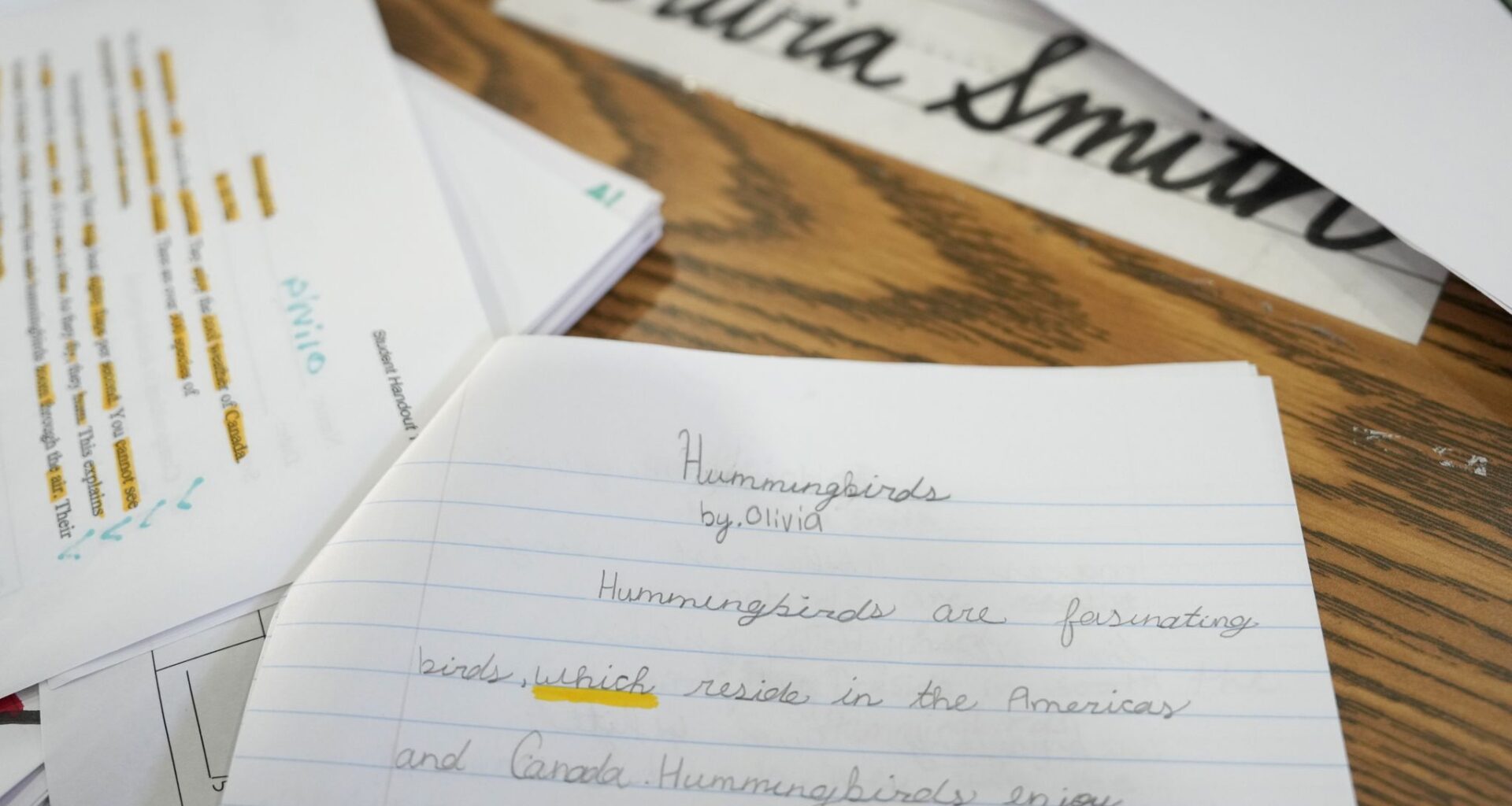
A paper written in cursive by 4th grader Olivia Smith, 10, is shown at the Magnolia School in Houston Wednesday, May 13, 2026.
Melissa Phillip/Houston Chronicle
Students attend class at Dietrich Bonhoeffer Academy in Houston, Friday, May 8, 2026.
Raquel Natalicchio/Houston Chronicle
A classroom at Dietrich Bonhoeffer Academy is photographed in Houston, Friday, May 8, 2026.
Raquel Natalicchio/Houston Chronicle
Students attend class at Dietrich Bonhoeffer Academy in Houston, Friday, May 8, 2026.
Raquel Natalicchio/Houston Chronicle
Students attend class at Dietrich Bonhoeffer Academy in Houston, Friday, May 8, 2026.
Raquel Natalicchio/Houston Chronicle
Rachel Davis, 4th grade teacher, left, Lucy Goldsby 9, Olivia Smith, 10, and Sarah Beth Smoter, 4th grade teacher, right, look at the state projects at the Magnolia School in Houston Wednesday, May 13, 2026.
Melissa Phillip/Houston Chronicle
Lily Machado, 9, left, and Emily Pesce, 8, right, work in a classroom at the Magnolia School in Houston Wednesday, May 13, 2026.
Melissa Phillip/Houston Chronicle
Students’ artwork lining a hallway at the Magnolia School is shown in Houston Wednesday, May 13, 2026.
Melissa Phillip/Houston Chronicle
A student’s project on the state of Kansas is shown at the Magnolia School in Houston Wednesday, May 13, 2026.
Melissa Phillip/Houston Chronicle
Fourth graders Lucy Goldsby 9, left, and Olivia Smith, 10, setup their state projects at the Magnolia School in Houston Wednesday, May 13, 2026.
Melissa Phillip/Houston Chronicle
A name written in cursive of 4th grader Olivia Smith, 10, is shown at the Magnolia School in Houston Wednesday, May 13, 2026.
Melissa Phillip/Houston Chronicle
After years of classrooms adopting more tech, a small but growing number of Houston-area private and charter schools are dialing back screens.
The pandemic saw many students move to online instruction, and afterward schools began to quickly adopt technology, allowing students to use Chromebooks for worksheets, homework and tests. In the 2021 school year, 96% of public schools reported providing digital devices to students who needed them.
Now, some schools are encouraging paper-and-pen learning and limiting devices to help students learn better and develop social skills amid national and statewide concerns about screen time.
Article continues below this ad
“The way that we’ve looked at technology is tied right into that we want these girls to have the greatest degree of freedom possible,” said Margaret Cronin, director of admissions and communications at the Magnolia School. “We feel like that in these early years, educating them without that distraction, in a lot of ways really will lead to that greater degree of freedom.”
Some public school districts have also scaled back screen time for students. At Los Angeles Unified School District, board members voted in April to limit screen time and transition away from one-to-one device policies. In Richardson ISD near Dallas, district leaders are introducing new rules that put a cap on how long students can use devices in class.
Focus on deep learning
At the Magnolia School, a private, all-girls Catholic school in Spring Branch, students cannot use any digital device in classrooms. At most, teachers use a computer to project a map of the United States or a picture of a country’s flag on a white board.
The absence of digital devices is often the school’s “biggest attractor” for families, Cronin said.
Article continues below this ad
Fourth grader Colette Kimball, 10, reads at the Magnolia School in Houston Wednesday, May 13, 2026.
Melissa Phillip/Houston Chronicle
Instead of laptops and tablets, Magnolia students do all their learning with paper and books. Kindergartners may use colored blocks to recreate printed images of flowers. Third-grade students write book reports on paper and have a reading nook in the classroom. Fourth-graders write personal essays in cursive.
“You can just see there’s a huge difference with my oldest, who has gone through classical (education) all the way, opening books and marking them up,” said Rachel Davis, a fourth-grade teacher whose youngest child uses a Chromebook at his public school. “I just think that you just retain so much more and experience it so much more.”
She said it’s difficult to compare her daughter and son due to their own learning differences, but she’s seen her daughter fall in love with learning through a low-tech environment.
AI IN CLASSROOMS: Here are the HISD schools that will become AI-focused ‘Future 2’ schools
Article continues below this ad
Many educators and parents pushing for less screen time say the shift is backed by a growing body of research on how students learn.
Meredith Austin, associate director at Rice University’s Center for Education, said studies have shown that heavy screen use in classrooms is linked to weaker academic outcomes.
A 2023 study analyzing National Assessment of Educational Progress data found that the more time students spent on digital devices in English class, the lower their reading comprehension scores.
Still, Austin said other factors have contributed to student learning declines over the past few years as well, including social media, reading instruction, COVID shutdowns and teacher shortages. It’s unclear to what extent screens have affected recent learning outcomes, especially because some research shows technology paired with good teaching instruction can benefit students.
CHATGPT: Houston ISD will use OpenAI’s new ChatGPT tool for special education compliance, official says
Article continues below this ad
Critical thinking
Annamarie Omanga, head of the Magnolia School, said the school’s no-technology policy pushes students to reflect and think more before writing out answers. She said it also helps students to come up with their own ideas instead of copying what they might see online for an essay or project.
“There’s less rapid fire of ‘what am I needing to put down here,'” Omanga said. “Even for myself with a phone, I can fire off stuff sometimes, like I didn’t think about it.”
Omanga said since the pandemic, the school has seen a large uptick in enrollment and interest from parents. Magnolia School’s student body has nearly tripled in size since it was founded in 2019, with currently 186 students in kindergarten through eighth grade.
Olivia Smith, 10, and her 4th grade teacher, Sarah Beth Smoter, are shown at the Magnolia School in Houston Wednesday, May 13, 2026.
Melissa Phillip/Houston Chronicle
Austin said when students read on screens, studies have shown they’re less likely to engage in deep reading — which is when one reflects and thinks critically about what they’re reading as opposed to passively consuming information.
Article continues below this ad
A review of 54 studies in 2018 found that people were more likely to comprehend informational texts better when reading on paper as opposed to a screen.
Austin said the same applies to writing. Since writing with a pencil can take longer than it takes to type, that slower speed can prompt students to reflect more on what they’re putting on paper.
“Simply having a device does not improve learning outcomes,” Austin said.
PHONE BANS: HISD’s strict new cell phone ban rules include alternative school, confiscation for repeat violators
But Austin and other researchers have cautioned that technology itself isn’t inherently harmful — and that how schools use it matters.
In fact, when technology is implemented correctly and teachers are trained on instructional software, it can lead to learning gains, Austin said.
Educational technology can also produce personalized guidance in subjects where students struggle and provide additional supports to students with disabilities and emerging bilingual learners, she said.
Social development
Students attend class at Dietrich Bonhoeffer Academy in Houston, Friday, May 8, 2026.
Raquel Natalicchio/Houston Chronicle
For some Houston schools, though, the issue goes beyond academics. It’s about fostering social skills and relationships.
That’s a key part of the approach at Dietrich Bonhoeffer Academy, a private Christian middle school in Bellaire.
“The kids are getting new brains, new bodies,” said Eric Lerch, head of school. “And we really wanted to create a learning program that met them where they were at.”
The low-tech school, which opened in 2022, has grown from five to 18 students over the past few years.
Lerch said students will occasionally use computers for research projects, but often print out information and keep it in binders to review. They are also required to outline their essays on paper before typing out drafts.
Jaime Sonnier, dean of student life, said by removing digital devices, she hopes that students are able to establish a healthier relationship with technology and not depend on it too much.
“We’re hopefully training them on the boundaries and why those are important,” Sonnier said. “Then they’re applying those to their high school … and the proper ways to use them as their brain develops.”
OTHER NEWS: How to prep your tech before the 2026 hurricane season
Lerch said the low-technology environment has helped push students to socialize, collaborate more and “really discuss things face to face without a screen in the way.”
Similarly at Magnolia School, Omanga said their limited technology has helped students to build better relationships with their teachers.
“They call it a rat race to keep up with all of the technology,” Omanga said. “It’s a lot more fruitful to educate a child when you know them as a person versus a set of data.”