
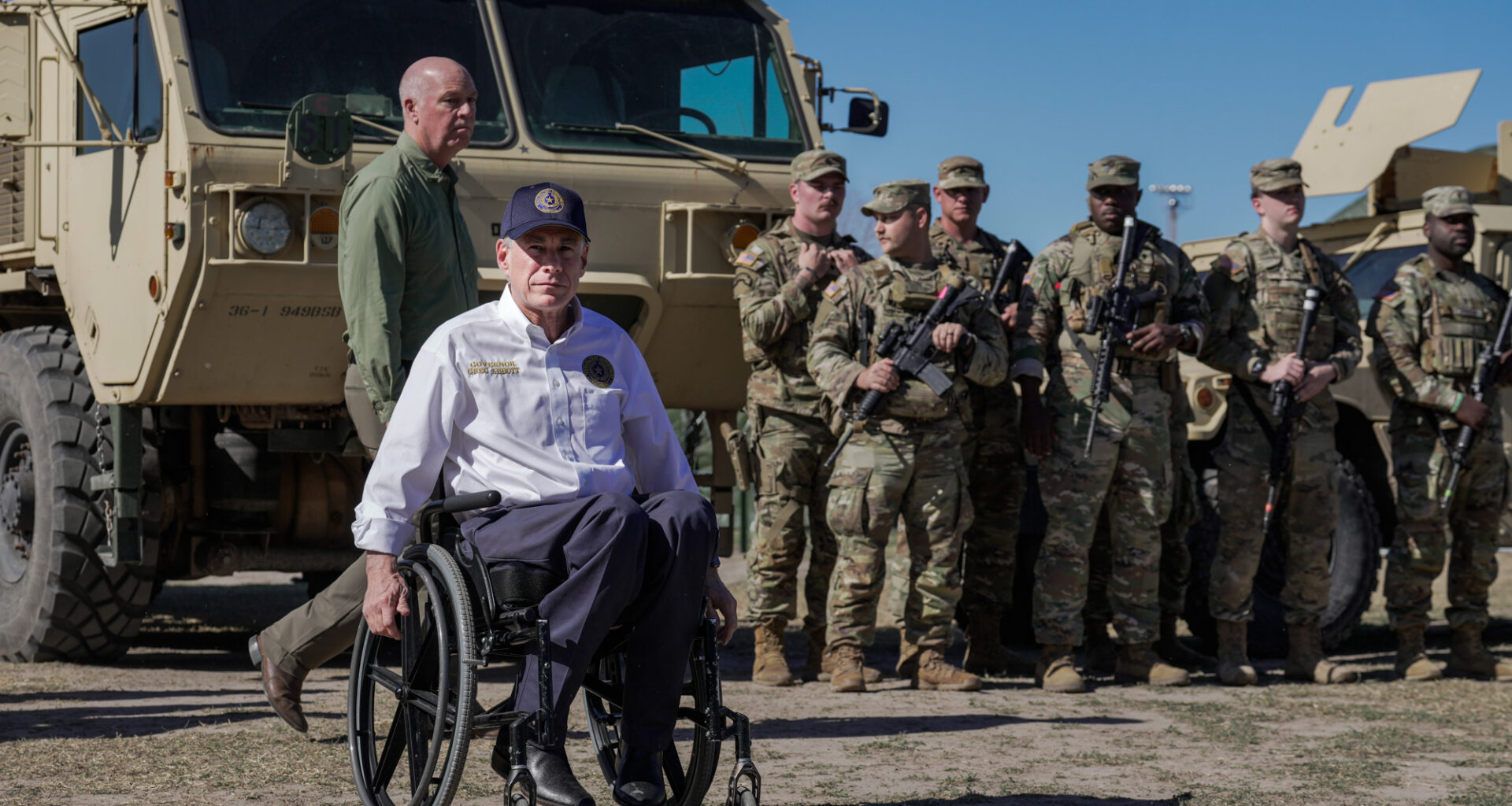
National Guard stands behind Texas Gov. Greg Abbott and fellow Governors as they hold a press conference along the Rio Grande at the U.S.-Mexico border to discuss Operation Lone Star and border concerns on Sunday, February 4, 2024 in Eagle Pass, TX.
Raquel Natalicchio/Staff photographer
Texas Republicans celebrated when they successfully tucked billions in federal funding into President Donald Trump’s One Big Beautiful Bill to reimburse the state for Gov. Greg Abbott’s $11 billion border security crackdown. But nearly a year later none of the money has been dispersed, and it’s unclear when Texas will see any of it.
The Department of Homeland Security and Department of Justice, the agencies overseeing the combined $13.5 billion, have yet to open applications for the reimbursements. DHS said in a statement that the agency is “working expeditiously to assess the best path forward” and is finalizing the application process for the $10 billion it will dole out, but offered no more information on when that might begin. DOJ did not respond to questions about the $3.5 billion in grants it oversees. Experts say the delay is notable.
READ MORE: Texas stands to get $11B back for border expenses under Trump’s megabill
Article continues below this ad
“I strongly suspect that whoever was assigned this did their work in about a week and it’s been stuck in the clearance process since. This is just not hard to do,” said David A. Super, an administrative law expert at Georgetown University Law Center.
Because of the political nature of the funding, reimbursements like this often need high-level clearance. Both agencies have seen their share of turbulence over the last year. Trump fired the heads of both agencies earlier this year. And DHS, which oversees the bulk of the funding, was shut down for weeks as Democrats sought reforms to U.S. Immigration and Customs Enforcement tactics.
“Change, shutdowns, the fact that it’s got high political salience” are all likely playing a factor, Super said: “I’m sure it keeps getting bumped up the chain of command. It’s probably been to the White House and they’re waiting for people there to make political judgments on what they want to do with the money.”
The governor’s office said it was confident Texas would get the funding.
Article continues below this ad
“Texas has a true partner in the White House that takes border security seriously,” said Andrew Mahaleris, a spokesman for Abbott. “We will continue working with DHS and the DOJ to ensure Texas is fully reimbursed for holding the line against the Biden Administration’s open border policies.”
But the delay has nonetheless created an opening for Democrats who are hoping to capitalize on what many expect to be a difficult midterm for Republicans. State Rep. Gina Hinojosa has sought to make it an issue in her campaign against Abbott.
“The people of Texas are realizing yet again they’re being duped,” state Rep. John Bucy III, a Central Texas Democrat, said about the delay. “What it tells us is they’re all about flash, but not about delivering. Maybe they prematurely celebrated. They should’ve waited until we got the money.”
Texas Republicans led the push to include the reimbursement funds in the government funding bill that Trump signed into law last summer. Abbott made multiple trips to Capitol Hill and the White House and wrote letters arguing the state was forced to spend billions to do the federal government’s job.
Article continues below this ad
As part of the push, U.S. Sen. John Cornyn, who is locked in a GOP runoff with Attorney General Ken Paxton, went as far as to say that Texas members of Congress should refuse to support other federal legislation until the payment was made. After the bill passed, he led a group of lawmakers in urging DHS and DOJ to prioritize Texas when considering how to dole out the money. But the money is not explicitly earmarked for Texas.
“The State of Texas bore the heaviest burden, incurring $11.1 billion in costs over four years,” the Texas Republican congressional delegation wrote in a letter to the agency heads in November. “We respectfully request that the Departments prioritize Texas in disbursing these funds.”
The governor’s border security crackdown, Operation Lone Star, is technically ongoing, even though crossings have ground to a near halt under Trump. State lawmakers last year authorized another $3.4 billion for the program.
The bulk of the funding spent on Operation Lone Star has been for personnel. State troopers working the operation have raked in so much overtime that some were doubling their salaries. Texas also spent roughly $3 billion to build 100 miles of border wall and deploy a string of buoys in the Rio Grande and another $58 million on razor wire and fencing.
Article continues below this ad
The costs, Abbott wrote in letters pushing for the reimbursement, “fell squarely on the shoulders of Texas taxpayers but should have been the federal government’s responsibility.”