
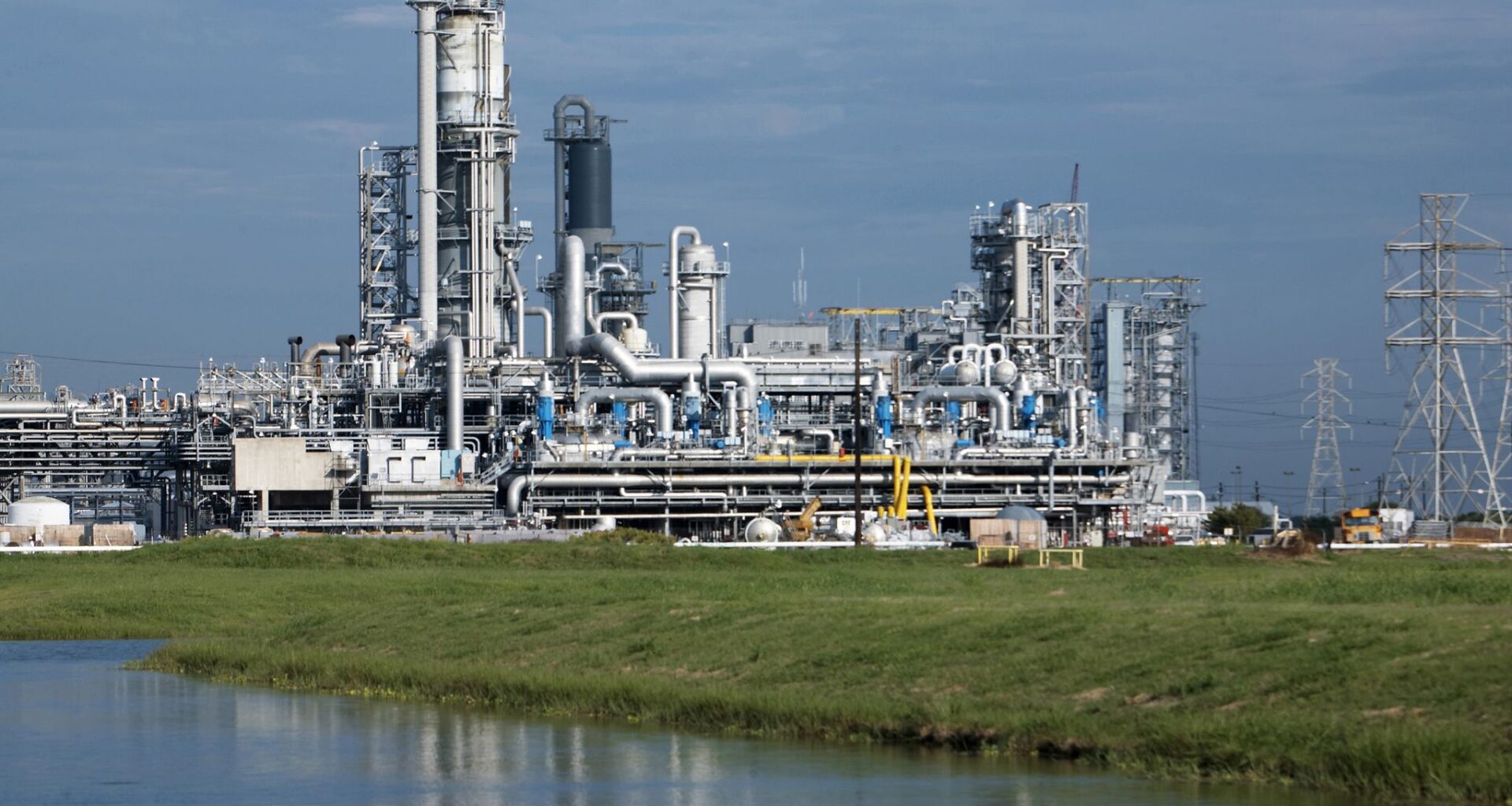
The BASF plant in Freeport began producing ammonia in 2018 under a joint operating deal with Norweigian fertilizer giant Yara.
BASF SE / Detlef W. Schmalow/BASF SE
Fertilizer plants along the Texas Gulf Coast are at the center of a federal inquiry into allegations of market manipulation, as recent price spikes have left farmers struggling to afford the chemicals needed to grow their crops.
The U.S. Department of Justice has requested information from fertilizer companies, as prosecutors investigate whether a series of corporate mergers in recent decades has turned the industry into an illegal monopoly that is gouging farmers.
At the same time, the U.S. Senate is weighing a series of bills that would require companies across the fertilizer supply chain to release their sales data to regulators, to try and chart where profits are being made. Similar legislation is under consideration in the U.S. House, and President Donald Trump has even taken notice, writing on social media last month, “the United States will not accept PRICE GOUGING from the fertilizer monopoly.”
Article continues below this ad
READ MORE: Trump admin’s cuts to housing programs in Texas, other states meet pushback in Congress
“I think there’s structural things that need to be addressed,” Senate Majority Leader John Thune said at a recent hearing on fertilizer prices in the Senate. “There’s a small number of manufacturers who have the lion’s share of fertilizer production.”
The industry has rejected the allegations, saying market forces are at play.
After the Russian invasion of Ukraine in 2021 disrupted major supply chains, the price of fertilizer spiked to over $1,600 a ton and never came back down to where it had been before the start of the conflict. When the U.S. launched an attack on Iran in late February, clogging supply lines through the Strait of Hormuz, fertilizer prices shot up again, more than 25% in some cases.
Article continues below this ad
That is expected to generate large profits for the Gulf Coast’s fertilizer industry, which has grown rapidly over the past decade as companies tap into the state’s abundant supplies of cheap natural gas to produce nitrogen-rich ammonia and other chemicals used to grow crops. Companies like Nutrien and Yara, which operate plants in Texas, have seen their stock prices climb sharply.
However, the costs have been devastating to Texas farmers, who are having to spend more and more to plant crops they might not be able to sell at a high enough price to cover their costs. Fertilizer typically represents around a third of a farm’s expenses, said Russell Boening, the president of the Texas Farm Bureau who owns a farm outside San Antonio.
“We already had some serious price increases over the years, and now what’s happened in the last two or three months has definitely added fuel to the fire,” he said. “Folks have talked about just quite frankly, using less fertilizer, but you’ve got to be careful there because what is that going to do to your production. It’s a risk.”
In March, Union Line Farms, an Iowa-based corporation, filed a federal lawsuit in Colorado claiming the country’s five largest fertilizer companies, CF Industries, Koch Agronomic Services, Mosaic, Nutrien engaged in a “conspiracy” to reduce their production in order to keep prices high.
“In a competitive market, record-high prices would have triggered a rapid and sustained supply response. That did not occur here,” the lawsuit read. “This ‘managed scarcity’ was not an accident. Instead, upon information and belief, Defendants in each market agreed to reduce supply.”
Article continues below this ad
Consolidation in the U.S. fertilizer sector stretches back decades, amid increasing competition from suppliers overseas that pushed domestic companies to merge supply chains in the interest of reducing their costs.
Veronica Nigh, an economist at The Fertilizer Institute in Washington, a trade group, dismissed claims that there is not enough competition within the industry and explained the long-term price increase as the result of external factors, including conflicts in Eastern Europe and the Middle East, China’s decision to reduce fertilizer exports and President Donald Trump’s tariff regime.
“A lot of it can be attributed to the fact, when we look at the major players there’s been a lot of volatility in those places,” she said. “Fertilizer markets are like oil markets; they’re global commodities. It doesn’t make it any less painful, but everyone’s paying a lot.”
Mark Welch, an agricultural economist at Texas A&M University, said while price hikes since 2020 did correlate with consolidation within the industry, it’s unclear if that’s the cause.
“Were prices going to creep higher no matter what, and this is companies trying to respond to the competitive environment?” he said. “(The Senators) are trying to tease out if it’s causation or just correlation. I could not say.”
Article continues below this ad
Fertilizer companies are pushing back against the Senate legislation forcing them to disclose their financial transactions, arguing they’re too focused on domestic production and not enough on imports, which represent a large swath of the fertilizer consumed in the United States.
But farmers, who represent a powerful lobbying block in Washington, are eager for answers.
Boening, of the Texas Farm Bureau, declined to posit an opinion on whether market manipulation was happening but said he wanted to see the companies’ data.
“If it’s found that that’s not the case, okay, that’s great. But members do feel like it does need to be looked at for sure,” he said.
Article continues below this ad