
DALLAS TWP. – Struggling with a multi-million dollar aggregate deficit and the reality that tax hikes might be needed each of the next four years to close it, members of the Dallas School Board tabled their proposed budget earlier this month. The school board will meet again Tuesday to try and find a path forward amidst increasing anxiety from some residents about their taxes and the district’s future.
Business Manager Lyndsey Dalton delivered a presentation on the $53.38 million proposed budget at the school board meeting May 11. She discussed the need to raise additional revenue to restore the district’s fund balance, which has fallen millions of dollars below zero.
“Creating and balancing a budget is not always easy,” Dalton said. “If we want to move forward though, action will need to be taken.”
The tabled proposed budget included a 4.1% property tax increase — the maximum increase allowable for Dallas under the state Act 1 Index. That increase will bring the district’s tax rate to $15.6028 per $1,000 of assessed value.
If the school board were to impose this tax hike, the owners of the median district home, which was assessed at $168,800 for the 2025-26 school year, would see their annual taxes increase $103.73 to $2,633.75. (Homeowners can seek to have this rising bill reduced by the homestead exclusion – a property-tax break largely funded through state gambling-tax revenue. Last year, homestead exclusions reduced Dallas homeowners’ tax bills by $110 each.)
Whatever tax rate the school board ultimately decides on Tuesday will come a year after the school board imposed a tax hike of 4.8% in a closely contested 5-4 vote; and two years after it imposed a tax hike of 4.9%. A 4.1% increase this year would result in a three-year, cumulative increase of 14.44%, raising the annual taxes the 2025-26 median homeowner with a constant assessed property value would pay over those three years by $332.37.
Assuming the district’s ratable tax base remains at its 2025-26 value of $1.68 billion and the collection rate remains at 96.5%, the proposed 4.1% tax hike would generate an additional $994,478.84.
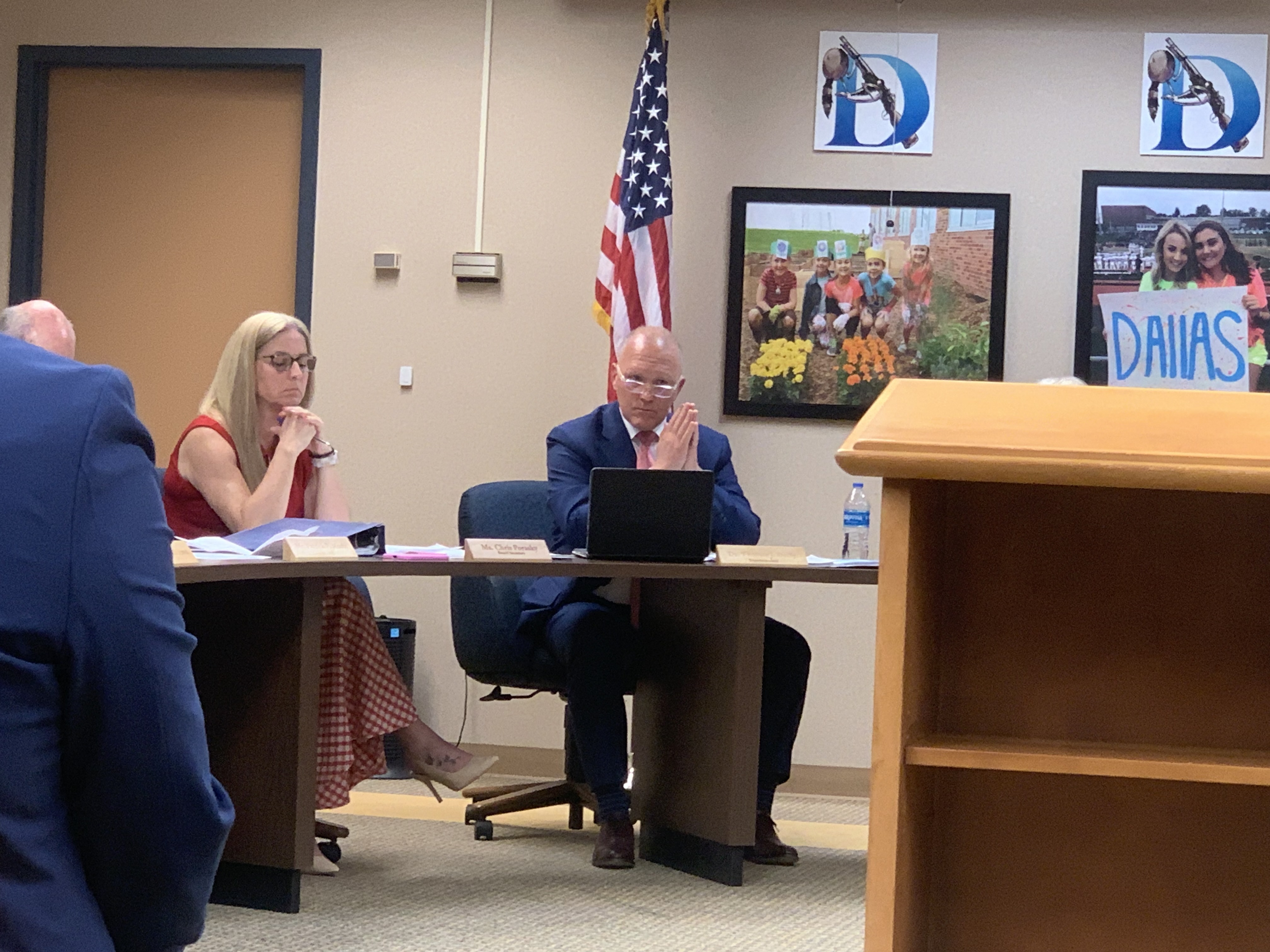
Dallas Superintendent Thomas Duffy at the school board meeting May 11 (CHRISTOPHER DOYLE/STAFF PHOTO)
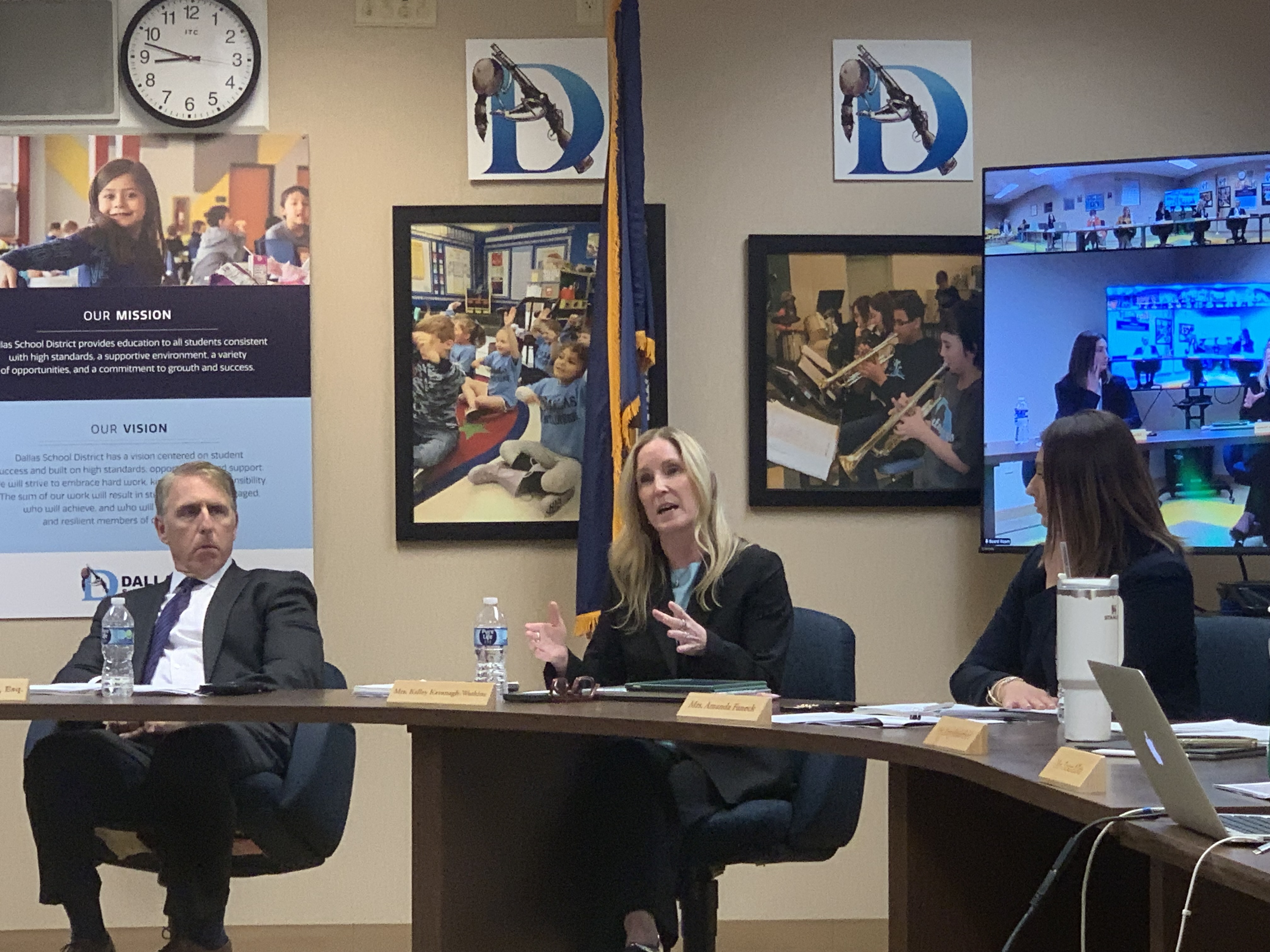
Dallas School Board member Kelley Kavanagh-Watkins at the May 11 school board meeting (CHRISTOPHER DOYLE/STAFF PHOTO)
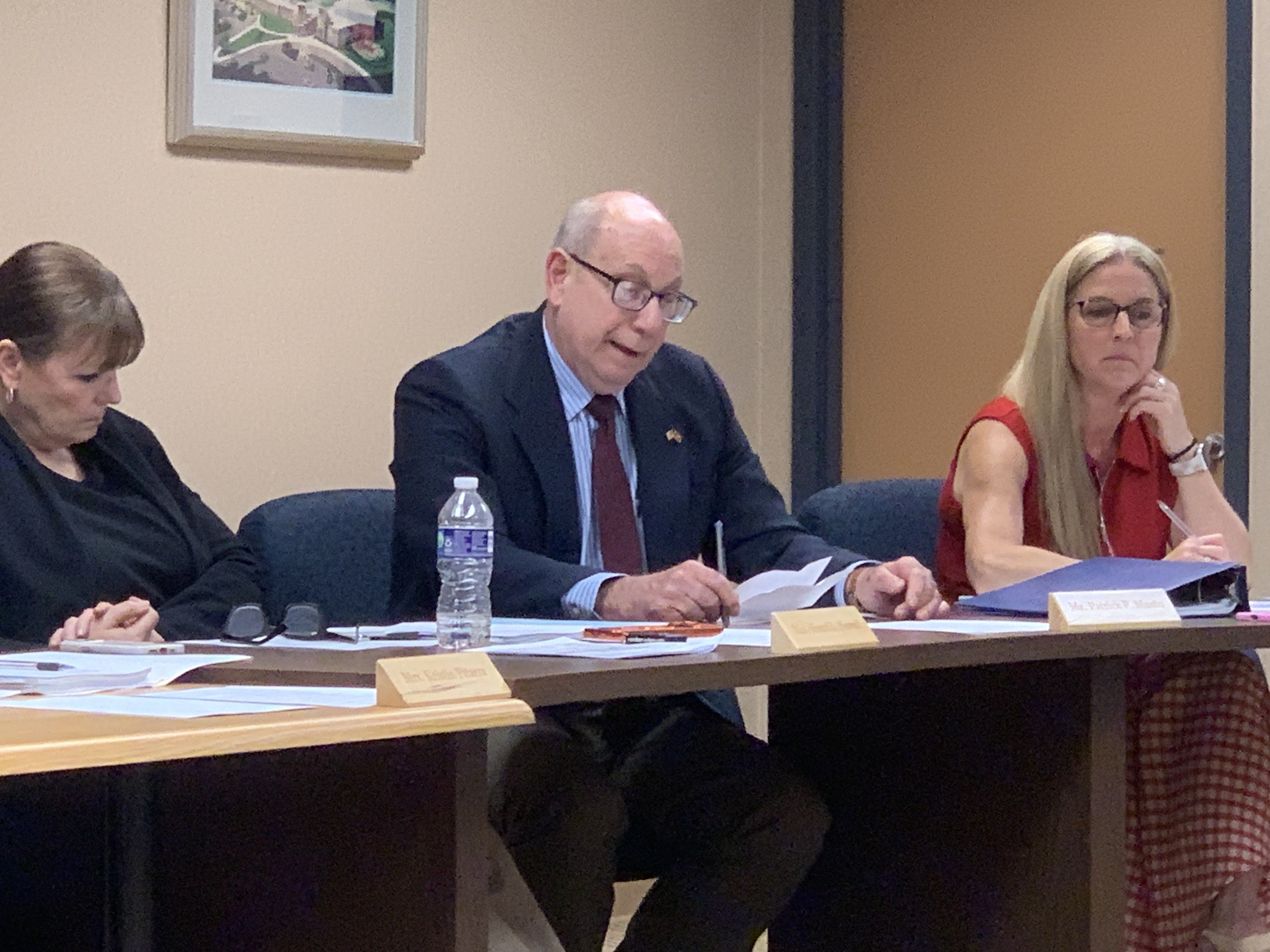
Dallas School Board member Patrick Musto at the school board meeting May 11 (CHRISTOPHER Doyle/STAFF PHOTO)
Show Caption
1 of 3
Dallas Superintendent Thomas Duffy at the school board meeting May 11 (CHRISTOPHER DOYLE/STAFF PHOTO)
This revenue may be needed to close a yawning deficit in the district. According to its 2023-24 audit, the latest one on record, the district had a negative fund-balance of $5.49 million. In its 2025-26 budget, district officials estimated that this balance would narrow to negative $4.51 million entering the school year and, through a budgeted annual surplus, narrow another $2.07 million by the end of the school year – still leaving the fund balance $2.45 million in the red.
Board President Larry Schuler urged his colleagues to vote in favor of the proposed budget, warning of dire consequences if the board failed to collect sufficient revenue. The school board ultimately voted 7-2 to table the proposed budget May 11, with Schuler and school board member Christine Swailes casting the two votes in opposition.
“We’re in this because of underfunding,” Schuler said. “If we don’t do something with the budget, we’re creating financial suicide for ourselves.”
Closing the deficit may require further tax increases in the years to come. During her May 11 presentation, Dalton laid out a plan for the district to put its fund balance in the black for the 2029-2030 school year. In that plan, the school board enacts significant tax hikes each year for the next four years.
“But, building in that specific projection of how we get to 2030 with a surplus, there are continued assumptions of tax increases as well as chipping away at some of those expenses,” Dalton said.
The district is pursuing administrative cost-saving measures, such as leaving certain vacancies in staff and faculty positions unfilled when it is determined doing so would not adversely affect students.
In addition, the district is trying to win savings through its ongoing contract negotiations with its teachers’ union, the Dallas Education Association. District officials have particularly expressed interest in exacting concessions to alter teachers’ healthcare benefits during those negotiations.
‘Warning Signs’
Dalton, who was hired as the school district’s business manager within the last year, said the district developed a deficit as the result of the habitual underestimation of expenses – particularly those pertaining to healthcare.
In just the last five years, healthcare expenses have increased 73.87%, rising from $4.05 million in the 2020-21 school year to a projected $7.05 million in 2025-26 – and that is a projection Dalton said the district was “very close to exceeding.”
Dalton said the district should have begun to anticipate higher healthcare costs, rather than stand by assumptions she said had proved unrealistic. In fact, Dalton said the district’s healthcare broker had supplied annual projections of healthcare costs and that the district and school board nevertheless “budgeted less than that for multiple years.”
“So, that was obviously a risk that was taken,” Dalton said. “Again, we’re self-funded (in healthcare), so this could have paid off. Unfortunately, it did not.”
Dalton said special education placements without commensurate increases in state funding and cyber charter school tuition have created additional financial pressures on the district.
Hannah Butterwick, a Shavertown resident and an accountant, said during the May 11 meeting’s public-comment session that she had met with Dalton and reviewed the last several years of the district’s audits. With the fund balance eroding by millions of dollars annually for several years, Butterwick said the current predicament in which the district now finds itself was easily foreseeable.
“The warning signs were present, years ago,” Butterwick said. “These were not subtle indicators. The trajectory was visible for your decision making.”
This possibility of serial tax hikes comes after the school board made the decision not to impose any tax increases for a five-year period between the 2019-20 and 2023-24 school years. Dalton said this tax freeze meant revenue did not keep pace with rapidly rising expenses.
“I think having five years without (tax increases) plus having five years with rising costs, it didn’t help the situation that we’re in,” Dalton said.
Board member Kelley Kavanagh-Watkins defended the tax freeze (the beginning of which predated her election to the school board). She said avoiding tax increases altogether afforded vital support to district families amidst the COVID-19 pandemic and its aftermath.
“It was after COVID, people were looking at job losses, financial uncertainty, rising costs,” Kavanagh-Watkins said. “So, raising taxes simultaneously, I believe, would have felt unfair.”
Board member Patrick Musto offered a similar perspective. He said the school board was now dedicated to investigating possible savings on healthcare and other contractual costs, while restoring its fund balance without, he said, resorting to tax increases to the Act 1 index.
“The district responsibility during COVID was to continue operating under these extraordinary circumstances while protecting students, employees, and taxpayers,” Musto said. “Our responsibility now is to stabilize the district financially while continuing to serve students and taxpayers responsibly.”
Superintendent Thomas Duffy said after the school board meeting that his administration would work to implement whatever budget the school board adopts, while continuing to exploring any possible cost savings.
“We’re going to make every effort to make every effort to decrease the need to continuously increase revenue,” Duffy said. “But, a realistic approach I think is what Mrs. Dalton gave.”
Under state law, the school board must adopt a proposed budget at least 30 days before its adoption of a final one. The final budget is due June 30.