
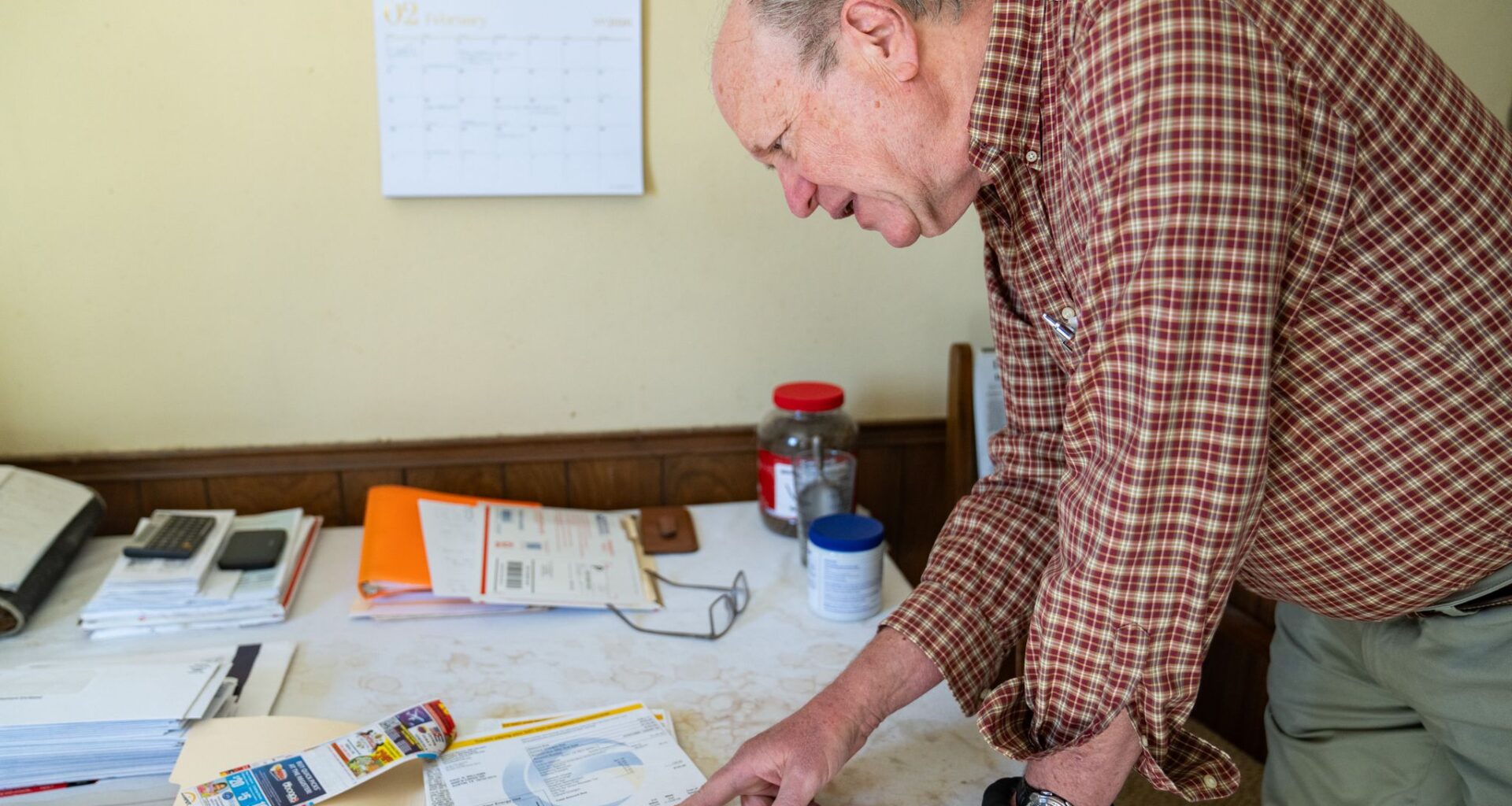
Paul Williams discusses his high gas bill at his home in North Austin. The Texas Gas Service franchise renewal agreement coming to the Austin City Council provides a once-in-a-generation opportunity to get longstanding problems corrected, consumer advocate Paul Robbins writes.
Mikala Compton/Austin American-Statesman
As inflation linked to energy costs soars, the city of Austin confronts several choices to manage them. One is the renewal of the Texas Gas Service franchise — its license to operate in Austin.

Over the course of the next three months, the City Council will consider the franchise renewal agreement. The last time this occurred was 20 years ago. This is literally a once-in-a-generation opportunity to get longstanding problems corrected.
Article continues below this ad
The council should use its leverage to reduce costs, expand assistance for lower-income customers, and cut greenhouse gas emissions from a fossil-fuel utility with no short-term prospects to use renewable energy.
Customers with Texas Gas Service, which provides heat to 94% of the gas utility customers in Austin, have been feeling the strain of ever-increasing rates. Between 2019 and 2026, Texas Gas’ residential rates increased by 124%, for an average annual increase of $360 per customer. Its rates for commercial customers increased by 167% in the same time period, for an average annual increase of $2,037 per customer. In this same time frame, inflation increased only 32%.
As harsh as these numbers are for households and small businesses, the total impact is even worse. By my calculations, between 2019 and 2025, the overall increase in bills, including higher rates and fuel costs, has taken $131 million out of Austin’s economy. This is money unavailable for food, housing, higher education, and a better quality of life.
The council should push for relief by insisting Texas Gas require developers to pay the full cost of connecting new buildings to their utility. As it is now, existing customers pay higher rates in part to subsidize these new customers’ connection costs. Texas Gas should operate like Austin’s city-owned electric and water utilities, where new customers are charged the full cost of connecting to the system.
Article continues below this ad
The city should also insist on a more robust assistance program for lower-income residents struggling to pay for essential utilities. While Austin spent $43.7 million last year providing electric and water utilities assistance, Texas Gas spends only an estimated $70,000 in the Austin area. Texas Gas has committed to launching a monthly bill assistance program for income-qualified individuals, but its emergency assistance program, intended to help customers avoid service cutoffs, provides too little.
Finally, the council should require Texas Gas to implement greater leak prevention programs, which would not only enhance profitability but also increase safety and reduce emissions. Natural gas is largely methane; when it is unburned, it is 28 times more potent than carbon dioxide as a greenhouse gas. A 2020 survey of gas utility leaks benchmarked Austin with a gas leakage rate double that of the lowest city in the report.
These issues must be addressed in the new franchise agreement if we are going to have rate relief, humane treatment of struggling ratepayers and effective emission reductions.
Austin also needs to think about the long game: city acquisition of Texas Gas. Our city began its electric and water utilities in 1895 to challenge a private utility accused of strangling its future. If a sale price could be agreed on, an Austin-owned gas utility could put its profits toward parks, police and potholes, not dividends to shareholders of a corporation headquartered in another state.
Article continues below this ad
The new municipal company would not be subject to federal taxes and certain state taxes, would have lower interest rates for investments, and a lower cost for its professional administrators.
The benefits of municipal ownership are not theoretical. Texas Gas Service’s rates in Austin are double those of the city-owned gas utility in San Antonio. Since 2019, San Antonio rates increased only 9%, nothing close to Austin’s 124%.
Austin needs to move in this direction to have more control over its own destiny.
Article continues below this ad
Paul Robbins is an environmental activist and consumer advocate. He has been editor of the Austin Environmental Directory, a sourcebook of green issues, products, services, and organizations, since 1995.