
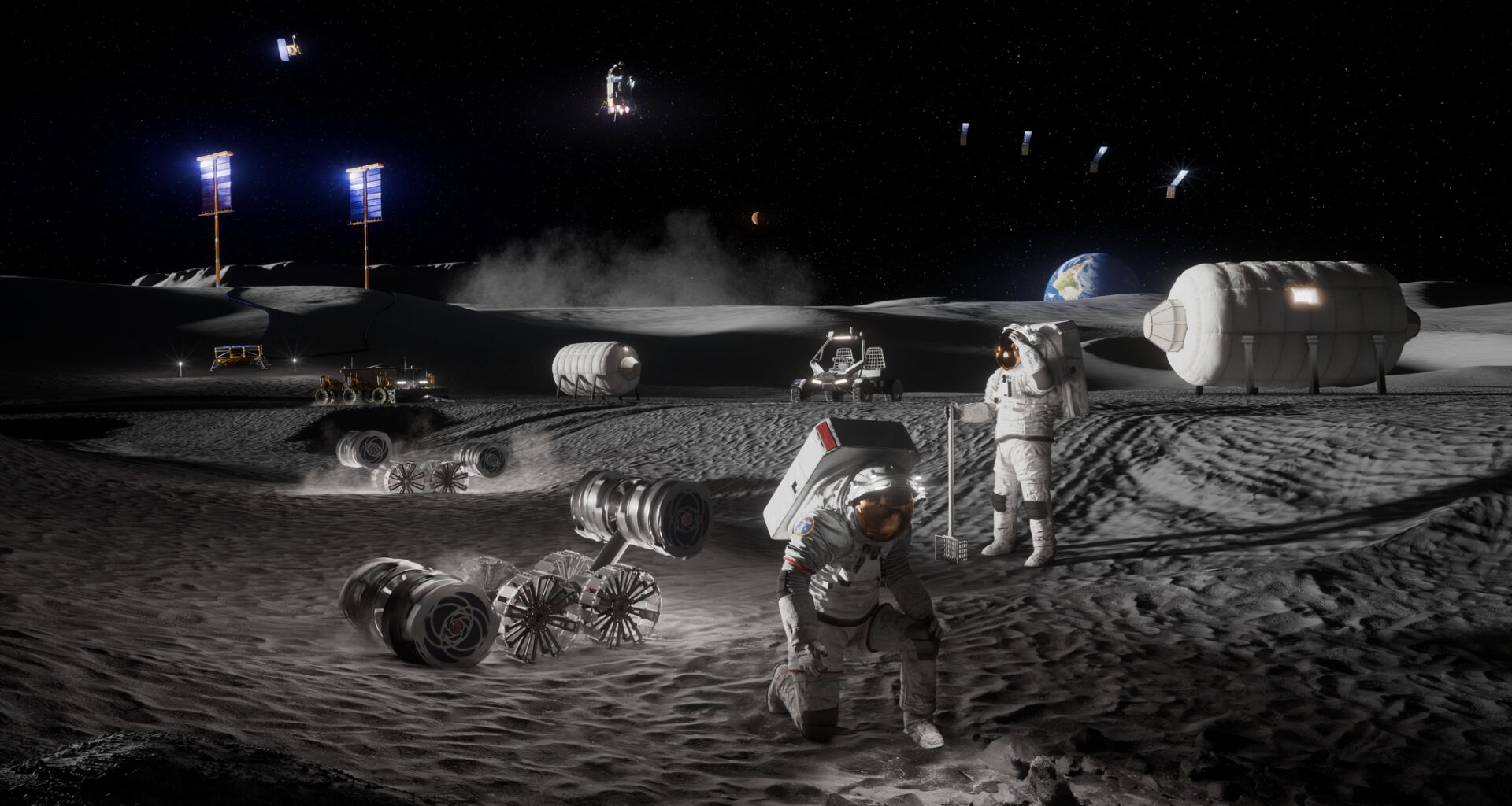
Artist’s rendering depicting astronauts, habitats, rovers, power systems and cargo operations supporting sustained human activities at the moon base near the lunar South Pole.
NASA
NASA unveiled new contracts on Tuesday as part of its push to build a moon base, awarding work to one Texas company while passing over another firm based in Houston.
Central Texas-based Firefly Aerospace will deliver NASA’s aerial scouts – propulsive drones built off the technology developed for the Ingenuity Mars helicopter – to the moon.
But Houston’s Intuitive Machines will not continue its work on an unpressurized vehicle for astronauts to drive. NASA selected California-based Astrolab and Colorado-based Lunar Outpost to build these Lunar Terrain Vehicles.
Article continues below this ad
MORE: Houston company among those competing to develop a rover for NASA’s crewed moon missions
The announcements came as NASA continues the momentum started by its Artemis II astronauts who flew around the moon last month and seeks to meet President Donald Trump’s mandate to build the first elements of a permanent moon base by 2030.
“In the time since Artemis II, we’ve been extremely active,” NASA Administrator Jared Isaacman said during Tuesday’s event. “We’ve been reviewing feedback from the Ignition events, speaking to industry, addressing supply chain challenges, having the tough conversations with those failing to meet expectations and offering NASA’s assistance to solve problems.”
Firefly Aerospace, headquartered outside of Austin in Cedar Park, received a $75 million subcontract to deliver the MoonFall drones that are being developed by NASA’s Jet Propulsion Laboratory in California.
Article continues below this ad
The company’s Blue Ghost lander made a soft lunar touchdown in 2025. For this MoonFall mission, Firefly Aerospace will use a version of its Elytra Dark spacecraft – which is designed for orbit, not landing on the moon – to carry the drones to the moon’s orbit. It will slow down and release them about 30 miles above the South Pole, where the drones will then land themselves.
These drones are expected to take propulsive hops around the moon’s South Pole in 2028 to scout the area, capture images of hard-to-reach places and evaluate radiation levels, among other things.
“This subcontract underscores our commitment to executing challenging missions that push the boundaries of lunar exploration,” Firefly Aerospace CEO Jason Kim said in a statement.
Astrolab and Lunar Outpost received contracts worth $219 million and $220 million, respectively, to build the unpressurized Lunar Terrain Vehicles that NASA astronauts will drive on the moon. Blue Origin’s Blue Moon Mark 1 lander will get them to the surface.
These vehicles are a mix between the Apollo-era moon buggies and the Mars rovers. They can be operated autonomously, driven by NASA astronauts (wearing spacesuits) or controlled remotely. They can reach speeds up to 6 mph and climb slopes of roughly 20 degrees.
Article continues below this ad
Houston’s Axiom Space, which is building a commercial space station, is part of the Astrolab-led team. It’s assisting with spacesuit integration, crew display and controls, and tool design.
NASA initially chose three companies, including Intuitive Machines, to design Lunar Terrain Vehicles as part of a feasibility study. NASA was not expected to fund all three to move forward with their designs.
The agency is planning to have a Lunar Terrain Vehicle on the moon before its astronauts arrive with Artemis IV, which is targeting 2028. There could be opportunities for additional vehicles in the future.
COMMUNICATIONS: Houston’s Intuitive Machines aims to be ‘national asset’ in space after Lanteris, KinetX deals
Houston’s Intuitive Machines could also remain connected with these vehicles through their communication systems, said Intuitive Machines CEO Steve Altemus. He congratulated Astrolab and Lunar Outpost and called their contracts the “opening phase of a broader moon base buildout.”
Article continues below this ad
Intuitive Machines is building five satellites that will orbit the moon and enable communication and data retrieval from landers, crewed habitats and other lunar infrastructure.
“Vehicles will need to communicate, navigate, transmit data and operate safely with crewed and uncrewed systems,” Altemus said in a statement. “Intuitive Machines is uniquely qualified to address this operational requirement.”
Intuitive Machines has also put two landers on the moon. It tipped over on both of those missions but has a third lander scheduled to launch later this year.