
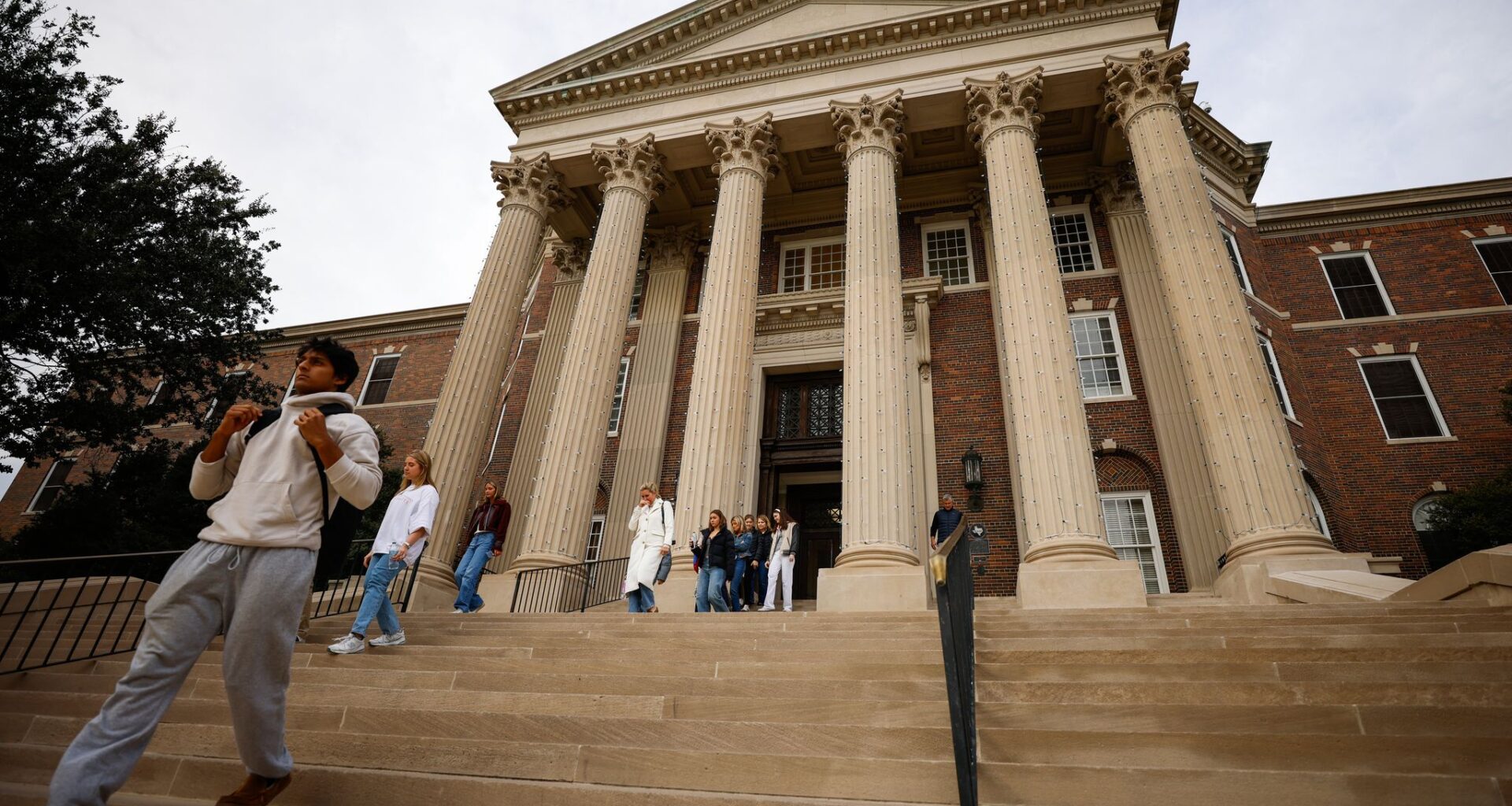
Bailey Kamau, a junior at Southern Methodist University, hunkered down to get a head start on final exams, burying herself in her books. Then, on this quiet Wednesday, at 11:31 a.m., her computer pinged.

The subject line of an email — and its sender — caught her eye.
As she glanced through President Jay Hartzell’s email, titled “Institutional Neutrality, Free Expression and Campus Guidelines,” the initial intrigue wore off, festering into concern.
Article continues below this ad
Kamau, a human rights major, worried about her department’s office, where pride and Black Lives Matter flags hang. She wondered about the fate of student protests, like the pro-Palestianian ones she attended two years ago. What would happen to the free expression that had come to define her college experience?
“Maybe,” she thought, “I’m not going to get a whole lot of studying done.”
Make Dallas News a preferred source so your search results prioritize writing by actual people, not AI.
Add Preferred Source
In the message dated April 29, Hartzell said the university would not issue statements on “external events, issues, or conflicts” that are not “directly tied” to campus, or its ability to teach and research. He also updated another policy: windows would remain clear of signs and flags, so university buildings “are not used to convey an individual’s position or endorsement.”
Article continues below this ad
This institution would, in effect, be a neutral one. At least it would strive to be.
In today’s fraught political climate, the number of universities choosing to be neutral on hot-button issues has skyrocketed. School leaders say adopting this stance ensures students and faculty can speak freely about controversial topics. But how universities enforce the policy has triggered debates over whether university leaders are protecting — or suppressing — free speech.
“Schools adopting these policies right now, like SMU, need to be careful about putting out guidance,” said Laura Beltz, director of policy reform for the Foundation for Individual Rights and Expression. “It [should] make an opportunity for students and faculty to speak, rather than shutting down student and faculty voices.”
Institutional neutrality followed Hartzell from the University of Texas at Austin — where he served as president, where scores of students were arrested for pro-Palestinian activism, where his crackdown on those protests drew scrutiny over First Amendment concerns. Nearly two years ago, the UT Board of Regents modified its free speech policy to adopt institutional neutrality, blocking its schools from stating positions on sociopolitical issues. Critics have since clashed with university leaders, arguing the policy was weaponized to suppress speech they disagreed with.
Article continues below this ad
Free speech experts and students say they are now watching to see whether the same fight will come to SMU — where it was Hartzell, not trustees, who approved the policy. SMU officials declined to make Hartzell available for an interview.
Protesters stand with linked arms inside a circle of Texas State Troopers and police at an encampment on the University of Texas Tower south lawn on April 29, 2024, in Austin. The protest was meant to call attention to the war in Gaza and to condemn UT’s relationship with defense companies .
Aaron E. Martinez/American-State
More universities want to be neutral
Institutional neutrality traces its origins to the 1967 Kalven Report from the University of Chicago. Considered the golden rule, the document states: “The university is the home and sponsor of critics; it is not itself the critic.”
Article continues below this ad
If a school takes positions on sociopolitical issues, a “chilling effect” can unfold, making faculty and students feel less welcome to voice their own opinions, said Dylan Selterman, research director at Heterodox Academy, a nonprofit advocating for more viewpoint diversity on college campuses.
“We want the faculty and the students to be able to speak up on issues that are within their expertise and are important to them,” he said. “The university should not do anything that gets in the way of that.”
There are appropriate times for universities to comment on issues, he noted. Schools can comment on issues that impact their functioning, such as federal cuts to research, he said.
They can express empathy for students impacted by major events, “without taking a side, without taking a political position, or a moral position,” he added. However, even those statements can backfire, he said, as expressing concern can be interpreted as taking a side in a conflict.
Article continues below this ad
In 2022, at the University of Notre Dame, then-President John Jenkins reaffirmed his advocacy for “the protection of unborn life” after the Supreme Court overturned Roe v. Wade. The same year, at Harvard University, then-President Lawrence Bacow condemned Russia’s invasion of Ukraine. And at SMU, administrators released statements after the murder of George Floyd in 2020, 2021, and 2022.
Those days may be gone, free speech advocates say.
“By remaining neutral, the University ensures that members of the SMU community feel free to explore concepts, ask hard questions, and speak openly,” Hartzell wrote in his recent email, “without the University’s voice overshadowing their own.”
Jay Hartzell takes the podium as Southern Methodist University’s 11th president during a formal inauguration ceremony on Sept. 12, 2025.
Shafkat Anowar/Staff Photographer
The Israel-Hamas war served as the flashpoint for colleges, spurring changes in free speech policies. A flurry of universities — and now, SMU — learned that the best way to address hot-button issues was to stay out of them, experts say.
Article continues below this ad
“Before that, there wasn’t a lot of pushback against colleges making political statements,” Beltz said. “When you had October 7, there was a big divide.”
Before the Oct. 7 attacks, only eight universities had an institutional neutrality policy, according to Heterodox Academy. Now, there are at least 165 universities, including SMU, Texas Woman’s University and Texas A&M.
The vast majority of universities have not formalized the policy. In 2024, Rutgers University Senate advocated against the policy saying it would give administrators “powerful tools to wield against the expression of disfavored views.”
Article continues below this ad
On the other hand, the same year, over 100 Duke University faculty members called for its adoption, according to The Duke Chronicle. It’s unclear to what extent administrators considered the policy, Selterman said.
Policy shakes up SMU campus
In a statement, SMU spokesperson Megan Jacob said the new neutrality policy “was not driven by any single incident or complaint.” The policy, she said, formalizes a recent practice and “is part of a broader effort to support open dialogue while ensuring the institution itself does not take positions on external issues.”
Article continues below this ad
Murmurs of institutional neutrality had been unfolding before it was officially announced.
Preston Patten, the former president of SMU’s Turning Point USA chapter, remembers Sept. 10 as “one of the worst days of my life.” That was the day conservative political activist Charlie Kirk was assassinated. Overtaken by anxiety and confusion, the senior watched his phone blow up “left and right” with messages.
But there was one message, from one person, he wanted to see.
“After the death of Charlie Kirk, we were waiting for President Hartzell and SMU to make a statement,” Patten said. “It never came.”
Article continues below this ad
Over several days, he corresponded with Hartzell, urging the school to issue a statement condemning political violence. SMU came out with statements after Floyd’s death, as well as one on the violence in Israel-Gaza in 2023, Patten wrote.
The exchange was first reported by The Daily Campus, SMU’s student newspaper.
“I am aware of the counterexamples you provided, but my understanding is that SMU’s practice has shifted in recent years,” Hartzell responded.
Though Patten agrees with institutional neutrality, he said there was no “moral clarity” from the institution when it came to Kirk’s death.
Article continues below this ad
“I don’t actually like when institutions step in and take a side, whether it be conservative, whether it be liberal,” Patten said. “The problem … [is] I don’t see murder as a particular political problem or a social problem. I see it as a moral stance.”
With update to flag policy, institutional neutrality is tested
As more universities adopt neutrality, a question has emerged: How, exactly, does a school enforce this policy?
Much of the debate circulating among SMU students is the updated flag policy.
Article continues below this ad
It’s a decision attributed to institutional neutrality and could serve as a litmus test for how the policy is enforced.
Signs, flags or other materials must be removed from “outward-facing University facilities and displays that could reasonably be interpreted as representing an institutional position,” Jacob said. When asked, SMU did not provide insight into how it determines which flags fall under that category.
“As questions arise, the University will continue evaluating them consistent with existing policies and its commitment to supporting open inquiry, respectful dialogue, and viewpoint expression across campus,” Jacob said.
A student can display those materials inside their dorms, but not on surfaces visible to the public, she added.
Article continues below this ad
Kamau frequents the human rights program’s office, where pride and Black Lives Matter flags hang.
Kamau understands the point of neutrality, but it went too far when the flags came down, she said. The flags are not endorsing a certain viewpoint; rather, they validate one’s identity, she said.
“This is my quiet space. This is my study space,” she said. “For myself, for other students who come from marginalized communities, how are they going to respond emotionally to these big changes?”
Article continues below this ad
Rick Halperin, director of the human rights program, also considers the flags to be affirmations of human dignity, not comments on sociopolitical issues. But the office voluntarily took down the flags after Hartzell’s email.
“If that’s the policy from one end of the campus to the other,” he said, “then I have no problem in complying.”
Could turmoil at UT Austin come to SMU?
During Hartzell’s tenure as president of UT, regents formally adopted institutional neutrality, following the pro-Palestinian protests when more than 100 people were arrested. While the policy has since faced criticism there, students and faculty hope the future could hold something different for SMU.
Article continues below this ad
In October 2025, the UT Office of the Dean of Students blocked the Graduate Student Assembly from considering two resolutions, citing institutional neutrality. The resolutions sought to oppose state legislation aimed at increasing state oversight of public colleges and eliminating diversity, equity and inclusion programs.
Institutional neutrality refers to school administrators, but in this case, “the speech is by the student,” said David Spicer, who served as the assembly’s president then. He is not speaking on behalf of the organization or the university.
GSA “acts as an extension of the University and cannot act to cause the University to violate the UT System policy,” a UT spokesperson said.
“These universities are just haphazardly adopting these policies,” Spicer said. “It’s almost this weaponization of speech policies that chill or eliminate opportunities for student and faculty speech.”
Article continues below this ad
What arose at UT, Spicer said, could arise at SMU and other universities: what he sees as the suppression of dissent among community members but a lack of scrutiny for those at the top.
“I call it, ‘Free speech for me, silence for the regime,’” he said.
Karma Chávez, president of UT’s American Association of University Professors chapter, said after institutional neutrality was implemented, “it’s only gone downhill.”
“The whole concept is really flawed from the jump,” she said.
Article continues below this ad
But private institutions face different constraints, compared with their public counterparts, which receive money from the state. Unless this “small private school” gets swept up in politics, the policy won’t drastically change SMU, she anticipates.
Beltz of FIRE considers SMU’s institutional neutrality policy a “strong articulation.”
“I’m hopeful,” she said. “I hope they develop clear guidance, so we don’t see these application issues.”
Bailey Kamau wants to evaluate the president for his SMU tenure, she said, not his UT one. Still, questions linger.
Article continues below this ad
“Is this the beginning of a wider agenda?” she said. “Where is this going?”
The DMN Education Lab deepens the coverage and conversation about urgent education issues critical to the future of North Texas.
The DMN Education Lab is a community-funded journalism initiative, with support from Bobby and Lottye Lyle, Communities Foundation of Texas, The Dallas Foundation, Dallas Regional Chamber, Deedie Rose, Garrett and Cecilia Boone, Judy and Jim Gibbs, The Meadows Foundation, The Murrell Foundation, Ron Steinhart, Solutions Journalism Network, Southern Methodist University, Sydney Smith Hicks, and the University of Texas at Dallas. The Dallas Morning News retains full editorial control of the Education Lab’s journalism.