
NATSPKG: https://drive.google.com/file/d/1tbB01ITx1wG7Sr4VQ9LLhfvTgkAU1B5v/view?usp=share_link
SCRIPT: https://docs.google.com/document/d/1HYHkpysJ_uIxrbMsWnJIwraZIxTcgU_4yTa0e-_dg34/edit?usp=sharing
INTERVIEW: https://drive.google.com/file/d/1fHAO8Sgi7xRDzlt6k6tt9oa6-FFq8wF2/view?usp=sharing
BROLL: https://drive.google.com/file/d/1zpBNtcpR56ciH7esYlnEzjKMAiPTT0nB/view?usp=sharing
Newswise — When Humberto Rodriguez Lopez lay down for brain surgery in June 2021, he had no way of knowing the procedure would be the first in a five-year medical journey that spanned two countries and two states.
Then 15, Humberto hadn’t quite grasped the magnitude of the cavernous angioma, a cluster of abnormal blood vessels in his brainstem, doctors had found. But he knew without the surgery, he had a high chance of severe disability or death. With surgery, there was also a chance his physical abilities would decline.
Not wanting to hold anything back, Humberto texted his high school crush and told her he had feelings for her.
“ If I go, I’m not going to go with any regrets,” Humberto remembers thinking.
Humberto was diagnosed only two months before by doctors in Honduras, where he lived with his family, after he began experiencing symptoms during a tennis match. Over the next several days, his symptoms worsened into excruciating headaches and trouble with balancing and other basic motor functions.
His doctors confirmed he had a cavernous angioma in his brainstem that had ruptured and bled. But there are only a few doctors in the world with the expertise to operate on them, none of whom were in Honduras.
“I was like a ticking time bomb,” Humberto said.
His family was ultimately referred to Jacques J. Morcos, MD, who was then practicing at the University of Miami.
“ This lesion is in the middle of the brainstem, which is a very dense and very critical collection of nerve tracts and nuclei of the brain. There is no room for error,” said Morcos, now professor and chair of the Vivian L. Smith Department of Neurosurgery with McGovern Medical School at UTHealth Houston and co-director of UTHealth Houston Neurosciences.
After a 10-hour surgery and several months of physical therapy in Miami and Honduras, Humberto made a miraculous recovery. He was back in school, walking on his own, and had no cognitive deficits as a result of the procedure. But his journey was far from over.
‘It’s happening again’
Morcos, who has done upward of 150 operations on brainstem cavernomas, informed Humberto and his family that he would likely need a future operation, as Humberto had a second small cavernous angioma near the first one but embedded deep in the brainstem.
About 0.5% of the general population have a cavernous angioma somewhere in their brain, Morcos said, and one-tenth of these are in the brainstem. But the majority are incredibly small and don’t require surgery.
Cavernous angiomas generally hemorrhage at a rate of 1% per year. But once they hemorrhage the first time, they are more likely to hemorrhage again, with a chance of 5% per year for those in the brainstem.
“ In view of the risks involved, we do not operate on a brainstem angioma that is discovered incidentally. Surgery is only justified if one or more of the following is happening: It is causing symptoms, it’s bleeding, or it’s getting larger,” said Morcos, who holds the John P. and Kathrine G. McGovern Distinguished Chair at UTHealth Houston. “And of those removed, 7% regrow. “Even new ones could appear at different locations, particularly among familial types.”
By May 2025, Humberto was living a normal life. He had graduated high school and was enrolled at Texas Christian University in Fort Worth, doing well in classes and actively involved in his fraternity.
His symptoms that month started with a headache, similar to the one he experienced while playing tennis four years earlier. This time, though, Humberto also had a pulsating sensation behind his right eye, which he said felt as if someone was stepping on his brain.
“I knew what a headache was, and this wasn’t that,” he said.
An MRI in Fort Worth confirmed Humberto and his family’s fear—the second cavernoma had ruptured.
“ I feel like my life was actually going great for once. I just started dating my girlfriend, I was president of my frat, and I was doing okay on my courses,” Humberto said. “It was a moment where I had started taking on more responsibility, and was growing up more.”
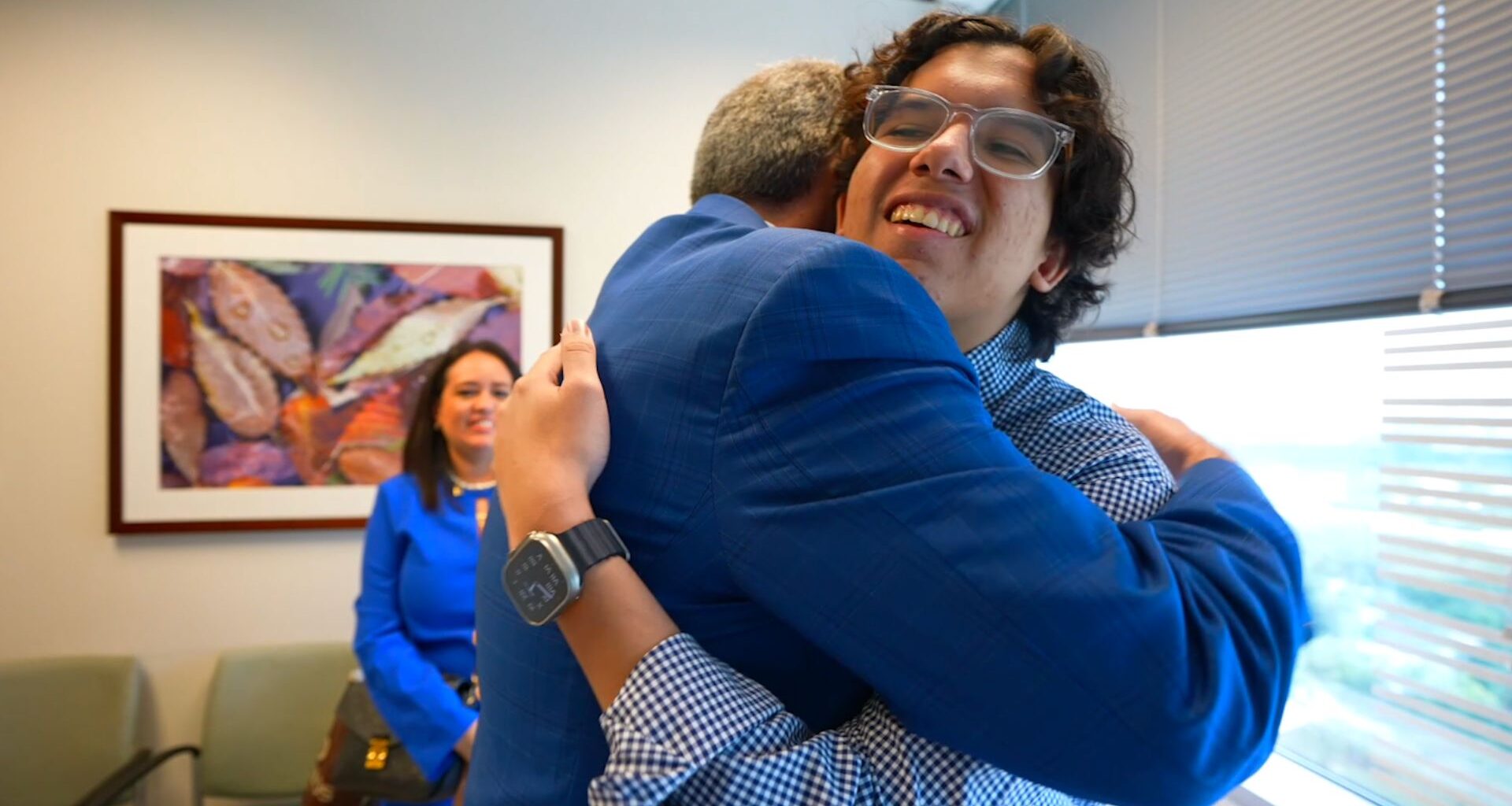
He soon found himself in Morcos’ office in the Texas Medical Center in Houston facing another brain surgery.
While the second rupture wasn’t as severe, without an operation, the results can still be devastating. A hemorrhage in the brainstem can affect everything from a person’s ability to walk and talk to their ability to eat and breathe on their own.
“ This is the most devastating area to have something happen in your brain,” Morcos said. “Think of any of your senses, and it can affect it. Inability to hear, to move your face, inability to walk or communicate. Everything that makes us human, it’s all bundled up in the brainstem. Think of it as the highest-priced real estate in the brain.”
Humberto said he wasn’t as afraid before his second surgery, in part because of the success Morcos had in 2021, and in part because of the confidence Morcos showed when Humberto was facing a second operation.
“I saw Dr. Morcos being very confident in the surgery and that he could figure it out,” Humberto said.
Humberto’s second surgery had a smoother recovery than his first. He spent time in Houston before going back to recover with his family in Honduras for the summer, and remembers feeling happy and healthy. By the fall, he was back at TCU attending classes.
But in October, a familiar headache returned that made his stomach drop.
“I would wake up late at night shivering and with this pain that I couldn’t take away. I’d hope for the best, thinking if I sit it out then eventually it would go away,” Humberto said. “I’d start crying and saying, ‘It’s happening again. I don’t want it to happen again.’”
Another MRI in Fort Worth led Humberto back to Morcos’ office. This time, however, his symptoms weren’t caused by the cavernous angioma.
Because of the surgeries to correct the previous ruptures, Humberto had developed communicating hydrocephalus, a condition that occurs when cerebrospinal fluid is not being reabsorbed normally, resulting in enlargement of the ventricular cavities of the brain. It is not uncommon for people who have had operations on cavernous angiomas or other lesions, particularly when prior bleeding has taken place.
“Think of it like sediments in your pipes at home,” Morcos said. “ The fluid has high protein in it from the previous bleeding that has happened. That ‘sediment’ blocked the circulation of the spinal fluid.”
To address the problem, Morcos placed a shunt in Humberto’s brain to allow the fluid to flow freely.
“I had a weird sense of calm before the surgery,” Humberto said. “Dr. Morcos is probably the best in the world, so I was pretty confident everything was going to be fine.”
‘Enjoying every moment’
After a three-hour operation in November 2025 and a few days in the hospital to help his body adjust, Humberto felt back to his normal self.
Morcos is confident that Humberto is unlikely to require future brain surgeries, as his MRI is clean, with no regrowth of cavernous angiomas. Humberto will require regular MRIs to monitor his brain, but is otherwise functioning as a normal 20-year-old.
Six months after his third operation, Humberto is back in school and is on track to graduate with degrees in finance and accounting in December.
“The experience has definitely taught me that time flies. Every second counts,” Humberto said. “Something I try to live by now is that being happy does not depend on getting everything you want. Being happy is a mindset. Enjoying every moment—that’s something I can control. That’s what being happy is.”