
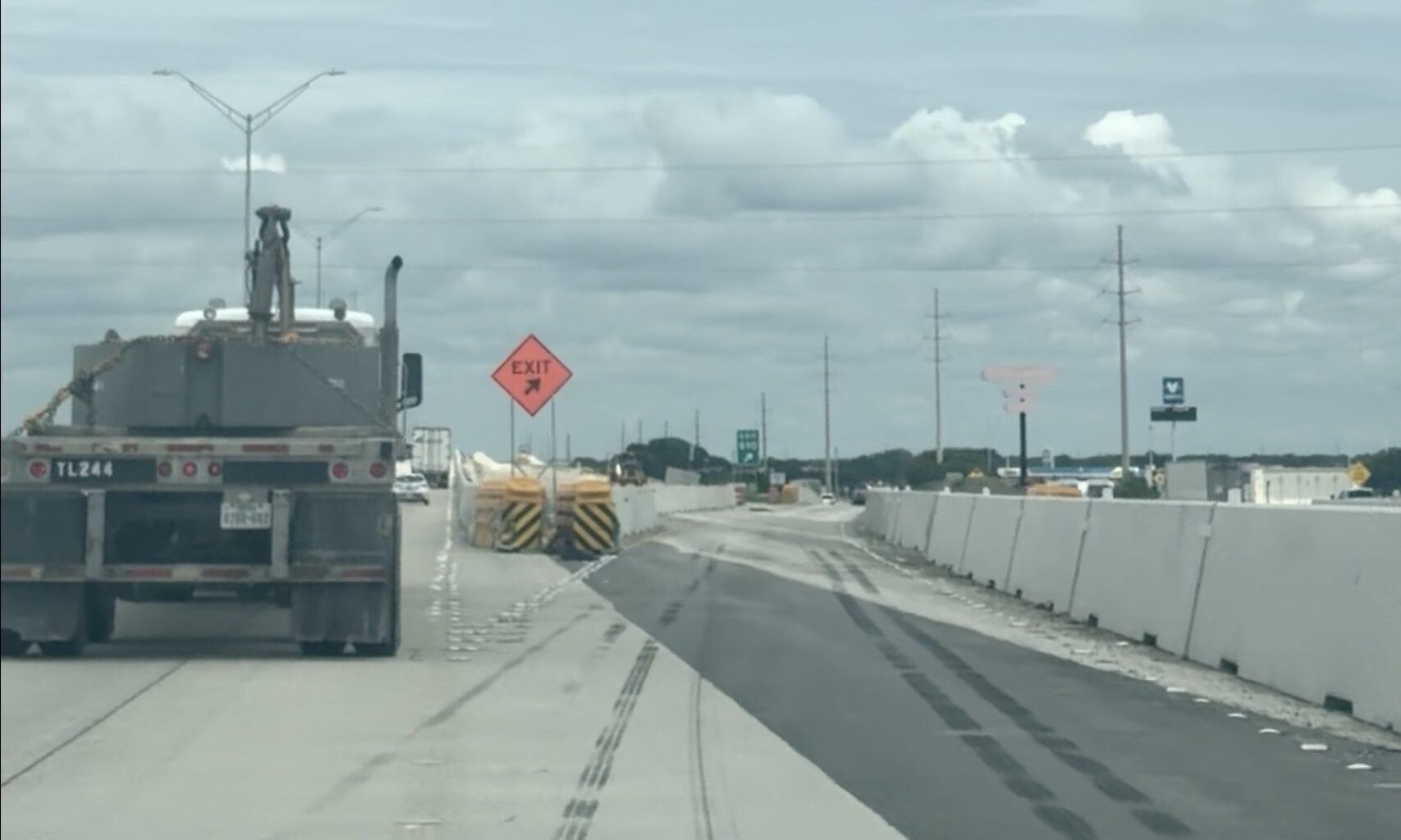
Driving in and out of San Antonio to the east along I-10 has become a treacherous endeavor, particularly as crews power through a massive expansion project of the interstate. But it’s all for the sake of progress, as traffic flow should open up when this nearly $250 million project wraps up in late 2029.
The sides of the busy highway around Seguin are lined with barriers. Lanes suddenly merge where the future six-lane interstate meets the unimproved four-lane under construction. Old, faded highway lines lead to mild confusion among some drivers, and crashes are on the rise.
The construction is linked to a massive plan from the Texas Department of Transportation to help move traffic along an increasingly busy stretch of I-10, which connects San Antonio to Houston.
“The project awarded to Webber LLC of New Braunfels will cost $245,194,039 and will consist of reconstructing the main lanes by expanding the existing four lanes to six lanes, improvements to entrance/exit ramps, as well as rehabilitation of existing structures and one-way frontage road conversion,” TxDOT says, noting it should all be finished by fall 2029.
This has meant alternating lane closures on the interstate. It’s also meant that the once-rural stretches of highway between FM 464 and Highway 130 no longer allow traffic to run in both directions, a fading feature of rural Texas highway systems. Boerne saw this disappear years ago, and TxDOT continues to implement this change across large-scale projects near burgeoning towns.
It’s a project marred by often frustrating closures and changes. Exit ramps have been closed for the foreseeable future, and the speed limit has been reduced from 70 mph to 60 mph across the construction zones. Just over a year ago, TxDOT completely shut down a lane of I-10 near Seguin for nine months.
This overhaul has also been marked by an increase in wrecks. Back in January, Seguin Police Chief Jason Brady said the number of wrecks inside the construction zone had overwhelmed first responders. A TxDOT spokesperson told MySA at the time that 75% of the 69 crashes in that stretch of I-10 between October 1 and December 30 of last year were due to speeding, unsafe lane changes or driver inattention.
During the commute, MySA observed numerous vehicles traveling at speeds well over 70 mph despite the posted speed reduction signs. Regarding unsafe lane changes, there are several choke points where six lanes merge into four, with very little signage or advanced warning.