
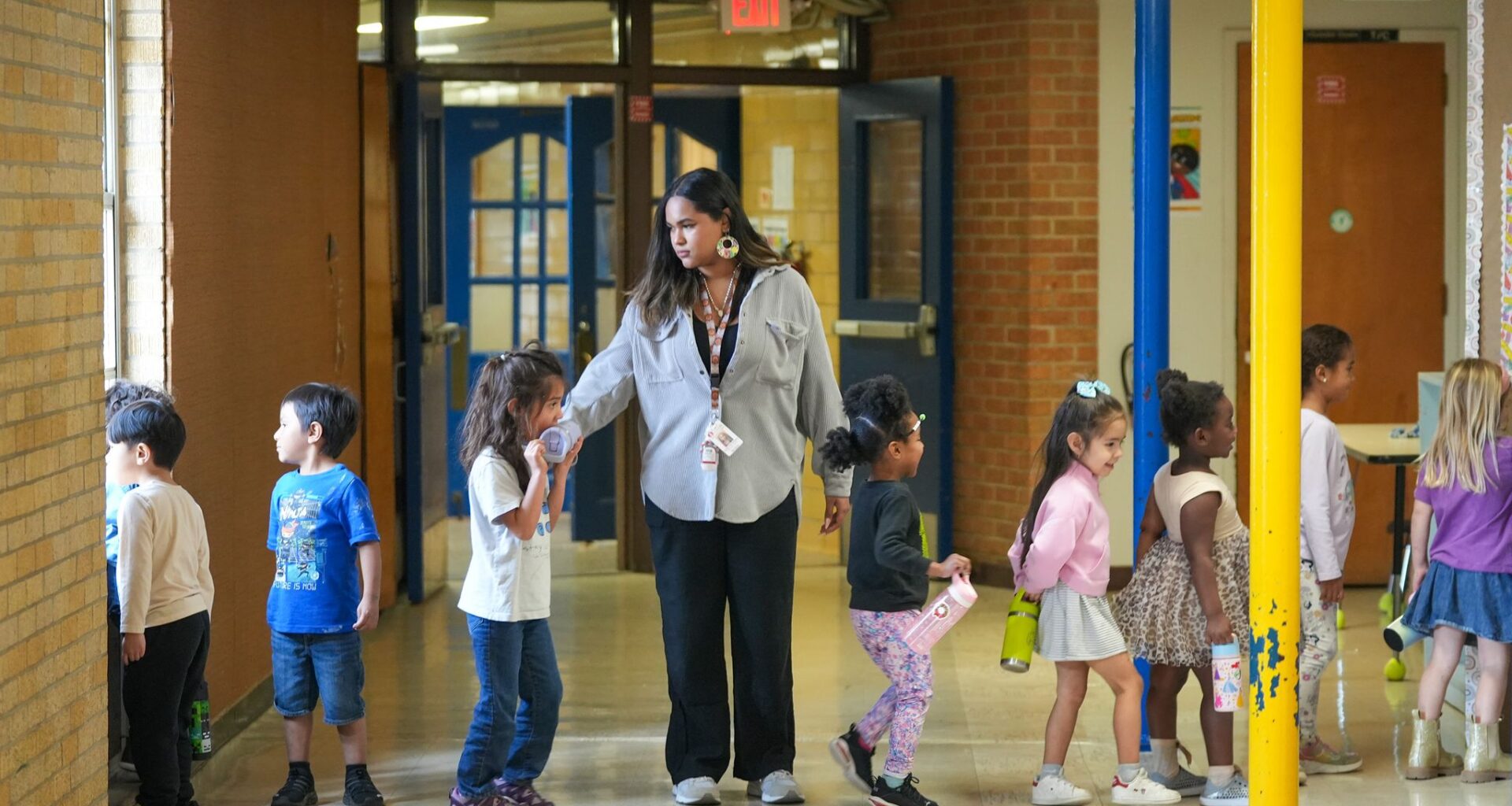
Pre-kindergarten teacher Daniela Guzman lines up her students in February at Becker Elementary School, one of the 10 schools Austin ISD is closing amid declining enrollment and growing budget challenges.
Jay Janner/Austin American-Statesman
Texas public schools enrolled roughly 76,000 fewer students this year, marking only the second annual decline in nearly 40 years. This drop is not an isolated event — it is the predictable outcome of years of policy decisions that disregarded demographic shifts and relied on outdated assumptions of perpetual growth.

Every Texan should be concerned about these consequences, especially as the midterm elections and the next legislative session present a critical opportunity for state leaders to pursue common-sense reforms and make long-overdue investments in public education.
Article continues below this ad
Projections indicate enrollment will keep declining through the end of the decade — a foreseeable trend given national drops in birth rates and a surge in homeschooling. Rather than planning for these realities, state leaders enacted policies based on endless growth, expanding charter and private school sectors without sufficient attention to efficiency, long-term planning or the supply of qualified teachers needed to support them.
For years, Texas Education Agency Commissioner Mike Morath has permitted rapid charter school expansion with little regard for regional capacity or long-term demographic shifts, sometimes granting approvals or exceptions despite concerns about sustainability. As a result, charter enrollment has soared by more than 300% over the past 15 years, while enrollment in traditional public school remained largely stagnant.
Charters now serve between one-third and one-half of all publicly funded students in major Texas cities. In Austin, charter enrollment has surged by more than 400% since 2009 — a trend that should have prompted serious scrutiny long ago about the sustainability and efficiency of such rapid growth.
Yet instead of addressing this looming crisis, state leaders recently enacted an optional private school voucher program, diverting even more students and funding from public schools. Policymakers know full well that public schools do not become less expensive to operate when enrollment declines, because in Texas school funding is tied to student attendance. If a third-grade class shrinks from 25 students to 19, the school still needs a teacher, but the funding loss can amount to tens of thousands of dollars.
Article continues below this ad
SIGN UP FOR THE AUSTIN ANGLE and get Statesman commentaries in your inbox
These pressures strain a school finance system that already ranks near the bottom nationally, leaving districts like Austin ISD squeezed by declining enrollment, rising competition and stagnant state investment.
Meanwhile, the responsibility for serving students with the highest needs is becoming increasingly concentrated. State policymakers have built a system where charter schools, on average, enroll fewer students who have disabilities or require intensive, costly services. As enrollment shifts, traditional public schools are left with a greater share of these students, even as their funding diminishes.
Compounding these challenges is a worsening teacher workforce crisis. Nearly half of the new teachers hired in Texas are uncertified. Many enter classrooms with little or no prior experience, and nearly one in five lack even a bachelor’s degree. These trends have been building for years while policymakers focused their attention elsewhere.
Article continues below this ad
Now, even the expansion model is starting to crack. Some charter schools — including networks once considered anchors of growth — are facing closures in cities like Austin.
Across any industry, including education, systems built on assumptions of endless growth are inherently fragile. Texans, familiar with the cycles of oil booms and busts, know this well — which makes the lack of preparation for a predictable downturn in school enrollment even more troubling.
This moment demands honest acknowledgment of policy failures and a reset of priorities. Texas must rethink school funding, manage growth across sectors more strategically, and invest in a stable, high-quality educator workforce.
Most importantly, leaders must recognize that public education is not a marketplace to expand but a public good to sustain for future generations.
Article continues below this ad
Sadly, Texas planned for a future that was never going to arrive. Unless state leaders change course immediately, student wellbeing and the state’s long-term prosperity will suffer.
The midterm elections and the next legislative session offer Texans a clear opportunity to reshape both leadership and the public education system before the consequences become irreparable.
David DeMatthews is a professor of education in the Department of Educational Leadership and Policy at the University of Texas. He is expressing his views as a private citizen.
Article continues below this ad