
After years of collecting stories often left out of the history books, the Dallas Asian American Historical Society has found a permanent home to preserve them.
The organization announced this month that it is partnering with the Dallas Public Library to house its growing collection of artifacts, photographs, and oral histories — marking a major milestone in its mission to document Asian American life in North Texas.
For Executive Director and co-founder Stephanie Drenka, it’s something the group has been working toward from the very beginning.
“This is something that we’ve dreamed about since we started the organization, before we had a physical space, before we even started collecting items,” Drenka said.
The nonprofit has spent the past four years building an archive through community donations, research, and storytelling. What began with just a handful of items has grown into a collection of more than 500 pieces and counting. They currently operate out of a space inside the historic South Side on Lamar building near downtown Dallas, where they host events, art exhibitions, and store many of the items they’ve collected.
But their goal has always been bigger than just collecting.
“Our mission has always been to put Asian Americans back into the narrative of Dallas,” Drenka said.
MISSING HISTORY
The need for this work became clear to Drenka and her co-founders early on.
Drenka said when the organization began researching Asian American history in Dallas, they found little documentation, few references in textbooks, no widely available archives, and limited academic programs focused on the subject.
“One of the motivations behind us starting a whole organization was realizing how little had been documented about Asian Americans in Dallas and in history books and textbooks,” she said. “It was difficult for us as curious individuals to even find breadcrumbs to follow.”
What records do exist are limited. The earliest documented reference to an Asian resident in Dallas dates back to 1873, when the city first published a directory. But many earlier stories were never formally recorded and have since been lost.
“So we can assume, based on the history of the Chinese labor that helped build the Houston and Central Texas Railroad that connected Dallas to the rest of the country, that we’ve been here probably from the 1860s,” said Drenka. “And because we don’t have that physical documentation, stories are lost, we lose our presence here, and our right to be part of the narrative. And that’s why it’s been really important for us to not only research, but also find tangible items that we can preserve.”
That realization sparked a grassroots effort to rebuild that historical record from the ground up.
BUILDING HISTORY
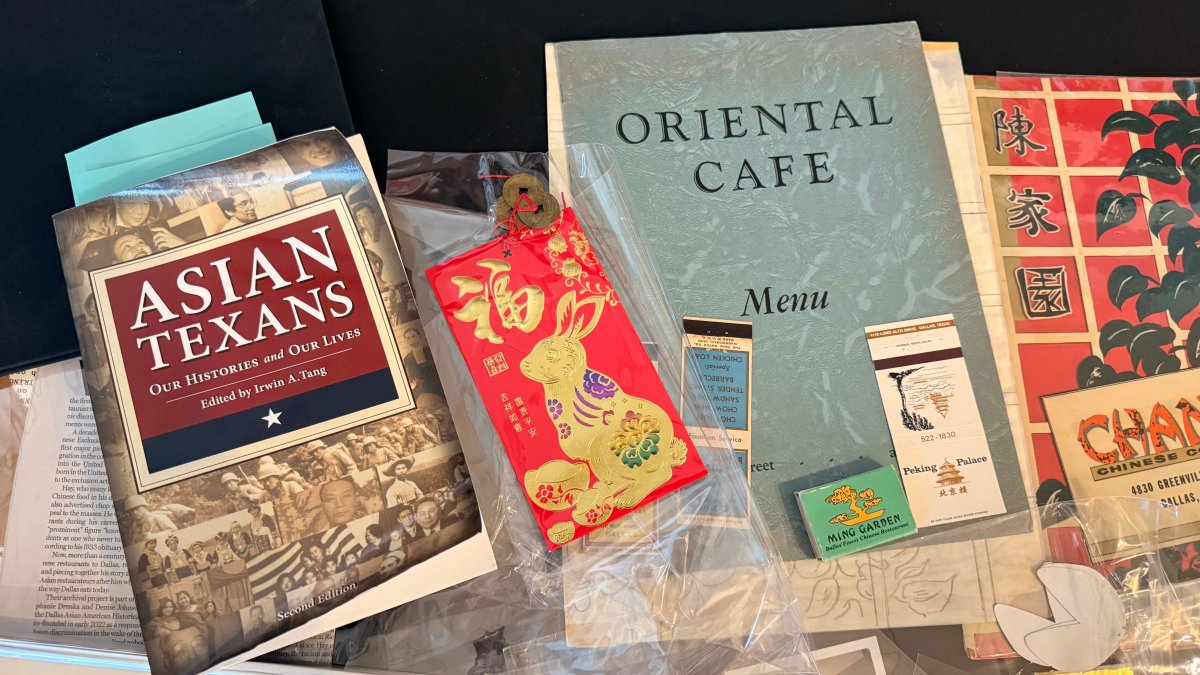
The society’s collection reflects everyday life — objects that might otherwise be overlooked but carry deep historical significance.
It includes menus from long-closed restaurants, matchbooks with distinctive logos, and photographs tucked away in family albums.
“It can just be a napkin or a book,” Drenka said. “All of these tell such a bigger story than what people can even imagine.”
One example is a hand-drawn menu from Chan’s Chinese Cottage, created by the restaurant’s owner. Combined with bank records from the family, the items helped confirm the business was operating as early as 1945, documenting an earlier than previously documented tangible existence of Asian cuisine in the Dallas area.
Other artifacts reveal how Asian American communities adapted and helped shape local culture. Restaurant menus, for example, often featured a mix of traditional dishes and American staples like steak, highlighting a blend of cultures unique to Texas to help cater to the surrounding population.
The archive also includes materials tied to major figures and moments, from civil rights activism to community sports.
Among them are items connected to Dr. Suzanne Ahn, a Korean American neurosurgeon and civil rights advocate, whose own historical collection was rediscovered after her death.
“And so it was an incredible full circle moment,” Drenka said.
There are also pieces tied to more recent events, including a letter from then-Vice President Kamala Harris sent after a vigil for victims of the Allen outlet mall shooting, where several Asian Americans were targeted and killed.
PRESERVING HISTORY
Until now, the collection has been housed in the rented space inside the historic South Side on Lamar building.
But as the archive continued to grow, the organization quickly ran into limitations.
“We’re limited by our small quarters here, which we love, but there’s not enough room for what we hope to collect,” Drenka said.
That includes a new oral history initiative, which aims to gather 20 to 40 additional interviews over the next year from Asian Americans in suburban communities across North Texas.
Beyond space, there were also challenges in preserving and sharing the materials.
As a volunteer-run organization, digitizing and uploading content could take months.
That’s where the Dallas Public Library comes in.
Under the new partnership, the library will take on the responsibility of preserving, cataloging, and digitizing the collection—while also making it accessible to the public both in person and online.
“We are the holders of local history and archives,” said Manya Shorr, director of the Dallas Public Library. “We take care of them by digitizing them, making them available for free online, and just putting them in order.”
The library system already plays a similar role for other community archives, including the Dallas Mexican American Historical League and the Remembering Black Dallas project.
Shorr says the partnership is a natural fit and an important step in expanding representation.
“We are thrilled to be working with the Dallas Asian American Historical Society… at the very least because we want to feature Asian American history here in Dallas and the Metroplex, which is not something that people know a lot about,” she said.
The Dallas Public Library offers climate-controlled storage, professional archival care, and digital infrastructure that smaller organizations often can’t maintain on their own.
“It’s not unusual for someone to be keeping boxes in their attic, and it’s just not good for the documents,” Shorr said. “What we can offer them here is long-term storage and of course, the public library is really the people’s house.”
SHARED HISTORY
For the historical society, the partnership means the collection will live beyond any single organization — and reach a much broader audience.
“We wanted something that lives beyond one organization or any of us,” Drenka said. “It feels like such an honor to have our stories live among some of those really important narratives.”
It also ensures families who donate their items can continue to access them.
“At any time, if a family member wants to go see photos that they donated, they can go to the library and bring their family and friends,” she said.
The library space will allow the nonprofit to focus on curating exhibitions for its growing Museum of Asian Texans.
Ultimately, Drenka hopes the move inspires more people to see their own stories as part of history worth preserving.
“Heritage is a responsibility and a privilege,” she said. “My hope is that people see that responsibility as their own… to really shape the stories that determine the narrative for our future.”
The Dallas Asian American Historical Society is continuing to accept contributions from the community. For more information on how to donate artifacts or share stories, contact them by clicking here or messaging them on their Instagram page.