
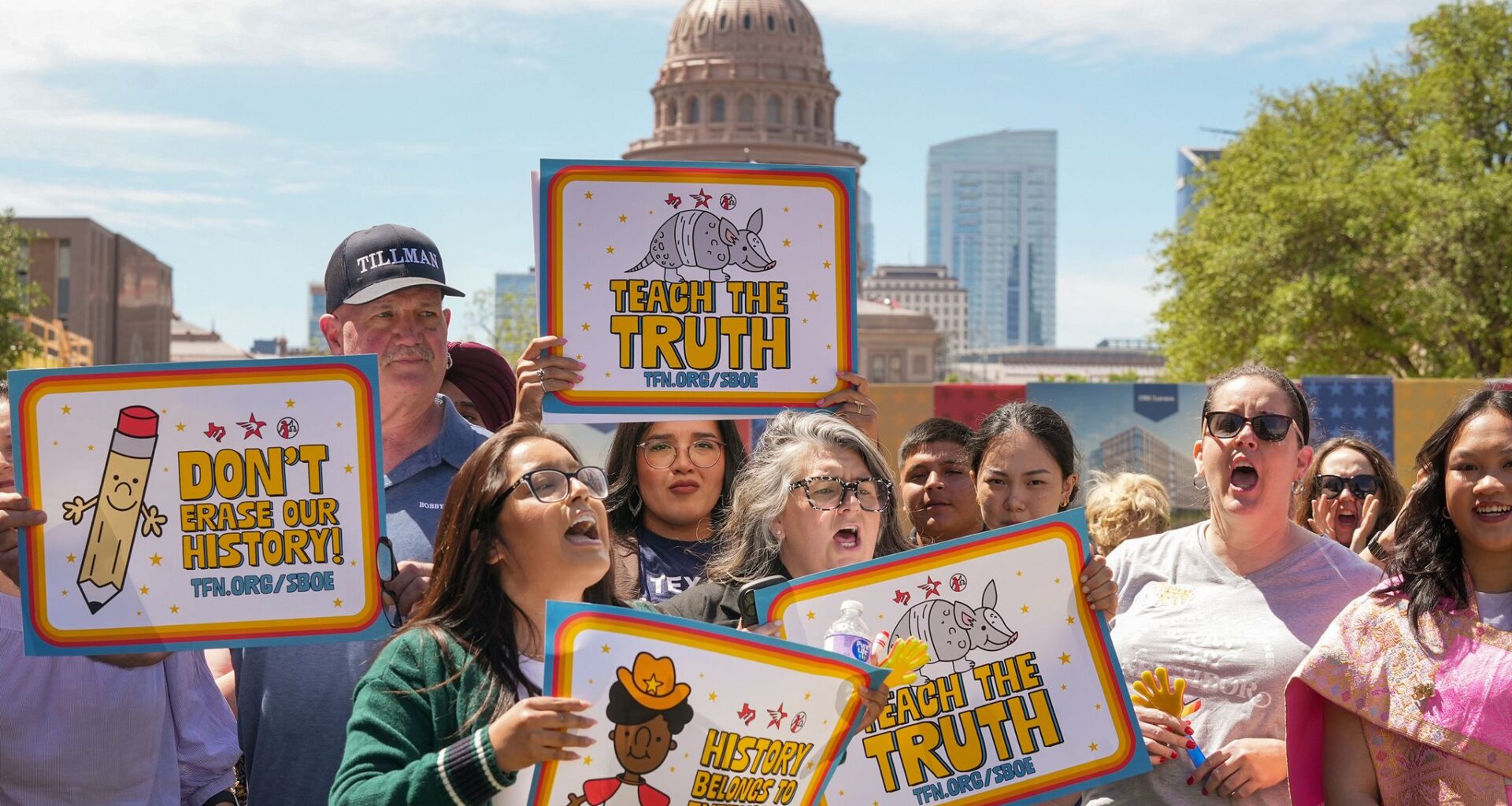
People hold signs reading “Teach the Truth” and “Don’t erase our history” during a rally on the Capitol Mall outside the Barbara Jordan State Office Building, where the State Board of Education meets, in Austin, Tuesday, April 7, 2026. Parents, educators and community members gathered to oppose proposed changes to the state’s social studies curriculum, known as Texas Essential Knowledge and Skills, or TEKS, as the board considers revisions.
Jay Janner/Austin American-Statesman
The Republican-led State Board of Education is weighing plans to weave Christianity into classroom instruction more directly than ever before, asking teachers across nearly every grade level to teach and test students on a broad swath of Christian history and biblical figures.
Conservative proponents of the overhaul say the changes are designed to help students better understand how religion has shaped the country’s culture and foundations. But experts say some of the lessons are at odds with the historical record or inflate the role of Christianity in major events.
“What we’re seeing in Texas is not homegrown history,” said Brendan Gillis, a director at the American Historical Association and history professor at Lamar University. “A lot of these formulations about bringing the Bible and Christianity into the curriculum are being drafted and circulated by national organizations that want to change how religion and religious history are taught.”
Article continues below this ad
The proposals are part of the board’s overhaul of the state’s social studies curriculum and the creation of a first-of-its-kind mandatory reading list. If given final approval at the end of June, the standards would enter public schools in 2030.
Religion is already a component of social studies classes in Texas, but the focus is mostly on tracing the history of religious freedom in the United States and analyzing major world religions.
The new standards, which the SBOE initially approved in April, would require students to read more than a dozen passages directly from the Bible and make connections between Christianity and major historical events, according to a Hearst Newspapers analysis of the proposals.
RELATED: Texas is overhauling what students will learn in social studies and history. Here’s what to know
Article continues below this ad
Building that understanding would begin as early as kindergarten, where students’ lessons about the Pilgrims would now include that their motivation for coming to the U.S. was “to advance the Christian faith.” High school lessons would ask students to identify religious influences on the American banking and economic system.
Historians and religious studies experts said Christianity has had major cultural impacts, but called several of the new aspects of the curriculum problematic.
The State Board of Education meeting room is pictured inside the William B. Travis Building in Austin, Texas.
2021 File Photo
In the third grade, the proposal calls for Texas students to identify the Bible’s Abraham and Moses as historical figures, though scholars generally view them as legendary or mythical figures without direct archeological evidence of their existence. Presenting them as on par with Benjamin Franklin or George Washington could complicate students’ historical reasoning skills, said Kate Carté, a historian of early America at Southern Methodist University.
In other cases, the standards leave out important context, the historians said. In the sixth grade, students would be required to learn about connections between Christianity and the abolitionist movement, but not that slave owners used the Bible to justify their position.
Article continues below this ad
Second graders and high schoolers would learn about the so-called Black Robe Regiment, which the board proposal describes as a group of colonial pastors who preached about freedom and served in the revolutionary forces.
READ MORE: Texas moves closer to mandating Bible readings in the state’s public schools
Carté, who published a book about religion and the American Revolution, said the concept is “completely bogus.” There is no historical evidence to suggest the existence of any such group, and clergy at the time were profoundly split on whether to support the revolution, she said.
“It’s certainly not a term used by historians,” Carté said. “They are making it up.”
The term appears to have been popularized by David Barton, an evangelical activist and former vice chair of the Texas Republican Party who served as an advisor on the board’s social studies overhaul. It has been primarily used in some modern-day evangelical circles as a rallying cry for pastors to become politically involved, Gillis said.
Article continues below this ad
Aasya Peera of Pflugerville holds a sign reading “Don’t teach our children lies!” during a rally on the Capitol Mall outside the Barbara Jordan State Office Building, where the State Board of Education meets, in Austin, Tuesday, April 7, 2026. Parents, educators and community members gathered to oppose proposed changes to the state’s social studies curriculum, known as Texas Essential Knowledge and Skills, or TEKS, as the board considers revisions.
Jay Janner/Austin American-Statesman
Barton did not respond to an interview request. His WallBuilders organization, along with other conservative organizations, has argued against the separation between church and state, emphasizing that faith can and should be integrated into public institutions.
Mandy Drogin, a senior fellow at the Texas Public Policy Foundation, a conservative think tank, said the new standards are not about proselytization.
“No one’s saying you have to worship anyone,” she said. “But you do need at least to understand how we were founded.”
The curriculum overhaul is part of a broader push by Republican state leaders to infuse religion into public schools. Last session, Gov. Greg Abbott signed new state laws that require public schools to post the Ten Commandments in classrooms and allow districts to create school-led prayer periods, which are voluntary.
Article continues below this ad
RELATED: Texas teachers are clashing with history advisers over the state’s social studies rewrite
The social studies standards and reading list would be compulsory for all students. They would likely be difficult for families to opt out of, especially because the materials will ultimately form the backbone of new textbooks and mandatory standardized exams.
Don Frazier, a Texas historian at Schreiner University and another content advisor on the overhaul, said Texas has many faith traditions, and advisors tried to be sensitive and inclusive to non-Christian religions, particularly in older grades. But, he said, the standards still needed to focus on providing a baseline understanding of Christianity.
“Whether people are devout or not, or Christians or not, Western civilization is built upon those foundations,” Frazier said. “Christianity is part of the marinade that everybody’s soaking in.”
The State Board of Education meeting room is pictured inside the William B. Travis Building (which houses the Texas Education Agency) in downtown Austin, Texas.
2021 File Photo
Through middle and high school, the proposals require students to trace the chronology of Christianity, including new lessons on its spread under the Roman Empire and major doctrinal events, like the Nicene Creed.
There are far fewer requirements for students to learn about other faiths.
In 10th grade, the board proposal says students must learn about world religions, such as Buddhism and Hinduism. Several grades require lessons on Islam, but largely focus on violence between Muslims and Christians by highlighting medieval conflict in the Crusades and Spanish Reconquista as well as the role of “Jihad” in 21st-century terrorism.
Mark Chancey, a religious studies professor at SMU, said he believed many of the standards inappropriately favor a particular evangelical faith above non-Western traditions and other branches of Christianity.
“It’s a selective emphasis on stopping Muslim expansion while glossing over disturbing behavior by Christian powers,” he said. “These standards do a disservice to students, and they misrepresent Islam by focusing solely on issues of conflict.”