
“That is why we signed up to do this job. To stop bad people and save innocent people.”
AUSTIN, Texas — Nearly three months ago, a mass shooter armed with an AR-15 style rifle attacked West Sixth Street, killing three people and injuring 16 others in the heart of Austin’s bustling entertainment district. Three Austin police officers stopped his attack in mere moments.
“Simply put, the guy just appeared,” one of the officers, Keston Campbell, remembers.

This story continues below.
Officer Artur Markov recalls, “The only thing you are thinking about in that moment is that people are dying.”
Those three officers who took down the gunman as hundreds of people around them dove for safety are now sharing their account publicly for the first time.
After the shooting, even the harshest police critics deemed these three officers heroes, and experts say what they did is a textbook example of how police should respond in a mass shooting.
What happened
Up until the shooting, the evening had been relatively calm, even though no night could be called “typical” in Austin’s entertainment district.
“We were all just there talking to each other, making sure we had eyes on the crowd, and making sure everyone goes home,” Campbell said.
But each of these three officers – working a voluntary overtime assignment that night – knows that a routine evening can change in an instant, and that’s what happened at 1:58 a.m.
It was a moment that pushed Campbell, Markov and Officer Nicholas LaBarbera into the center of one of the city’s worst mass casualty events since the University of Texas Tower shooting 60 years ago.
All of a sudden, they heared details from 911 callers.
“There’s been a shooting at Buford’s on Sixth Street, and there people dead over here,” a 911 caller shouted to a dispatcher.
And they got the earliest reports from arriving fellow officers:
“We’ve probably got six or eight people that have actually been shot,” an officer said.
Standing at the corner of Sixth and Neches streets, Officers Campbell and LaBarbera jumped into their patrol car and sped toward the scene.
“There wasn’t an ‘oh crap’ moment. It was just, ‘OK, cool, this is happening, we are going,’” Campbell said.
“All the pertinent information that we’d had up to that point, which was just radio traffic, is that the suspect had fled the scene in a vehicle and had turned westbound on Sixth Street,” LaBarbera said.
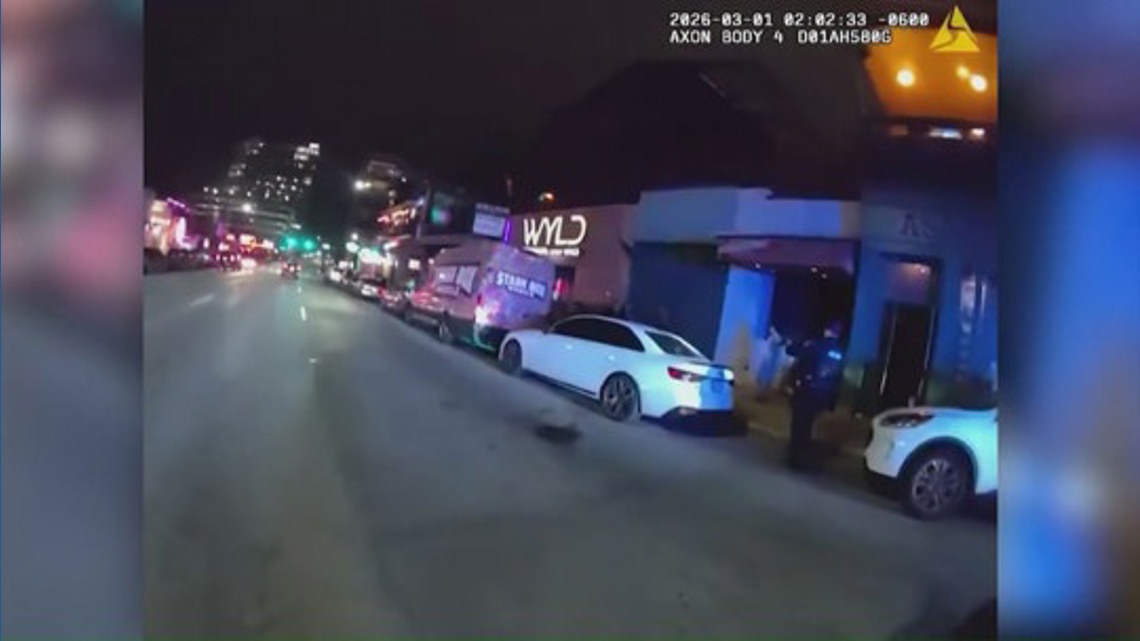
Body camera footage captured what happened next.
Officer Campbell, behind the wheel of the patrol car, parked the car just as the shooter, who had initially opened fire with a pistol, returned to the area outside Buford’s Backyard Beer Garden and began shooting again. Hundreds of people were in the area.
LaBarbera and Campbell bolted from their patrol car.
“We were just moving toward where I heard the gunfire,” LaBarbera said.
Campbell touched him on the shoulder and gave him this reassurance.
“Hey, I’m with you!” he said.
Campbell began screaming for people to duck.
“As soon as I said get down, about 20 or 30 of those people just magically disappeared,” Campbell said. “They found every nook and cranny to conceal themselves.”
Within seconds, they saw the shooter.
“We kept asking, ‘Where is he? Where is he?’ Nobody really knew, and it just felt like he materialized out of nowhere,” LaBarbera said.
The shooter opened fire – “We heard his first round crack over our heads,” LaBarbera said – before both officers shot him.
Markov, alone in his patrol car, moved in from another direction.
“I see him basically walking and shooting,” he said.
When he realized that the bystanders had all ducked, he also opened fire.
An FBI investigation has since found the shooter was motivated to carry out the attack by the U.S. military action in Iran a day earlier but had no ties to a larger terrorist group.
The aftermath
In the past three months, each officer has grappled with what happened in his own way.
Markov, who immigrated to the U.S. from Russia and has a 2-year-old, said being a father has helped him remain focused.
“I’m really thankful for my daughter,” Markov said. “She helped me a lot, but I also wanted to get back to patrol to kind of normalize my life back.”
Campbell, who grew up in Chicago and who had always planned to be an English teacher before joining APD, said family members in his native Trinidad have guided him through what happened from a world away.
“I’ll say not only is it not normal to take someone else’s life, it is also not normal to realize that someone is indeed trying to take yours,” Campbell said.
And LaBarbera, who came to Austin from New Jersey to join the department, said he plans to return home for a new job in law enforcement. He has been in touch with some of the victims from that night.
“Hearing their perspective was something I had never even considered, so I am very grateful for that and it has helped me process this and kind of move on with my life,” he said.
Each of the officers say that they believe they were prepared for this moment – and believe they were right where they needed to be, at the right time, doing the job they promised to carry out.
“That is why we signed up to do this job,” LaBarbera said. “To stop bad people and save innocent people.”
Policing experts point out that no situation is ever exactly the same, but the response to this mass shooting stands in sharp contrast to how hundreds of law enforcement officers reacted four years ago this week when they waited 77 minutes to take down the gunman in Uvalde – a botched response we spent months examining.
Experts, including the director of Advanced Law Enforcement Rapid Response Training in San Marcos, say just as Uvalde is now used to teach police can go wrong when responding to a mass shooter, the Austin case will be used by instructors to showcase how fast action by officers prevented more injury and death.