
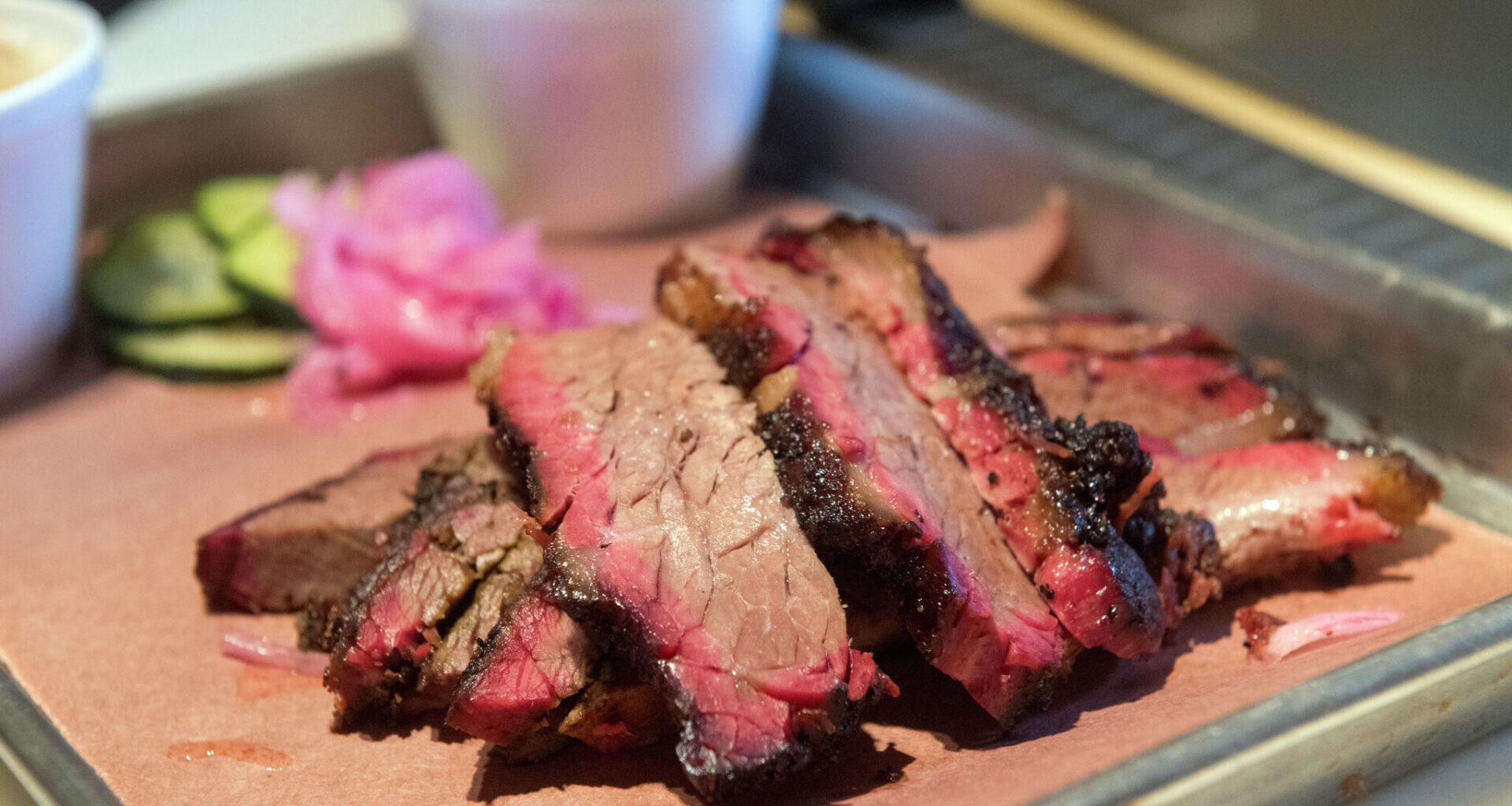
The fun part of Texas barbecue is watching a pitmaster slice into a freshly cooked brisket. Juices leak out as the knife reveals the glistening meat beneath the charred bark. It’s a special peek into the daunting work that goes into preparing that cut of beef.

Across Texas, barbecue pitmasters and business owners are facing an emotional and logistical reckoning. Brisket has been getting harder to come by and more expensive to deal with. For consumers, it may mean coming to grips with a world where brisket isn’t available daily at your favorite restaurant.
Article continues below this ad
Why brisket numbers are decreasing
The brisket comes from the breast or lower chest of a cow. You only get two briskets per cow, and each roughly weighs between 10 and 20 pounds. That’s a serious problem when the number of cattle in the U.S. is at historic lows and demand is so high. Dr. David P. Anderson, a livestock economist with Texas A&M University, told Chron the overall herd hasn’t been this small since 1961. Much of that is due to a serious drought that has affected U.S. cattle-producing regions for the past several years.
Cattle graze in green pastures in Bexar County.
JERRY LARA/Staff
“The cows are eating grass. If there’s less grass, you can’t have as many cows,” Anderson said. “We also went through a series of years with lower cattle prices and rising costs to raise them. It forced many of those ranchers to sell off much of their herd.”
Article continues below this ad
And while the beef yield has gotten larger from cows on average, that hasn’t changed the number of briskets you can get from the cow.
“Everybody likes barbecue and everybody wants brisket. That applies nationwide. Central Texas barbecue has sort of become every barbecue place in the country. Everyone is going to have brisket on their menu,” Anderson said.
Not only that, Anderson added, but “I’d also point out a big chain like Arby’s has brisket. That adds to the demand for brisket that didn’t used to be there.”
Article continues below this ad
The math and mentality of a brisket
What customers of a Texas barbecue smokehouse see across the counter with their tray isn’t just a brisket. It’s an untold story of rigorous work. Ernest Servantes, the pitmaster and owner of the critically acclaimed Burnt Bean Co. in Seguin, Texas, told Chron it takes a four-man crew to cook a batch of brisket.
“Two in the morning and two in the afternoon,” Servantes said. “That’s not counting the guys who prep it and season it.”
Isaias Raymundo, pit-master, weighs out slabs of brisket before cutting them for a catering order at Roegels Barbecue Co., Tues., May 19, 2026, in Houston. Over the trimming and smoking process, the brisket loses roughly 40 to 50 percent of it’s weight.
Antranik Tavitian/For The Washington Post via Getty Images
In Houston, brothers Richard and Nick Orozco and business partner Kyle Tucker are readying to open The Station at Smokey Oaks in the city’s Garden Oaks/Oak Forest neighborhood. The trio told Chron their brisket preparation and smoking process can take several days, and the skillset involved isn’t just trained but a honed art. At their business, the pitmaster makes the same as the general manager.
Article continues below this ad
“One of the things I’ve learned being on the pit as long as I have, those moments at 2 a.m. or 3 a.m. where a lot of folks think that’s time you kill—how you load that next log, how clean that smoke is, how much it weighs … It’s those midnight moments, those redirects will ultimately impact the finished product,” Nick Orozco said. “There’s not a moment where a pitmaster is on cruise control.”
But aside from the labor, there is significant loss. Before anything is done, pitmasters have to trim the fat off each brisket before it’s usable. That’s 15 to 30 percent weight off the brisket right off the bat (Orozco said that percentage can hit 50 or higher). After seasoning and cooking, the brisket that’s ready for eating is often about 60 percent smaller than at its original state.
So if you’re thinking about the math, a pitmaster can purchase a 20-pound piece of USDA prime brisket for $4-7 a pound, and only seven or eight pounds of that get to the counter. It’s why at some restaurants you pay $30-40 per pound for brisket. You’re paying for the loss.
Pitmasters consider radical shifts
The severity of the situation prompted Servantes to tell the Washington Post that he was mulling only serving brisket just one day a week to keep his restaurant and 28 employees afloat. Coincidentally, the Orozcos and Tucker had also considered the same possibility but decided against it. “It didn’t sit well with us,” Richard said. “The common man will turn away.”
Article continues below this ad
However, it’s not all doom and gloom. Anderson at Texas A&M said the squeezing conditions have actually forced a kind of inventive spirit among Texas pitmasters, the Orozcos and Tucker included. The trio have already begun looking at what was previously “trash” and have now turned it into a source of revenue.
Banger’s restaurant’s pitmaster Ted Prater shovels coal into a barbecue smoker at the restaurant, Austin, Texas, December 14, 2018.
John Anderson/The Austin Chronicle/Getty Images
“[Turning that leftover trim] into a robust in-house sausage program, a burger program, using tallow for our fryers,” Richard Orozco said. “There’s fat on the brisket, but it still can be rendered properly, and with art, we can turn it into a creamy delicious fat that you can [use as a] sub [for] olive oil, and [it] has less cholesterol.”
Nothing will replace brisket from the Texas trinity, but Anderson noted that tri-tip, a triangular cut of beef from a cow’s bottom sirloin and a signature of California cuisine, has started to appear on Texas menus and grocery stores. “I think there are things like it that might not replace the brisket, but it might add some more variety or force of creativity on the part of our barbecue guys,” Anderson said.
Article continues below this ad
What is the future for Texas brisket?
Central Texas barbecue has become one of the most successful exports from the state in recent memory. Almost too successful, some would say. James Beard- and Michelin-winning establishments the country over all feature some form or another of Central Texas-style cooking and products.
“American barbecue is Central Texas barbecue,” Servantes said. “Ten years ago, we didn’t have this problem. Guess who is using brisket now? The whole country.”
Historically, brisket was a blue-collar item. Today, it’s now a luxury good. According to Servantes, meat packers (that’s an entirely different story) have been shipping the goods to hungry fans overseas, from Europe to East Asia. And that demand has only fueled the price.
Article continues below this ad
A BBQ chef prepares a delicious serving of smoked Brisket.
Joel Villanueva/Getty Images
Servantes pointed to Bryan Furman, considered one of the best pig cookers in the barbecue game. After Furman’s B’s Cracklin’ Barbecue caught fire in Atlanta, the pitmaster opened a restaurant in Oregon where he’s selling brisket at $69 per pound. And people are buying it. “It was working-man’s food and now it’s a luxury item,” Servantes said.
Pitmasters may be loath to think of brisket as a once-a-week item or special, like the mighty beef rib or or occasional lamb leg, but that choice might be harder to avoid as independent restaurants and joints continue to shutter. Customers may also have to rethink what it means to visit their favorite lunch or dinner spot too, especially if the bill at the end of the meal keeps increasing.
Article continues below this ad
Maybe barbecue becomes a once a quarter … or once a year proposition, with brisket turning into a rare delicacy.
In other words: “Brisket might be the next beef rib,” said Richard, “and that would be unfortunate.”