
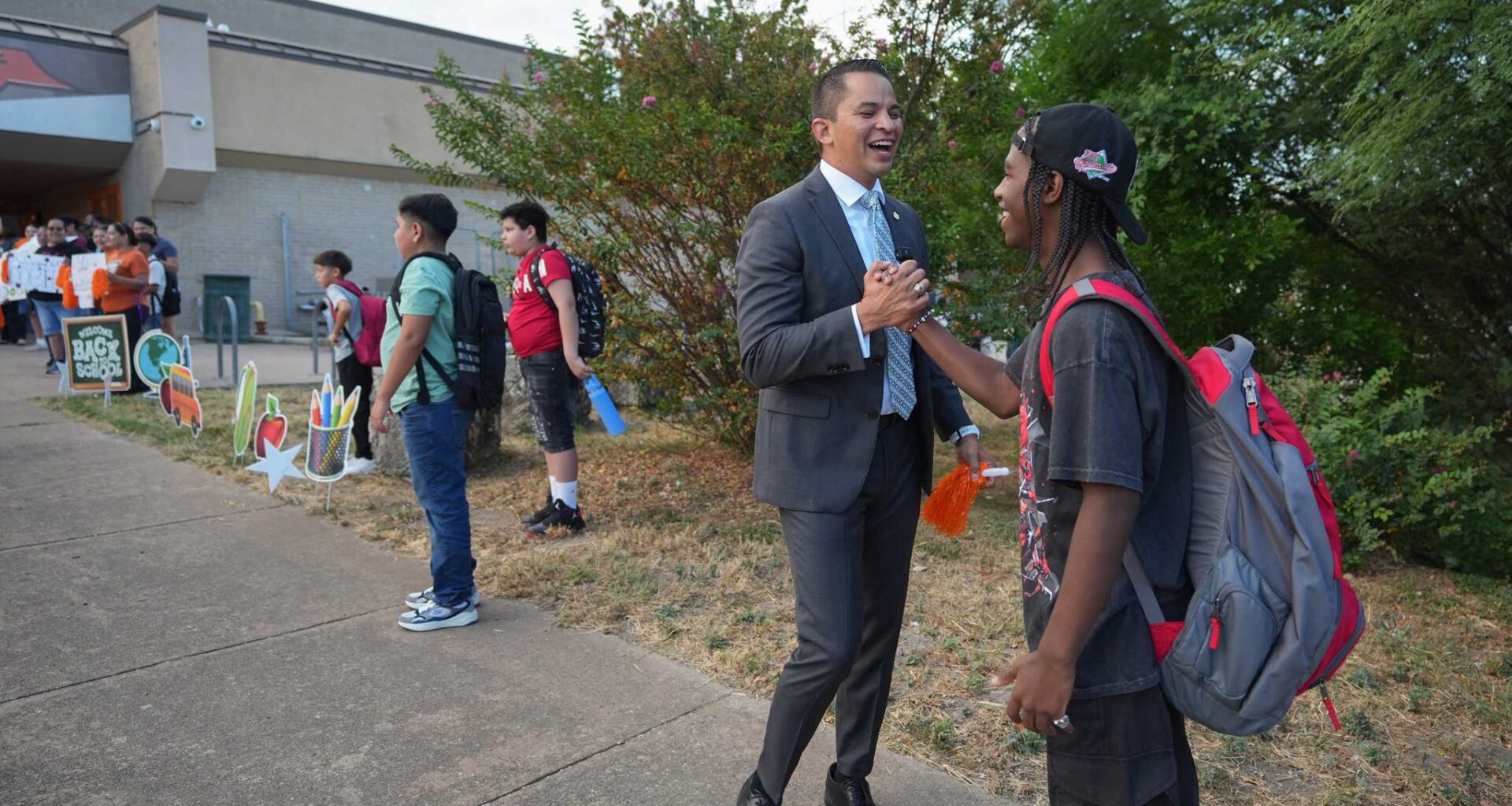
Austin Independent School District Superintendent Matias Segura greets eighth grader Roshawn Brown, 14, on the first day of school at Dobie Middle School in Austin, Tuesday, Aug. 19, 2025.
Jay Janner/Austin American-Statesman
As Dobie Middle School celebrated its last day of the school year, sixth-grade teacher Taylor Carriker-Cavin relaxed. This year, her North Austin school faced intense pressure to rapidly improve students’ academic performance. On Thursday, she celebrated with her co-workers for a job well done.

Students were more engaged in the classroom and showing promising improvement in math and science, she said. Plus, district trustees had voted to partner with the nonprofit Texas Council for International Studies next fall to run the school along with two others, giving the campuses more time to improve academic scores without state consequences taking effect.
Article continues below this ad
“The teachers at the school put in incredible work,” Carriker-Cavin, who teaches sixth grade science, said. “I have no doubt student growth improved this year.”
But minutes after students left for the summer, the teacher’s phone buzzed with a text. The message said the Texas Education Agency had denied the district’s bid to buy Dobie and the other campuses more time to improve, bringing Austin Independent School District closer to a state takeover.
“I’m truly shocked,” Carriker-Cavin said. “I’m worried our students’ needs aren’t going to be met for who they are, but for their test scores.”
TEA denial renews takeover fears
Dobie, Webb and Burnet middle schools each serve a student body that is more than 92% low-income in North Austin. The three campuses have long struggled on the state’s A-F accountability system, which is based largely on test scores from the State of Texas Assessments of Academic Readiness, or STAAR.
Article continues below this ad
Each has scored four F grades in a row and is only one more away from mandatory state intervention. At five consecutive failing scores, TEA must either close the offending campus or take over the entire school district, replacing the elected board of trustees with a TEA-appointed board of managers. Letter grades are likely to be released in August.
Austin ISD trustees had a plan to buy the schools more time. Taking advantage of a state law that allows districts to work with external partners to run struggling campuses and “pause” accountability consequences for two years, the Austin school board voted in March to hand over control of three middle schools to Texas Council for International Studies, which runs schools with International Baccalaureate or IB programming.
In a Thursday letter, a TEA official said the partnership is not eligible for those benefits, including the pause, because of the nonprofit’s inconsistent track record of improving campuses’ academic performance.
Article continues below this ad
Staff at the affected schools told the American-Statesman the denial threatens the future of the campuses, their jobs and the students’ well-being as a state takeover looms. Some felt angry at Austin ISD for signing a contract with the nonprofit partner before knowing TEA’s decision, and at the state agency for measuring success based on STAAR scores, not on the school’s impact on students’ lives.
Others fear the denial will halt students’ and staff’s academic momentum built over the past year.
“For my kids to leave school and think ‘They’re gonna close down my school because I’m a bad kid, because I can’t read,’ as much as I can tell the kids it’s not you … they still get it ingrained in their brains that this is my fault,” Adam Kranz, a counselor at Dobie Middle School, said. “And that is the biggest tragedy.”
Staff question next steps
Austin ISD leaders and lawmakers downplayed the severity of the denial and looming takeover Thursday afternoon and evening, insisting that the partnership and special accountability pause were still a possibility. Superintendent Matias Segura framed the denial to parents as a “procedural step” that “does not slow down our momentum,” saying the district would submit more materials to TEA to show the nonprofit’s merit and probability of success.
Article continues below this ad
In a statement, the Central Texas legislative delegation of nine lawmakers warned that “the district is at a precarious moment where state takeover is a real risk” but said it is “not inevitable.”
A Burnet middle school teacher, who declined to be named for fear of retaliation, said she doesn’t think the district did enough to protect the school from that denial and worries it rushed into a partnership with TCIS too soon.
The partnership felt “like a done deal,” she said. After TEA’s denial, she worries the district isn’t admitting how serious the situation is or thinking proactively about what happens next.
“It’s hard to know who to trust,” she said. “I don’t want to come back because I don’t feel like (the district) is taking care of me, I’m taking care of it.”
Article continues below this ad
On Thursday after the final school bell rang, Carriker-Cavin read the news out loud to her coworkers with a sinking feeling. She thought about the Houston ISD takeover that cut staff and strictly regulated curriculum. Though she has seen tremendous academic progress in students this year at Dobie, the odds of all campuses avoiding an F grade feel low, because the STAAR test isn’t “meant for schools like these,” she said.
The state’s STAAR scores, which Commissioner Mike Morath and state lawmakers have increasingly relied on as a metric to measure school performance, doesn’t factor in students’ increased engagement in extracurriculars like band and soccer, she said. They do not show how students who started the school year speaking no English ended it by consistently participating in class discussions, she added.
“The students at these campuses are more than just their test scores,” Carriker-Cavin said.
After waving goodbye to students Thursday afternoon and seeing eighth graders off at their graduation ceremony, Kranz drove to Dallas. When he read about TEA’s denial, it was a “gut punch,” he said. Now, it feels like the school won’t have a chance to move forward.
Article continues below this ad
“We’ve been working to their system, teaching to their tests, using the curriculum they support, doing everything we can to meet their expectations, and working our butts off for it, and still it feels like we get told like that wasn’t enough,” Kranz said. “It feels like more of the same, but it still hurts, it hurts a lot.”
Ken Zarifis, president of Education Austin, the district’s teacher union, said he has to hold onto hope. He taught at Burnet for 12 years, and his son attends the school now.
“That is not a failing school, I don’t care what the state says,” Zarifis said. “Yes it needs help, yes it needs support, but it’s getting better.”
The union president added that he thinks all three campuses could receive a passing grade, alleviating the fear of takeover. But regardless, he urged members to hold on to hope that Austin ISD may remain under local control.
Article continues below this ad
“People need to slow down, see what’s coming and not overreact,” Zarifis said. “We’ve got to take it one step at a time and support the people who are there.”
Austin ISD declined to answer the Statesman’s questions about sending more materials to TEA or seeking a new partner at the campuses. TEA did not respond to a request for comment.