
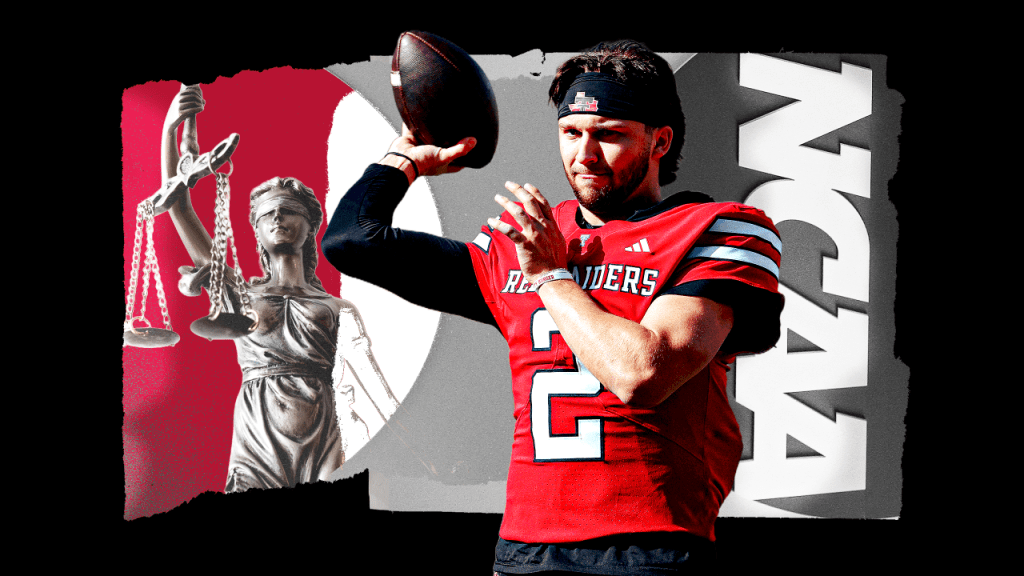
The NCAA on Friday accused Texas Tech quarterback Brendan Sorsby of placing over $90,000 in bets while playing for Indiana, Cincinnati and Texas Tech from 2022 to 2026, and of transferring money to others for bets in Texas, where sports betting is barred by a criminal statute. Sorsby is away from the team for treatment of gambling addiction and has sued the NCAA to declare him eligible.
The assertions are raised in the NCAA’s brief opposing Sorsby’s application for a temporary injunction from Judge Ana Estevez of Lubbock County (Texas) District Court. Sorsby, who reportedly landed a $5 million NIL deal to join Texas Tech as a transfer from the Bearcats, seeks a resolution before June 22, which he says is when he would need to apply to the NFL for the league to consider holding a supplemental draft in which the 22-year-old would be eligible for selection.
As Sportico has detailed, the NFL is under no obligation to hold such a draft and might have reservations about doing so for a player who is addicted to gambling.
Judge Estevez will hold a hearing at 9 a.m. local time Monday to consider Sorsby’s motion for an injunction. While she might not issue a ruling during the hearing, she could signal which way she is leaning.
The Sorsby case is being closely watched for any precedence it could set in the future for college athletes accused of betting.
Sorsby has admitted in court filings that he bet on his own college team, Indiana, in 2022. The NCAA, like other major sports associations, considers an athlete betting on their own team as grounds for permanent disqualification.
In a brief authored by Julia M. Peebles and other attorneys from Haynes Boone, Holland & Knight and Wilkinson Stekloff, the NCAA says Sorsby seeks a court order that would “make the NCAA the first and only major American sports league to allow an athlete to compete after betting on his own games.”
That type of judicial decree, the NCAA warns, would create a perverse set of incentives. Other athletes could follow Sorsby’s “lead and rush to court if caught” and would “undermine the integrity of college athletics by rewarding conduct that is universally prohibited in American sports.”
The NCAA also argues that the applicable standard of legal review is extremely deferential to private membership associations, of which the NCAA is one. The brief cites court rulings stating the proposition that courts won’t intervene with a private membership association unless a rule is “against public policy” or has been arbitrarily applied. That standard is common in the U.S., as courts generally find that if a member of an association agrees to follow the rules, it should follow them or it can always quit the association.
In that same vein, the NCAA notes that Texas law requires a party challenging a private membership association’s decision to first exhaust any internal processes before turning to the court. The NCAA says “that has not happened here” since Texas Tech has the right to appeal the NCAA’s denial of Sorsby’s reinstatement and the school has said it plans to do so.
Sorsby’s legal theory rests on the idea that he is a third-party beneficiary of the contractual relationship between the colleges he has attended as a student and the NCAA. He maintains the NCAA is liable for breach of contract and breach of the duty of good faith and fair dealing, and argues the NCAA has unfairly handled his gambling addiction with respect to his eligibility.
The NCAA directly attacks this argument as unserious and contradictory. The NCAA argues that Sorsby is asking the court to declare him eligible to compete “even though he serially and repeatedly violated rules” in addition to possibly violating a Texas criminal statute.
A good portion of the NCAA’s brief details Sorsby’s alleged betting activity and how he used friends and family members to further his betting. For example, from January to September 2024, Sorsby allegedly placed at least 165 bets, or about 500 counting parlay legs, totaling $38,000. Sorsby is also described as using third-party accounts not in his name, allegedly providing more than $60,000 to a friend between December 2023 and June 2025 to deposit in a FanDuel account registered to his brother-in-law.
In arguably the most damning allegation, the NCAA says that Sorsby continued sports betting activities after transferring to Texas Tech in January 2026. He allegedly sent about $5,000 via Venmo or Zelle “to individuals who placed bets on his behalf using prediction applications such as Underdog, PrizePicks, and Chalkboard.”
The NCAA claims that “by this point” Sorsby was placing bets “entirely through proxy accounts” rather than in ways that would be traceable back to him.
In 39 states, along with Washington, D.C., and Puerto Rico, people who are 18 or 21 (depending on the state) can bet legally on sports, under certain conditions. That framework reflects a rush among states to legalize sports betting in the aftermath of the U.S. Supreme Court’s ruling in Murphy v. NCAA (2018), where the court held it was unconstitutional for Congress to compel states to deny sports betting when there was no accompanying federal standard.
But Texas, like California, Utah and Alabama, is one of the 11 states where sports betting remains illegal. It is a class C misdemeanor, punishable by a $500 fine, to gamble in Texas.
The NCAA’s detailing of Sorsby’s alleged betting activities reflects one of the risks Sorsby took by suing the NCAA. Litigation is conducted in public, and the NCAA will disclose information about a student athlete it normally would shield when necessary to best defend against that student’s lawsuit.
Whether Sorsby is able to play for Texas Tech in 2026 is the center of his lawsuit, but how the lawsuit potentially impacts his prospective NFL career is a topic that will be worth watching in the months ahead.