
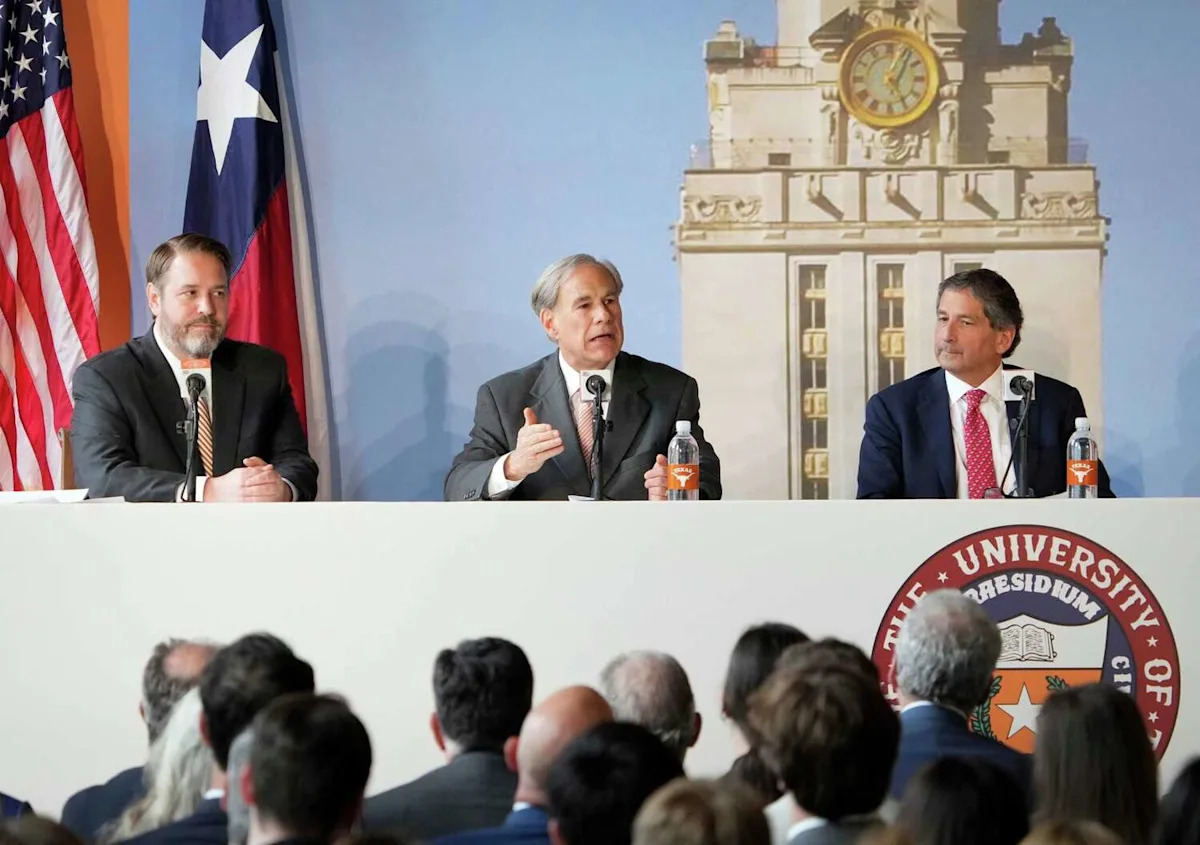
A lot has changed at Texas public universities this year, and under a new state law, who holds power has shifted.
Though politicians like Gov. Greg Abbott and vocal lawmakers have urged limitations on what can be taught in the classroom and called for the firings of professors for speech deemed too controversial, the power at higher education institutions rests elsewhere. Those deciding the future of Texas’ public colleges and universities are the regents appointed by Abbott.
Last session, lawmakers passed Senate Bill 37, expanding the ways a university’s board of regents can influence campus operations by reviewing core courses and degree programs, ending or curtailing the power of faculty senates and approving the hiring of top leaders.
Here’s how power flows at UT campuses now.
Who makes decisions at public universities in Texas?
The flow of power at public universities starts with the university system board of regents, run by trustees who oversee the high-level functions of one or more universities. They approve budgets, major building projects and degree programs — and pick the university president.
At the University of Texas System, the board of regents is led by Chairman Kevin Eltife, a former mayor of Tyler, Texas and conservative state senator who has served on the board since 2017.
Abbott appoints all regents, but they are confirmed by the Senate before officially taking the post. Regents serve six-year terms, and many have historically donated to Abbott, according to Texas Tribune reporting.
The board works with the chancellor, who is appointed by the board. Across Texas, three recently appointed chancellors previously served as conservative state lawmakers, including Chancellor John Zerwas, who now oversees the UT System after leading its health affairs operations for nearly six years.
UT’s board and the chancellor oversee institution presidents, who are responsible for campus operations, strategic planning, fundraising, university policy, appointing local leadership and representing the institution.
At UT, Jim Davis serves as president. He was appointed by the board last February through an alternative process that allowed the board to nominate an internal candidate without a national search or committee recommendation, sidestepping faculty input. After Senate Bill 37, Davis appointed William Inboden as his number two and UT’s chief academic officer after consulting with the board, but without prior recommendation from a faculty committee.
Both leaders were reviewed by a committee of faculty afterward, the university said, and in Davis’s case, by alumni and staff, too. Zerwas was also appointed without a national search or input from a committee of stakeholders.
The president and provost have a cabinet of leadership officials who help shape university priorities, including vice presidents of legal affairs, research and operations.
Under the president and provost, deans are appointed to oversee the vision, faculty, budget and fundraising for their individual schools for five or six-year terms. Deans communicate with department chairs, typically a faculty member appointed to represent their colleagues and provide feedback on budget needs and events.
At the University of Texas System, the board ended faculty senates at all campuses, shuttering a forum that had guaranteed faculty input in university decision making. But UT leaders have affirmed that under the principle of academic freedom, faculty still have ultimate say over their curriculum and classroom.
Davis also appointed a faculty advisory board to advise him on decisions, but the meetings are not public, and it is not clear how the board is tapped for input.
Who oversees higher education in Texas?
The UT System board reports to the Texas Higher Education Coordinating Board, which serves as the top authority for higher education in the state and a bridge between the systems and lawmakers. The higher ed coordinating board is responsible for disseminating state financial aid, rulemaking, monitoring compliance of some state laws, approving degree programs and maintaining the state’s higher education attainment data.
SB 37 also added an office of ombudsman under the coordinating board, which allows Texans to report violations of law like the state’s anti-DEI law. Universities are obligated to comply with any ombudsman investigations.
Have a question about schools in Texas? Submit it below, and our education reporters will look into it.