
Recently, The Dallas Morning News published an insightful article, “The hole in the donut is growing,” about Dallas County’s population decline. For those of us familiar with all the reporting on the new jobs being added locally, learning about this decline may be stunning.
While this turn of events is unwelcome, it certainly was not unanticipated. One of the advantages of the Dallas area’s economic growth is that the Dallas County Commissioners Court has been aware of the challenges in urban areas for quite some time. In addition, our staff told us a decade ago that had it not been for the phenomenal growth of our foreign-born residents, our total population decline would have started much earlier, in the 1990s.
That is why, years ago, we began taking steps to ensure Dallas County would not turn out like other areas. We developed a reputation for prudent financial management; we are among few counties nationally to have a AAA bond rating from the major rating agencies so we will be able to navigate these challenges from a position of financial strength, not weakness.
We became a major player in transportation, providing $30 million a year to cities, building new thoroughfares, expanding existing ones, creating new left- and right-turn lanes to keep us moving efficiently and helping the development of the North Texas Tollway Authority. Just like the circulatory system of a living organism, transportation is essential.
Article continues below this ad
We also recognize the importance of cultural amenities and having more sustainable development and walkable neighborhoods. While cities should lead in creating sustainable and walkable environments since they have the power to zone and to adopt building codes — a power counties do not have — we have tried to assist as much as we legally and effectively can.
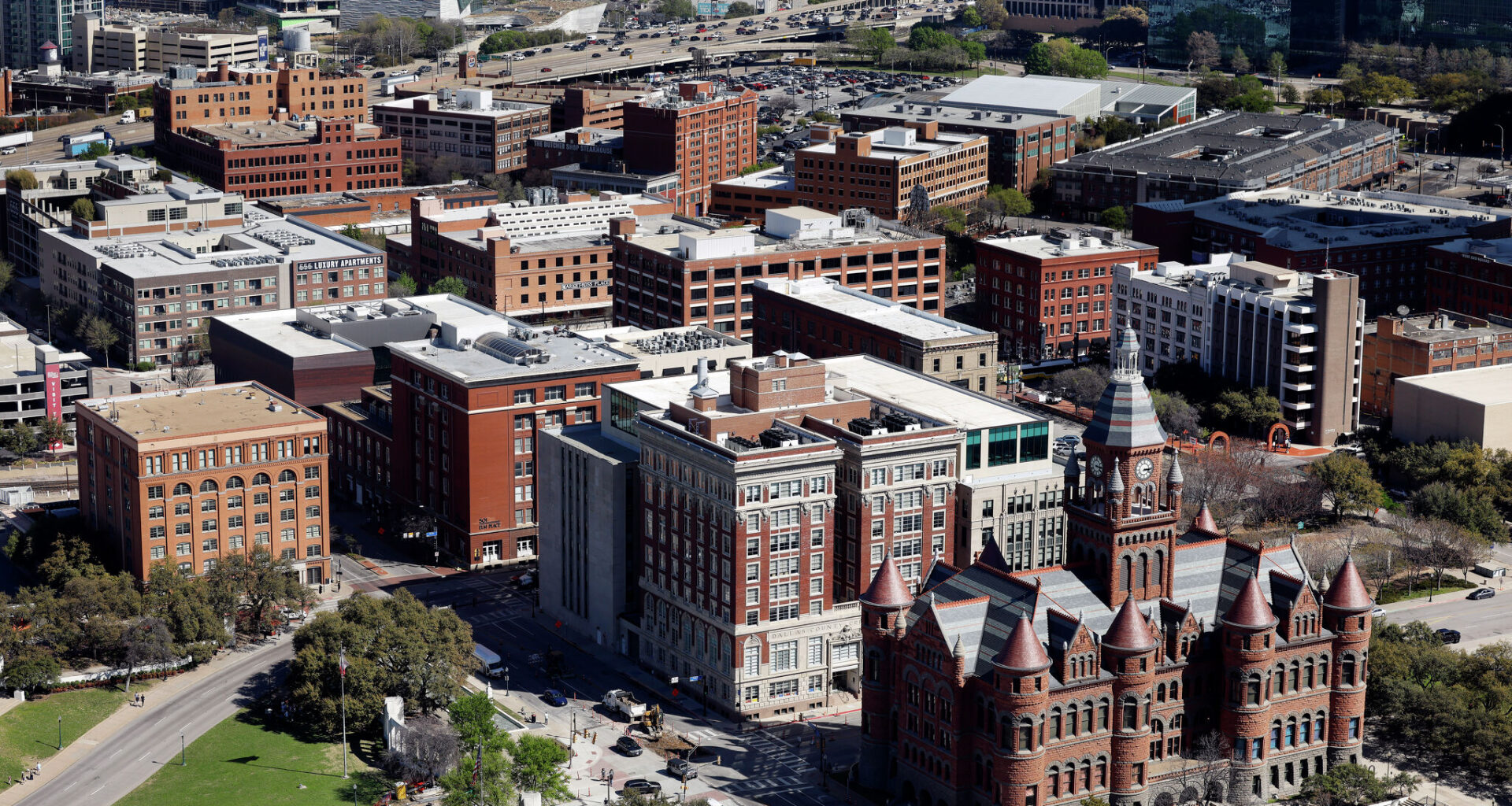
One of the advantages of the Dallas area’s economic growth is that the Dallas County Commissioners Court has been aware of the challenges in urban areas for quite some time, writes John Wiley Price. Pictured here, Old Red Dallas County Courthouse (lower right), the former Texas School Book Depository building (left) and the Dallas County Records Building (in between) are seen in the West End area of downtown Dallas last March.
Tom Fox/Dallas Morning News
We have participated in tax increment financing (TIF) districts, like State-Thomas and Cityplace, whose focus was not just on generating growth, but on creating development of a high-density nature. We have funded more than 70 miles of completed trails throughout the county, including the initial funding for the Katy Trail and fostering alternative transportation connections to destinations such as the University of Texas at Dallas, Las Colinas, the American Airlines Center and DART’s rail stations.
We participated in the original development of the Dallas In-Town Housing Program, revised our tax abatement policy to assist it and provided financing through the city’s various downtown TIF districts. When this program began in 1993, there were only 235 housing units in downtown. Today, that number has grown into the thousands.
Article continues below this ad
In the 1980s, when the county was rapidly growing, there was a concern that seemingly everything was soon going to be covered in concrete and that irreplaceable open space would be lost. In response, we began acquiring environmentally unique land and created a park system. Today, this system consists of 21 preserves with over 4,100 acres. These green spaces are typically located within 20 minutes of where most people live.
Further recognizing the importance of cultural amenities, Dallas County was instrumental in the creation of the Sixth Floor Museum. Even though only about one-third of the nation’s population was alive when President John F. Kennedy was assassinated, this museum remains incredibly popular. The Alamo is one of the few historic sites in Texas that attracts more visitors than the Sixth Floor.
There are over 30 cities in Dallas County. We are truly only as strong as the smallest of those cities. We are proud of the role that we and these cities have undertaken but we understand that, as much as has been done, our population growth has stopped. This may be inevitable, like aging. However, there is a significant difference between “being older” and “being old.”
We know we can always do more, and we know that we all have to work together, but let us use the “donut” analogy as a reminder about “being older.” It is imperative that we truly work together, even more than ever, and not revert into “us versus them,” “we were first,” “we’re not getting our fair share,” or “we’re the biggest” discussions. There is, after all, nothing at stake here except our future.
Article continues below this ad
John Wiley Price is a commissioner for Dallas County, District 3.
Have thoughts about this? Send a letter to the editor using our letters form or email letters@dallasnews.com. Letters should be no more than 200 words and include the first and last name of the writer and city of residence.