
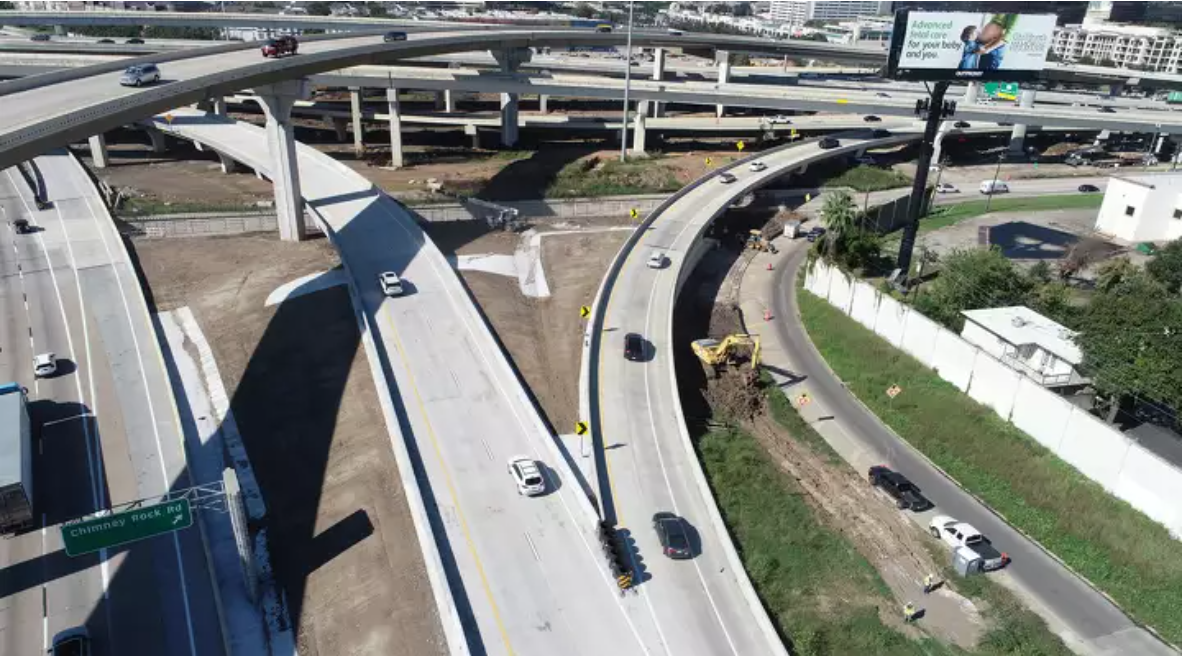
Years after the interchange project between 59 and the 610 West Loop ramp completed Houston drivers still face traffic congestion heading towards the Galleria.
TxDOT
One of Houston’s busiest highway interchanges underwent nearly six years of reconstruction. But when the massive project at U.S. 59 and Interstate 610 reopened, many drivers were left wondering what exactly had changed.

Some called the $260 million overhaul an “apparent waste of tax dollars,” citing one glaring issue: the southbound U.S. 59 connector ramp to the West Loop remained a single lane despite its reputation as one of the area’s worst bottlenecks. Now, nearly two years after construction wrapped up, the ramp remains infamous for daily traffic backups.
Article continues below this ad
The Texas Department of Transportation (TxDOT) says the problem is less about the intersection itself and more about the surrounding traffic patterns, raising the question: could the issue ever really be fixed?
RELATED: Houston’s West Loop 610 still a nightmare after 5-year repair, drivers say
Why wasn’t a second lane initially constructed?
When TxDOT faced backlash in 2024, officials told Chron that a second lane on the U.S. 59 connection ramp to the West Loop wasn’t constructed because of right-of-way issues with the nearby Afton Oaks neighborhood and a lack of funding due to space constraints.
Article continues below this ad
“We recognize this is a major concern,” TxDOT public information officer Danny Perez told Chron in 2024. “Obviously, we would have done it if we could.”
In recent responses to Chron, however, TxDOT has emphasized a different challenge: the lack of capacity on the West Loop itself.
“I-610 West Loop, north of I-69, does not have enough lanes to receive a two-lane ramp from Downtown/I-69 Southbound,” Perez told Chron in an email. “There are only enough lanes to receive three main lanes of I-610 northbound across I-69 and two ramp lanes from I-69.”
Article continues below this ad
In other words, widening the ramp alone could create new problems downstream.
Kailai Wang, assistant professor in the Department of Industrial and Systems Engineering at the University of Houston, backed up TxDOT’s claims.
“Downstream lane capacity is extremely important,” Wang said. “Merge conditions…and overall travel demand at all intersections in the downstream is much more important than the deployment of a single ramp alone.”
It doesn’t just come down to whether TxDOT has (or doesn’t have) the space for an additional ramp lane, Wang said.
Article continues below this ad
The U.S. 59 and West Loop 610 interchange remains one of Houston’s most notorious traffic bottlenecks nearly two years after a $260 million overhaul.
TxDOT
“The key question is not only whether a second ramp line can physically be built or designed, but whether the surrounding freeway systems…can safely and efficiently observe that additional traffic flow,” Wang said.
The UH engineering professor said adding a second ramp lane might not even solve the problem.
“Interchange design is usually much more complex than simply adding another line at one specific location,” Wang said. “Adding additional ramp lines…may simply shift the bottleneck further downstream rather than fully (eliminating) the congestion.”
Article continues below this ad
Would TxDOT ever consider another fix?
For the thousands of Houston-area drivers who crawl through the interchange every day, the obvious question is whether relief is coming. The answer appears to be: maybe someday, but not anytime soon.
“We will continue to look at ways to improve traffic flow for those that would consider taking the I-69 southbound connector to I-610 northbound to get to their destination,” Perez told Chron. “This might be finding ways to move traffic more efficiently along the I-610 West Loop northbound especially in the lanes that the I-69 southbound connector ramp to I-610 northbound feed into or (possibly) a future ramp project at the location.”
Article continues below this ad
However, Houstonians who drive through this corridor regularly shouldn’t hold their breath. TxDOT continues to say any potential fix would be far into the future.
“Currently, there are no efforts underway to do so,” Perez said.