
FIFA is coming to Houston and nonprofits are airlifting dogs to other cities. Houston’s stray crisis is that bad. Even after our visitors leave, we should have streets where it’s safe for people to walk, unafraid of roaming dogs.
Houston Chronicle
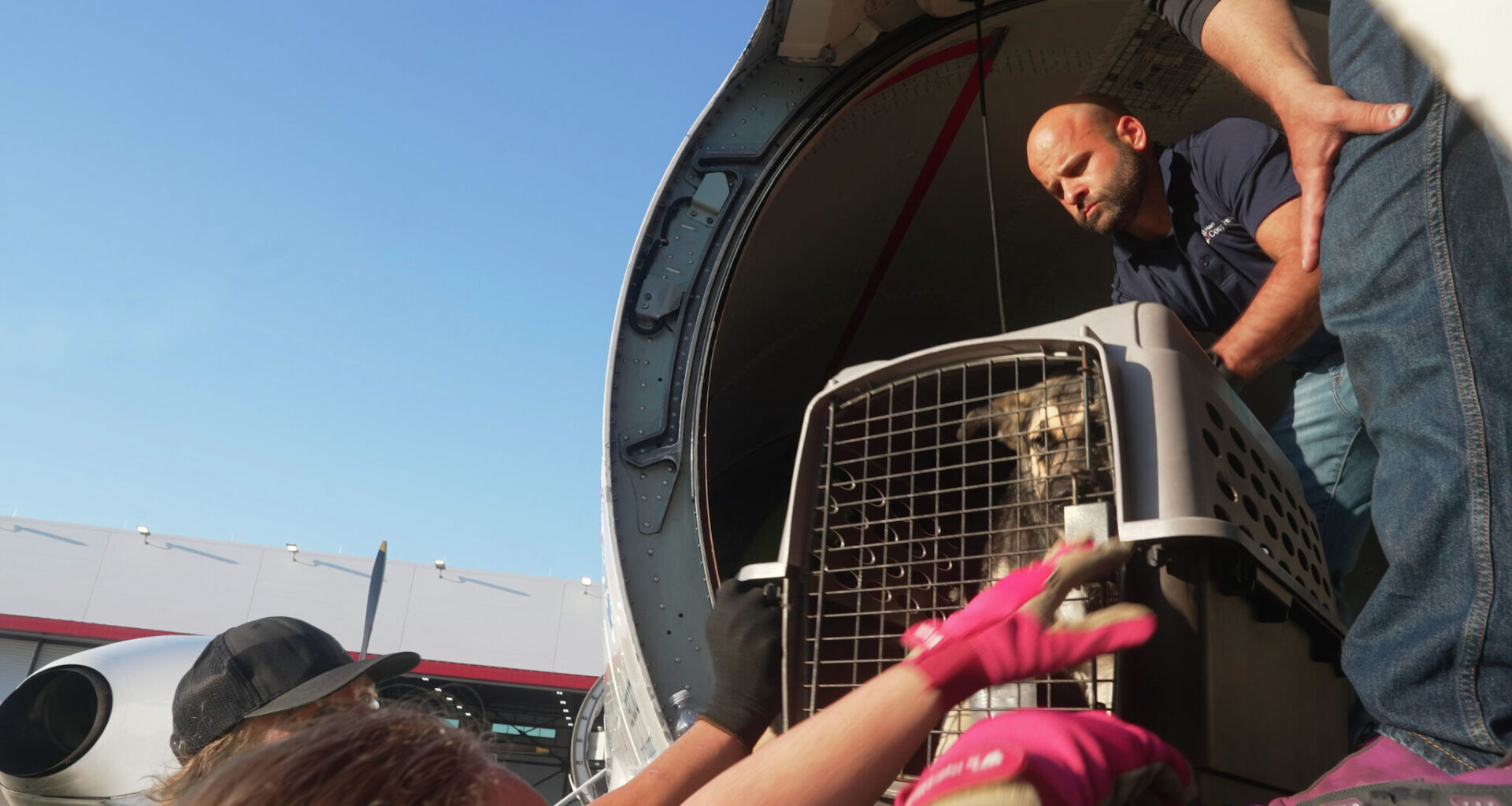
In mid May, only weeks before World Cup games start in Houston, a weary group gathered at dawn, hoisting crates, one by one, onto a tarmac at Hobby Airport. The contents: terrified puppies and cats bound for a flight to Minnesota, a state with a greater demand for adoptable pets.
Tama Lundquist, co-president of Houston PetSet, pressed her hand against the metal door of a cage. “God bless you, honey,” she whispered to the whimpering puppy inside. “God bless you. All your good days are ahead of you.”
Because of severe dog and cat overpopulation here, Houston’s shelters are in a constant state of crisis. Our warm weather means animals can breed year-round, and there is no harsh winter freeze to reduce their numbers. Every year, they export thousands of stray animals to cities where it’s easier to find homes for the animals. But usually the dogs and cats are loaded onto crowded buses, not a turboprop cargo plane.
Article continues below this ad
Corey Steele, director of Veterinary Public Health at Harris County Public Health, helps move a crated puppy into a turboprop plane chartered by Wings of Rescue, a nonprofit best known for flying at-risk pets out of disaster areas. Houston PetSet, along with five local rescues, coordinated an animal transport with Wings of Rescue on May 14, 2026 at William P. Hobby Airport in Houston, TX. They airlifted 160 dogs and cats from across the city to receiving shelters in Minnesota.
Sharon Steinmann/Houston Chronicle
For today, though, Wings of Rescue, a nonprofit best known for flying at-risk pets out of disaster areas, had donated this $30,000 charter flight to St. Cloud, Minn. Houston PetSet, six local rescue groups and Harris County Pets brought 160 animals from across the region.
The hardworking nonprofits were scrambling to make Houston’s stray dog crisis — a public safety risk and one of Houston’s biggest shames — less visible to the World Cup’s visiting soccer fans. With these animals out of Houston’s shelters, there’d be room to take even more dogs off the street.
The frantic doggy airlift was, everyone knew, a small, temporary solution to one of the city’s long-standing challenges. But it seems that Houston can only rouse itself to move fast on animal welfare and human safety when we’re expecting company.
Article continues below this ad
A crisis getting worse by the day
BARC, Houston’s city animal shelter, rounds up a pack of stray dogs in Fifth Ward on February 29, 2024.
Sharon Steinmann/Houston Chronicle
There’s never been an official count of our region’s stray dogs, but rescue groups estimate the number to be in the hundreds of thousands. Across the East End, Fifth Ward, Third Ward and Sunnyside — neighborhoods near World Cup activities and FIFA Fan Fest locations — packs of stray dogs are a fact of daily life.
“This city has had our share of maulings. I think I counted 12 since the end of December of ’25,” said Shannon Parker, executive director of Houston Pets Alive.
Even quiet suburbs are struggling with the problem. In December, a man in his 60s was mauled to death by a pack of three dogs along the Mason Creek Hike and Bike Trail in the Morton Ranch area.
Article continues below this ad
Three years ago, I met Barrio Dogs founder Gloria Zenteno to talk about our city and county’s failure to address this unrelenting public safety threat . Her Greater East End nonprofit does community outreach through spay and neuter events, education and advocacy. She took me to Mason Park, where we saw half a dozen loose dogs. A tired German Shepherd circled us, begging for attention, and a husky puppy was running in the street. Zenteno says the situation is even worse now.
Gloria Zenteno, president of Barrio Dogs in Houston’s East End, talks to a stray German Shepherd in Mason Park in September 2022.
Sharon Steinmann/Houston Chronicle
“I would love to say that it’s gotten better,” she sighed, “but it really hasn’t.”
A week after the airlift, I watched one of Zenteno’s volunteers, Danna Fullen, a retired radiation therapist and expert trapper, patiently try to catch a pit bull mix roaming a strip mall at Navigation Blvd. and North Paige St., just a mile from the FIFA Fan Fest area. For nearly two hours, as mall customers walked past, Fullen tried to coax the dog with jerky and treats.
East End resident Jimmy Pizzitola, on his way into Stellar Bank, managed to get within a few feet of the dog and even made eye contact. But the dog was already spooked, and Fuller worried he might run into traffic. She called it quits. She would try again another day.
Article continues below this ad
“Once these dogs are out here, they may not start out as aggressive,” she said. “But eventually they have to learn to protect themselves, protect their food sources, protect their areas. And that’s when it becomes dangerous for people.”
Two days later, with the help of an officer from BARC, Houston’s animal control agency, and a tranquilizer dart, Fuller was finally able to capture the dog. Now his name is Palmer, and he’s in the care of Barrio Dogs.
It was a tiny success, a little bright spot inside a whole lot of bleakness. Houston’s nonprofits are working hard to respond to our stray-dog crisis, taking care of one animal at a time. But they’re never going to catch up without local government. There’s always going to be another dog that needs a home.
Half what other Texas cities spend
Houston PetSet, along with five local rescues, coordinated an animal transport with Wings of Rescue on May 14, 2026 at William P. Hobby Airport. They airlifted 160 dogs and cats from across the city to receiving shelters in Minnesota.
Sharon Steinmann/Houston Chronicle
Much of Houston’s problem is, plain and simple, that we don’t spend enough money. With more than 2.3 million residents, the City of Houston spends $16 million a year on animal services. That comes to roughly $6.75 per person.
Article continues below this ad
By comparison, other big Texas cities spend far more. Fort Worth spends almost $12 per capita, and El Paso, almost $14. Dallas and San Antonio both spend more than $14, and Austin spends nearly $18.
Some cities, like Dallas, have reported success lowering their stray dog population by providing free spay and neuter programs and returning loose dogs to their owners.
Houston stands out for the scale of the crisis and the woeful lack of resources.
“My work takes me to animal shelters across every corner of Texas,” said Shelby Bobosky, founder of Lone Star Humane Association based in Dallas.
“BARC is the most underfunded municipal shelter in Texas — and potentially the nation. This crisis is visible on the streets, where the stray population far exceeds any other area I have visited. BARC does a phenomenal job despite the difficult hand it is dealt, time and again.”
Houston’s chronic underinvestment has consequences. Fewer animal control officers mean slower responses to dangerous dog calls and picking up strays. Insufficient funding also means fewer free or low-cost sterilization services in the neighborhoods that need them most.
BARC did not respond to my request for comment, but the agency has reported that it continues to be overwhelmed with more than 50,000 service calls a year, including “high-priority public safety cases.” The shelter took in 22,445 animals in 2025, up 8 percent from the previous year.
BARC also reports that calls involving dangerous dogs are increasing. The raw numbers are staggering. In 2025 BARC received 10,549 priority one and 6,542 priority two calls, which include animal cruelty, neglect and bite cases. The official response rate is 98% but the reality is that many of the worst cases go unresolved.
According to BARC’s presentation last year to two City Council committees, the shelter “does not have adequate funding or space to achieve desired outcomes.”
In other words, the city’s system is failing, and the city knows it. Even if the city eventually builds the new shelter that voters approved in a 2022 bond vote, those cages will fill quickly. The dogs just keep coming.
Houston PetSet, along with five local rescues, coordinated an animal transport with Wings of Rescue on May 14, 2026 at William P. Hobby Airport. They airlifted 160 dogs and cats from across the city to receiving shelters in Minnesota.
Sharon Steinmann/Houston Chronicle
As the World Cup nears, nonprofits are doing what they can to prepare. Houston PetSet is investing more than $90,000 in efforts like the airlift and to erect soccer-themed billboards that show photos of scared street dogs.
H-E-B also donated $15,000 to support the work. “As Houston prepares for the World Cup, we have a chance to show the strength and compassion of our community,” said Lisa Helfman, H-E-B’s Houston public affairs director. “Addressing animal homelessness is essential to creating safer, healthier neighborhoods.”
She’s right. But compassion without policy is not a solution.
Houston cannot billboard its way out of a stray animal crisis. We cannot transport enough animals out of state to offset years of underfunding and unchecked breeding. And we cannot claim to be fully prepared for the world stage while relying on nonprofits to quietly manage a humanitarian and public safety crisis the city itself has failed to control.
Houston’s 2027 budget process is underway right now. The final vote is scheduled for June 10. Residents still have time to speak at public meetings and contact council members to urge them to increase BARC’s budget.
When the world comes to Houston, by all means let’s make ourselves pretty with flowers and murals. But even after our visitors leave, we should have streets where it’s safe for people to walk, unafraid of roaming dogs.