
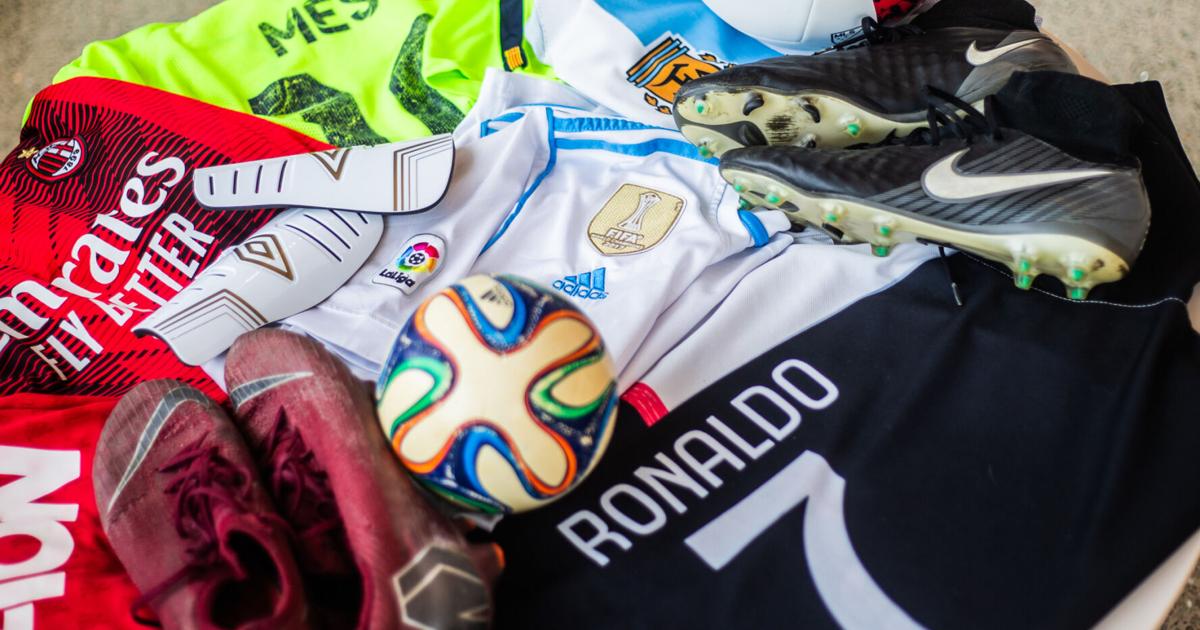

Most authentic soccer jerseys are priced over $100, whereas most replicas cost less than $100. Soccer Post store manager Charlie Butler said he’s seen an increase in soccer gear prices.
Like most sports, soccer requires essentials: shin guards, cleats, jerseys and a soccer ball. Except now, some of these items have become luxuries that casual fans may shy away from.
Jerseys are commodities for some, and are one of the most clear displays of fandom for any sports team. The price tag to show that love has jumped in recent years, and replicas have become more common than the authentic versions.
Soccer Post store manager Charlie Butler said what sets authentic jerseys apart is that they are licensed products made with higher-quality materials. He said these items, and every other product the store sells, have seen a price increase.
“I think prices in general are going up. I see that, especially more when you have products that don’t change,” Butler said. “I’ve done it long enough where I’ve been able to see it, it’s gone from a $10 shin guard to a $12 shin guard, to now it’s $14. So it’s the exact same product, no changes, and it goes up.”
Soccer as a whole has seen massive growth in the U.S., and with that comes pricier accessibility to watch and play. From soccer balls to boots, the booming fanbases drive in more eyes, which has allowed for unique collaborations and limited items that invite more interest.
FC Barcelona has been one of the biggest clubs to follow a trend of creating distinct kits. International artists such as Travis Scott, Drake, Rosalía, Karol G, The Rolling Stones and Coldplay have been featured by the team as part of a sponsorship deal with Spotify, which launched in July 2022, according to the FC Barcelona store website.
These special kits are considered “ultra exclusive,” and some have reached prices in the thousands. Regular jerseys, while sitting in much more comfortable ranges for fans, have seen a jump over the past decade alongside the introduction of these types of collaborations.
For the 2015-16 season, an adult home jersey for Manchester United could be bought for $90. That same jersey now goes for $155, according to the Man United Store website.
The price for a club’s standard replica home jersey, with no name on the back or a special crest, is reflected across the globe. If fans want to represent someone like Argentina’s Lionel Messi or have a premium UEFA Champions League match kit, they can expect to pay closer to $200 for the more distinguished uniforms.
UTA’s women’s soccer club president, Sarah Perez, said because of prices like these, only a couple out of the dozen jerseys she owns are genuine. She said the authentic Mexico jersey she bought stands for more than a shirt; it represents her family and culture.
“I’ve always gone there [Mexico], with traveling and everything, with my family,” Perez said. “It’s like a part of me, so I would spend some money on it because it is something important to me.”
Information systems senior Eduardo Hernandez has played soccer his whole life and said the sport is a big part of who he is and what his community is built on. He said he didn’t always buy jerseys, but since high school, he now has three authentic jerseys and a bunch of replicas.
Hernandez said there is a purpose for both kinds of kits. He said he would not want to play pick-up with his friends in one of his nicer jerseys because he cares more about those and would rather represent his teams with cheaper versions when on the pitch.
“You can tell there’s definitely a quality difference between authentic jerseys and the non-authentic ones, I agree with that. So I can see why the price difference is there,” he said. “I care more about the quality, authentic ones, so I wouldn’t want to risk tearing it or getting it dirty or anything.”
@kaleivie_