
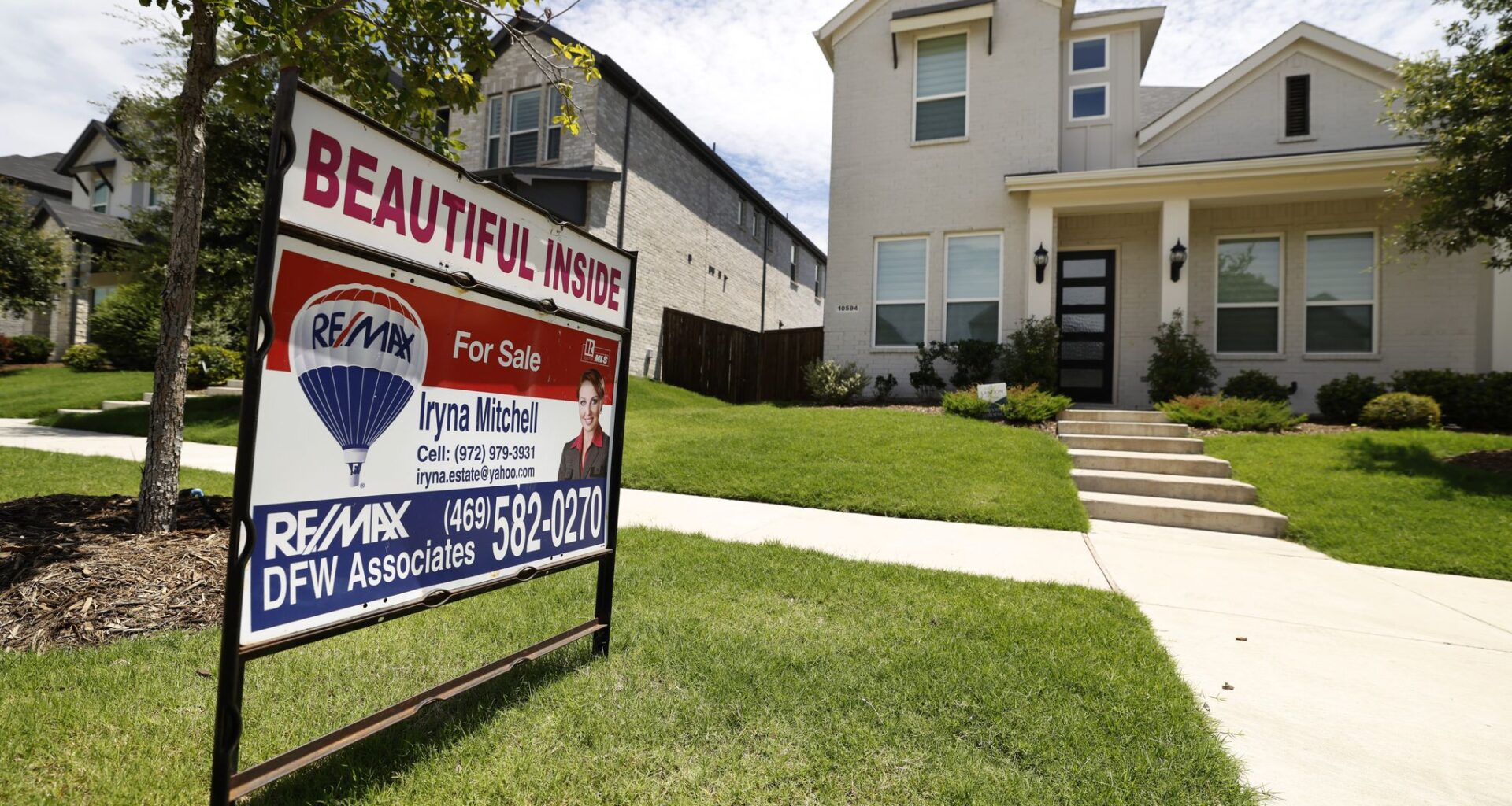
A home listed for foreclosure on Prairie Rose Rd in Frisco, Texas, May 30, 2026.
Tom Fox/The Dallas Morning News
Burgeoning affordability pressures in the North Texas region have pushed foreclosure filings to a six-year high, according to the latest numbers from property data provider ATTOM.

Recent first-time homeowners may be more likely to feel the squeeze, according to real estate experts, who attribute the rise in foreclosure activity to a normalization of the housing market amid increasing homeowner costs.
Foreclosure filings increased by more than 32% in North Texas
Article continues below this ad
In the first four months of 2026, owners of more than 2,700 properties in Collin, Dallas, Denton and Tarrant counties filed for foreclosure. This is nearly a third more than the number of filings in the same period last year.
While the bulk of foreclosures were filed in Dallas and Tarrant counties, the rate of increase is especially noticeable in Collin and Denton counties where filings for this period jumped 44% and 180% respectively compared to the previous year.
“Most of today’s foreclosure activity is being influenced by affordability pressures, higher borrowing costs, inflation-driven strain on household budgets, and localized economic stress,” said Rob Barber, CEO of ATTOM.
Article continues below this ad
He shared that the April foreclosure rate in the Dallas-Fort Worth region of one filing per 3,421 housing units was slightly better than the national average of one filing per 3,388 units.
Since 2019, D-FW generally moved in the same direction as the national trend, he said, falling sharply during the pandemic and rising slowly afterwards.
But since the start of 2026, D-FW has had stronger growth in foreclosure activity each month, compared to the previous year, Barber said. Filings in D-FW this April increased 28.3% annually compared to a 17.8% increase nationwide.
These counts remain a fraction of the filings recorded during the 2008 financial crisis.
“[It] suggests the housing market is continuing to normalize following the pandemic-era foreclosure moratoriums and homeowner assistance programs, rather than signaling housing distress,” Barber said.
Article continues below this ad
Foreclosures are coming off historic lows in 2020 and 2021, he added. “Unlike the last housing downturn, many distressed homeowners still have equity in their properties, which can provide alternatives to foreclosure such as selling the home before reaching the final stages of distress.”
The role of housing equity in foreclosures
Homeowner equity is the value of a home over what is owed on its mortgage. Nationwide, the typical homeowner has gained 50% housing equity over the last five years, according to Jessica Lautz, deputy chief economist and vice president of research at the National Association of Realtors. That equity is even higher in North Texas, she said, considering the region’s rapid growth.
“It would have to be someone who’s owned [their property] for a very short period of time and had an unexpected shock within that household,” she said. Because a typical homeowner would be able to sell at a profit with all the housing equity accrued over the years.
“It is unlikely that they would have to make a distress sale.
After cresting in 2022, housing prices in Collin County are down by more than 6% over the past year, according to Zillow.
Article continues below this ad
The most vulnerable owners are those who bought at the peak of the market in 2023 and 2024 with a high interest rate mortgage, according to Yanling Mayer, a housing economist at the Texas Real Estate Research Center.
“They paid a lot for their homes, and they financed at a much higher interest rate than people who were able to buy or refinance their home loans during the height of the pandemic under ultra low interest rates,” Mayer said.
Many of those more recent homeowners took on adjustable rate mortgages with the hope that rates would eventually come down, but that hasn’t really happened yet, she added.
For those who have owned a home for a while who may now be looking to sell, they’ve accumulated enough equity to pragmatically lower their selling price to make the move, said Ted Wilson, principal with Residential Strategies Inc.
Article continues below this ad
“That’s fine if you’re one of those people, but if you bought a house more recently and you have to sell now, you may find your house value is worth less than what you paid for it, and that could lead to foreclosures.”
Tougher lending standards and rising housing costs
More disciplined lending conditions than those in play during the last housing downturn are still keeping the housing market stable, according to experts.
A home that is listed for foreclosure on Plainsman Ln in Frisco, Texas, May 30, 2026.
Tom Fox/The Dallas Morning News
In the wake of the 2008 financial crisis, lending standards tightened through the Dodd-Frank Wall Street Reform Consumer Protection Act of 2010.
Article continues below this ad
“It’s harder to become a homeowner today,” said Lautz. “You have to show your income, where your down payment is coming from, that you can qualify to pay for your mortgage on a monthly basis…”
The down payment requirement has become fairly strong, said Sriram Villupuram, associate professor of finance and real estate at the University of Texas at Arlington.
“So nobody’s going to walk away unless they are having some kind of economic strain, job loss, or are suddenly in poor health or hospitalized, which is the standard reason for personal bankruptcy in the U.S.”
In addition to a personal economic shock, we are also seeing “systematic shock,” said Villupuram, as general inflation, property taxes and insurance rates increase.
According to Barber, these bills along with rising mortgage payments for homeowners with adjustable-rate loans and mounting consumer debt are also burdening for some homeowners.
“When interest rates go up, most of what you’re paying is going towards servicing the interest, and very little goes towards paying off the loan,” said Villupuram.
And for those who have overextended themselves, that leads to higher foreclosures, said Wilson.
“Foreclosures picking back up toward a pre-pandemic level absolutely has to do with these ancillary costs,” said Joel Berner, senior economist at Realtor.com,
Those tend to squeeze the most vulnerable homeowners first, he said. “People who otherwise, are just pulling things together to make their payment, when one of these things jumps up in a given year, it really makes the difference and means that they can’t afford their housing payment anymore.”
Berner emphasized it doesn’t mean the housing market is in trouble. “It’s just kind of getting back to a natural pace,” he said.
There is a pipeline of homebuyers who have been shut out because of affordability and a lack of inventory, said Lautz.
On a personal level, obviously that foreclosure would hurt the individual, she said,
“But if we think about the housing market as a whole, if that inventory was available, there would be a buyer for that home.”
This reporting is part of the Future of North Texas, a community-funded journalism initiative supported by the Commit Partnership, Communities Foundation of Texas, The Dallas Foundation, the Dallas Mavericks, the Dallas Regional Chamber, Deedie Rose, Lisa and Charles Siegel, the McCune-Losinger Family Fund, The Meadows Foundation, the Perot Foundation, the United Way of Metropolitan Dallas and the University of Texas at Dallas. The News retains full editorial control of this coverage.