
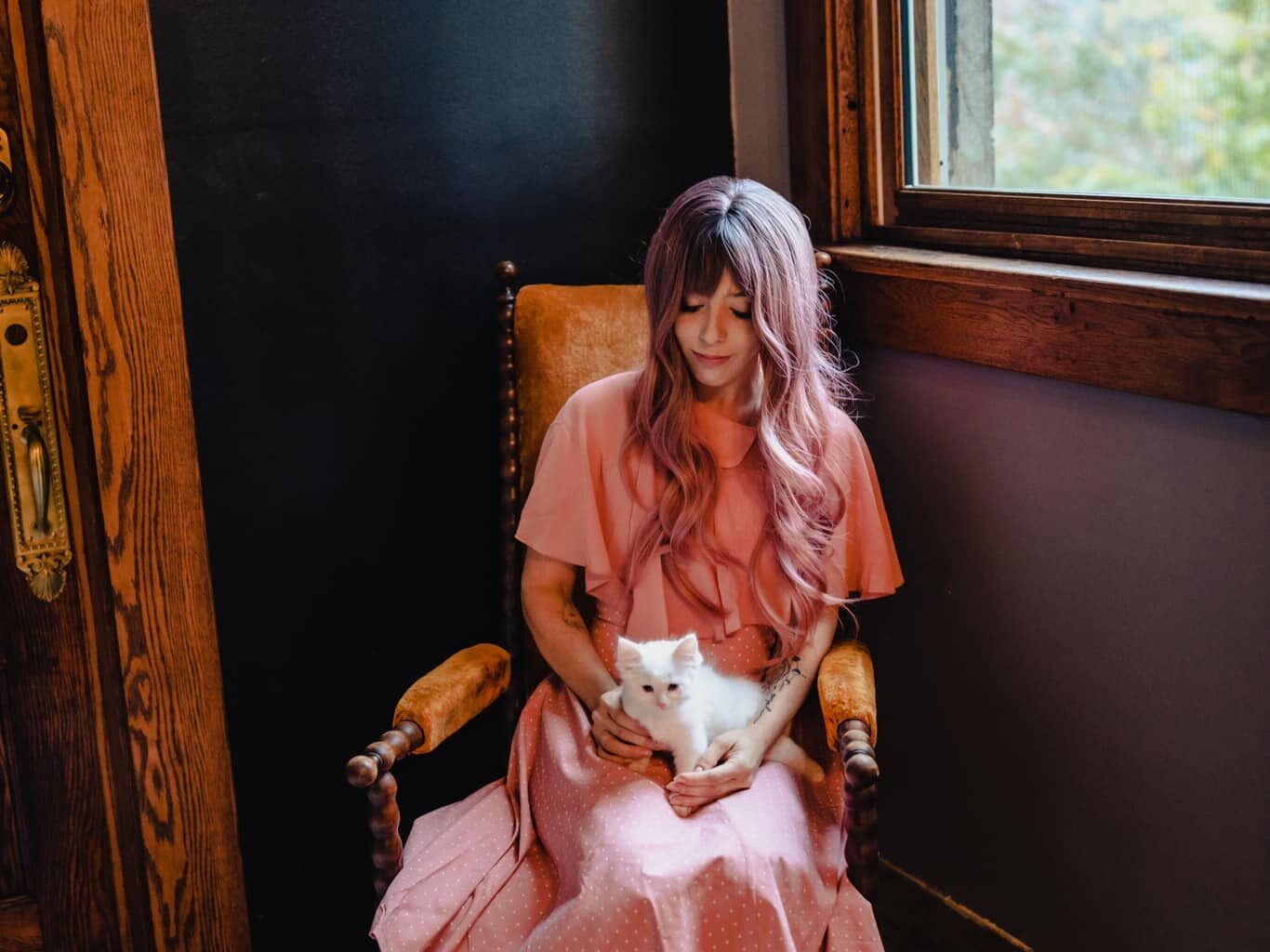
Kelly Anderson and Belle, a genetic clone of Anderson’s late cat, Chai. Anderson shares Belle’s life online through Belle the Clone Kitty, where she documents what pet cloning does — and does not — bring back.
Courtesy of Kelly Anderson
Kelly Anderson knew something was wrong before the vet walked in.

Chai, her ragdoll cat, had surgery that morning to remove a plastic deli meat wrapper she’d swallowed while Anderson was out of town. The vet said it went fine. He told her to come back in three hours to pick up her pet.
Article continues below this ad
When Anderson arrived, the vet told her staff found Chai unresponsive in her crate after surgery. She’d died at 5 years old from complications after anesthesia.
Chai, Anderson’s cat, died in 2017 after complications following surgery. Anderson later had Chai cloned through ViaGen Pets, resulting in Belle, who was born four years later.
Courtesy of Kelly Anderson
ANIMAL WELFARE: Storms send hundreds of orphaned baby animals to Georgetown wildlife center
That night as she grieved, Anderson remembered hearing about a pet-cloning company then based in Cedar Park — ViaGen Pets. She stayed up researching cloning facilities around the world. The next morning, she called ViaGen.
Article continues below this ad
Four years later, she met Belle.
Belle is Chai’s genetic clone — but Anderson is quick to make one thing clear: Belle is not Chai brought back to life.
Through her social media platforms, Belle the Clone Kitty, Anderson documents her pet-cloning journey — she’s one of a small number of people who have gone public about cloning their pets. Online, Anderson explains the process and leads discussions around misconceptions and criticism. She does side-by-side comparisons of Belle and Chai, answers questions from curious pet owners and pushes back on one of the biggest misconceptions about pet cloning.
Article continues below this ad
“You’re carrying on a piece, not the whole,” said Anderson, 36, an Austin-based social media manager. “I wanted to carry on a piece of my cat who passed away at 5 years old.”
Why did she clone her cat?
Critics of pet-cloning often ask why people don’t just adopt a new cat rather than spending money and time on cloning. Anderson isn’t anti-adoption — she’s fostered and adopted cats herself — but Chai was different, she said.
Chai was sick a lot as a kitten — she suffered from multiple infections that kept her isolated and medicated for months. Anderson later realized she’d gotten Chai from a bad breeder. The kitten grew into a shy, skittish cat who hid when anyone came over. But she loved Anderson — Chai was her owner’s shadow.
Article continues below this ad
When Anderson struggled with depression, Chai seemed to know when to comfort her owner. She found her way to provide comfort when Anderson was crying or lying in bed, her thoughts spiraling.
“She literally saved my life multiple times,” Anderson said.
Many pet-cloning advocates describe the process as cathartic. Anderson started a Facebook group for people who have cloned pets or are going through the process — around 70 or 80 people who trade stories about cloned cats, dogs and horses. For many of them, she said, the clone fills a hole left by a pet whose loss felt impossible to explain to anyone who had not experienced that kind of bond.
How much does cloning a pet cost? And how does it work?
Pet cloning remains rare, expensive and controversial. Cloning a cat through ViaGen cost Anderson — who had to take out a personal loan — $25,000 at the time; the company now charges $50,000 to clone a cat or dog, plus DNA storage fees.
Article continues below this ad
ViaGen’s process begins with a veterinarian taking small skin tissue samples from the original animal, which the company uses to grow living cells in a lab before freezing them for long-term storage.
When a client decides to clone, ViaGen uses a process called somatic cell nuclear transfer: scientists take an egg cell from a donor cat, remove its nucleus and fuse it with one of the preserved cells from the animal being cloned. If the reconstructed egg develops into an embryo, it can be transferred into a surrogate cat and carried like a normal pregnancy.
For Anderson, the process was slower than expected. She started in 2017 thinking that she might have a kitten in a matter of months. Instead, she said, ViaGen believed Chai’s cell quality may have been damaged because the cat had been frozen overnight at the vet after she died, and the embryos repeatedly failed to take.
Anderson did not meet Belle until 2021 — but she believes the wait gave her time to grieve Chai and open her heart to Belle as a new cat rather than a replacement from a time of grief.
Article continues below this ad
Kelly Anderson and Belle, a genetic clone of Anderson’s late cat, Chai. Anderson shares Belle’s life online through Belle the Clone Kitty, where she documents what pet cloning does — and does not — bring back.
Courtesy of Kelly Anderson
How popular is pet cloning?
For years, pet cloning mostly lived in the realm of science headlines and celebrity curiosity.
The first commercially cloned pet was a cat named Little Nicky, created in 2004 for a North Texas woman who paid $50,000 to clone her late Maine Coon.
Article continues below this ad
In 2018, singer Barbra Streisand revealed that two of her dogs, Miss Scarlett and Miss Violet, were clones of her late dog Samantha. Then, in 2025, football star Tom Brady announced that his dog Junie was a clone of Lua, the family dog who died in 2023.
In response to Brady’s announcement, PETA urged grieving pet owners to adopt rather than clone, arguing that a cloned dog would not inherit the original animal’s temperament or quirks. Other critics raised concerns about the cost, the use of donor eggs and surrogates, and the number of shelter animals still waiting for homes. Online, the reaction was more visceral: some commenters called the idea weird or unsettling, while others said a clone that looked like a lost pet but behaved differently might make grief worse, not better.
Anderson said the reaction to Brady’s pet-cloning news showed how unsettled people still are by the idea. The price, the ethical debate and the emotional strangeness of the process have kept it uncommon. Anderson said she hopes the process will become more normalized, but she’s not optimistic it will happen.
“I think [it’s] always only going to be a very niche amount of people that do it. I don’t think it’s ever going to become mainstream.”
Article continues below this ad
Are cloned pets the same as the original?
Belle and Chai are near-perfect genetic matches, but their personalities differ. Chai spent her kittenhood sick and hidden under a bed. Belle went to bars and breweries her first week home. Chai was introverted and clingy. Belle is outgoing and curious — an “adventure cat,” Anderson said.
Despite the social media popularity, Belle has drawn steady criticism — about adoption, about surrogate animals, about whether the industry profits from grief. Anderson says some of those concerns are fair, but she’s most concerned about how the cloning companies market themselves to consumers.
Article continues below this ad
“I don’t love the preying on grief angle of it,” she said. “It’s not fair to people to play that game.”
She tries not to sell people on cloning, instead simply trying to inform them of the version they may not want to hear: it won’t return the animal they lost.