
A delayed desal vote, curtailment plans and a newly submitted private desal proposal fueled discussion at a Corpus Christi water town hall.
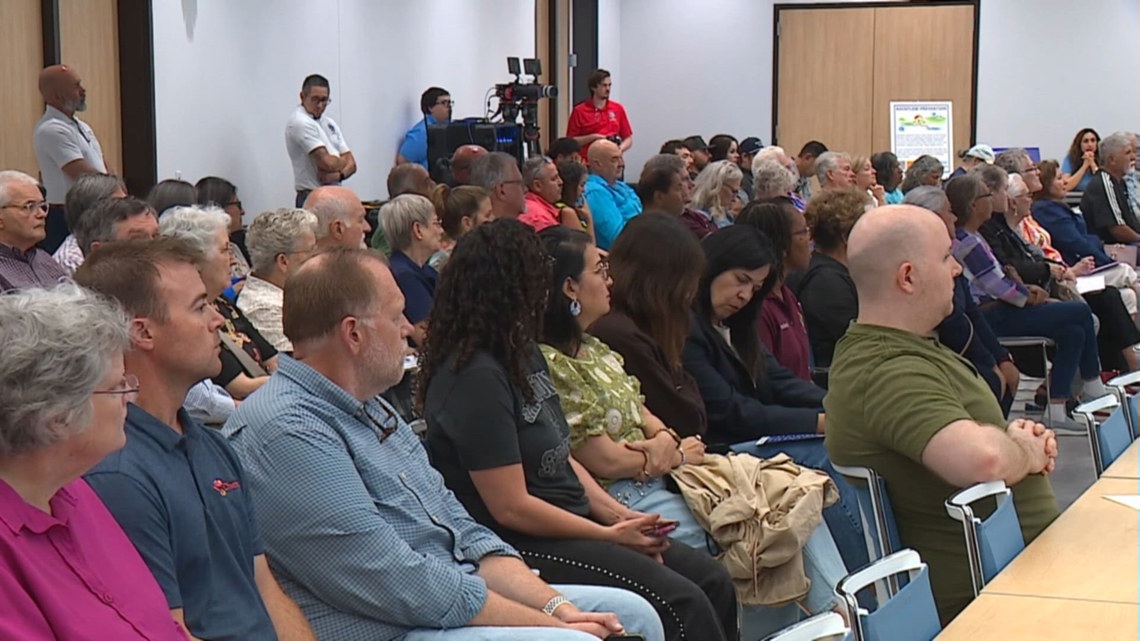
CORPUS CHRISTI, Texas — Dozens of residents gathered at Del Mar College’s Oso Creek Campus Wednesday night for the first public water meeting since Corpus Christi City Council voted to delay a decision on the proposed Inner Harbor Water Treatment Campus.
The meeting came less than 24 hours after council voted early Wednesday morning to postpone consideration of the desalination project until September following a marathon meeting at City Hall.

This story continues below.
District 5 Councilman Gil Hernandez, who introduced the motion to delay the vote, used the meeting to explain his reasoning to residents.
Hernandez said recent rainfall and several water projects expected to come online next year could provide additional time before mandatory water curtailments become necessary.
“What’s key about that is some of these projects that we’re working on will start coming online early next year, so if we can hold ourselves off until those projects come online, then we can avoid curtailment in totality,” Hernandez said after the meeting.
Hernandez also reiterated concerns about moving forward with a billion-dollar project without firm financial commitments from the city’s high-volume water customers.
“If you’re gonna borrow a billion dollars, you need to make sure you have guaranteed revenue coming in for the long term,” Hernandez said. “Those bonds are for 30 years.”
However, Corpus Christi Water Chief Operating Officer Nick Winkelmann said the city’s official projection for water curtailments remains December despite recent rainfall.
Winkelmann also addressed concerns about the role industrial growth has played in the region’s water challenges, telling attendees that local officials have not actively recruited large-volume water users in recent years.
“But I can say recently in the last few years there has been no recruitment of large volume users. We’re not in that position,” Winkelmann said.
He added that while Corpus Christi supplies water across seven counties, the city does not control where companies choose to locate.
“We provide water to seven counties in the region, but we don’t control the region,” Winkelmann said. “If there’s a company coming in that’s not in the city limits, we don’t control where they’re moving, going, or building their factory.”
The meeting also featured discussion of alternative water supply proposals.
Damon Gibson of Axe-H2O, a company that has previously pitched a privately financed desalination project to city leaders, told attendees the company has submitted a business proposal to Corpus Christi for consideration.
Gibson said the proposal would allow private investors to finance construction of a desalination facility at the Barney Davis power plant site in Flour Bluff, rather than relying on city-issued debt.
Winkelmann confirmed the city has received the proposal but said staff members are continuing to evaluate it.
“We’ve received the documentation,” Winkelmann said. “We know previously that a site had not been selected, we also know Axe H2O doesn’t have a specific agreement with the owners of the Barney Davis site, we also know Axe H2O has never built a desalination plant and we know that company was formed just recently.”
Winkelmann said city staff are reviewing all potential water projects carefully because of the long-term financial impact they could have on customers.
“We are the stewards of the rates that all of you pay and take responsibility greatly,” he said.
He also pushed back on claims that the Axe-H2O proposal would save taxpayers money, saying city analysis suggests the project could cost ratepayers more over the life of the agreement.
“We’ve evaluated that and over the course of 30 years it would cost our ratepayers an additional $500 million and not owning an asset,” Winkelmann said. “That being said all of the numbers should be vetted, none of those decisions should be taken lightly.”
As Gibson left the podium, he was met with modest applause from some audience members.
The meeting also drew residents eager to offer their own ideas for addressing South Texas’ long-term water needs.
Among them was Corpus Christi resident Leo Hernandez, who recently launched Airflow H2O, a company that builds atmospheric water generators. The systems use dehumidification technology to pull moisture from the air, filter it and convert it into drinking water.
Hernandez said the region’s ongoing water challenges inspired him to develop the concept.
“We have to look at other ways to provide good, clean, safe drinking water,” Hernandez said.
The meeting was the third in a series of community discussions focused on Corpus Christi’s water future. The next public information session is scheduled for June 24 at Moody High School Gymnasium in District 3.