
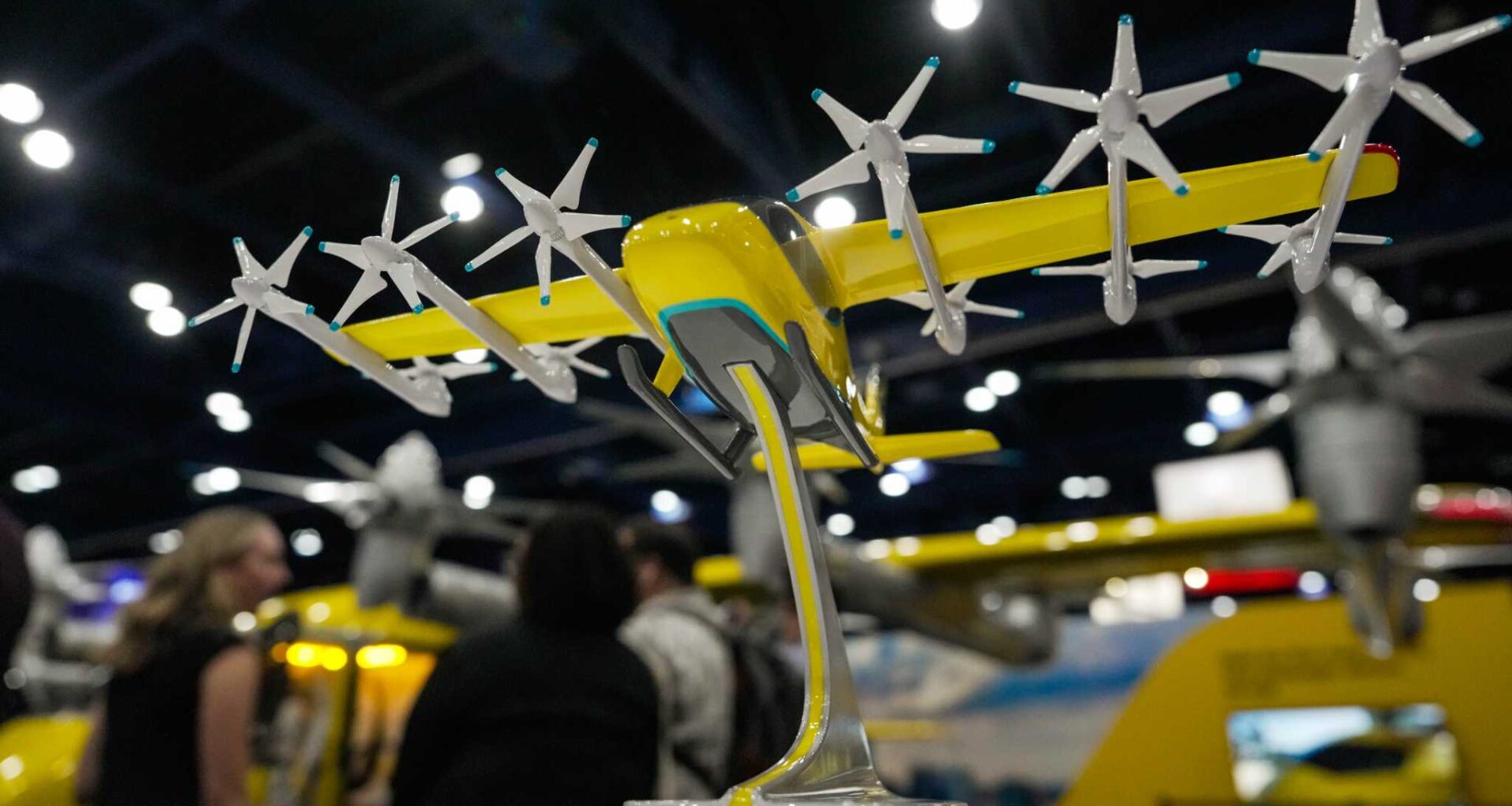
Wisk Aero showcases their fully autonomous electric air taxi at the Xponential Convention held at the George R. Brown Convention Center on Tuesday, May 20, 2025 in Houston. Companies occupying the former Kelly Air Force Base–now called Port San Antonio–are working on the next revolution in aviation: aircraft without pilots. Jim Perschbach, Port San Antonio’s CEO, told me the old airfield’s days at the cutting edge of flight are far from over as Texas takes center stage in developing automated flight rules.
Raquel Natalicchio/Staff photographer
Kelly Field, shown here circa 1925, was a training center for military aviation. Planes in the foreground are Curtiss P-1 Hawks, pursuit aircraft ordered by the Army Air Service. Today, companies occupying the former Kelly Air Force Base–now called Port San Antonio–are working on the next revolution in aviation: aircraft without pilots. Jim Perschbach, Port San Antonio’s CEO, told me the old airfield’s days at the cutting edge of flight are far from over as Texas takes center stage in developing automated flight rules.
UTSA Special Collections
Boeing 737 Max planes are seen on the tarmac at Kelly Field, Monday, April 5, 2021. Companies occupying the former Kelly Air Force Base–now called Port San Antonio–are working on the next revolution in aviation: aircraft without pilots. Jim Perschbach, Port San Antonio’s CEO, told me the old airfield’s days at the cutting edge of flight are far from over as Texas takes center stage in developing automated flight rules.
Jerry Lara/San Antonio Express-News
Army Air Corps Reserve Col. Charles A. Lindbergh, center, poses Nov. 26, 1928, with Lt. Bernard S. Thompson, operations officer at Kelly Field, left, and Capt. Arthur B. McDaniel, the Army flying field’s director of training. Today, companies occupying the former Kelly Air Force Base–now called Port San Antonio–are working on the next revolution in aviation: aircraft without pilots. Jim Perschbach, Port San Antonio’s CEO, told me the old airfield’s days at the cutting edge of flight are far from over as Texas takes center stage in developing automated flight rules.
UTSA Special Collections
A Texas Air National Guard 149th Fighter Wing F-16D departs over the runway landing lights Thursday, June 8, 2023, as it performs touch-and-go landing maneuvers at Kelly Field. Companies occupying the former Kelly Air Force Base–now called Port San Antonio–are working on the next revolution in aviation: aircraft without pilots. Jim Perschbach, Port San Antonio’s CEO, told me the old airfield’s days at the cutting edge of flight are far from over as Texas takes center stage in developing automated flight rules.
William Luther/Staff
Wisk Aero showcases their fully autonomous electric air taxi at the Xponential Convention held at the George R. Brown Convention Center on Tuesday, May 20, 2025 in Houston. Companies occupying the former Kelly Air Force Base–now called Port San Antonio–are working on the next revolution in aviation: aircraft without pilots. Jim Perschbach, Port San Antonio’s CEO, told me the old airfield’s days at the cutting edge of flight are far from over as Texas takes center stage in developing automated flight rules.
Raquel Natalicchio/Staff photographer
Nearly a century ago, Maj. William Ocker and Capt. Charles Crane developed a new piloting technique at San Antonio’s Kelly Field called “blind flying,” where the pilot relied on new kinds of instruments to navigate without needing to look out the window.
Pilots still use Ocker and Crane’s techniques when flying through clouds, fog or darkness.
Today, companies occupying the former Kelly Air Force Base — now called Port San Antonio — are working on the next revolution in aviation: aircraft without pilots.
Article continues below this ad
TOMLINSON: Texas is running out of cheap water. Will we learn from Corpus Christi?
Jim Perschbach, Port San Antonio’s CEO, told me the old airfield’s days at the cutting edge of flight are far from over as Texas takes center stage in developing automated flight rules for pilotless planes.
“The aircraft are capable of getting in and out of really dense urban environments. It’s going to require the development of modern airspace management,” he told me, standing before a model of Port San Antonio. “It’s not just these little four-passenger vertical takeoff and landing vehicles. They’ll be closer to being flying buses, with 40, 50, perhaps 60 passengers.”
Port San Antonio wants to be where that future becomes reality.
Article continues below this ad
A Texas testbed
Transportation Secretary Sean Duffy chose the Texas Department of Transportation to help develop these new rules through the Electric Vertical Takeoff and Landing Integration Pilot Program. Public and private organizations will work out how to safely add autonomous aircraft to existing flight patterns and connect San Antonio with Houston, Austin and Dallas-Fort Worth, as well as small communities in between.
“This is a first-of-its-kind effort to safely integrate electric aircraft into U.S. airspace and puts Texas squarely in the center of the next generation of aviation as we work to improve safety and connectivity across the state,” TxDOT Emerging Aviation Tech Director Sergio Roman said in a statement.
American airspace desperately needs new rules. U.S. air traffic control remains rooted in the 1970s and can barely keep up with current demand, let alone delivery drones or electric vertical take-off and landing air taxis known as EVTOLs.
“We still have, I think, some real reliability risk in the system because we’re running off of 1970s and ‘80s computing power, compact discs. It’s crazy what the system is using today,” Federal Aviation Administration Administrator Bryan Bedford told CBS News. “We have 313 FAA facilities and each of them are essentially running off Compaq computers. … It works, it’s reliable, it’s safe, but it’s not efficient.”
Article continues below this ad
A Boeing-backed startup operating at Port San Antonio, SkyGrid, is leading the efforts toward the development of what are called automated flight rules.
“There’s visual flight rules, you fly by looking out the window, then instrument flight rules, which interestingly enough, were developed here in San Antonio by Ocker and Crane in the 1930s,” Perschbach said. “Automated flight rules you can think of as being like drivers’ aids that you have on a car.”
SkyGrid is developing more precise systems that share data between individual aircraft as well as with air traffic controllers. The company hopes to automate decision-making and create predictable aircraft behavior, whether a pilot or a robot is in command.
Unicorn airfield
This new equipment will require full scale tests in a realistic environment. Perschbach wants to make Port San Antonio a primary test site.
Article continues below this ad
“We share with the U.S. military Kelly Field, which has all the capabilities of a big international airport but doesn’t have commercial service coming through it,” he said. “People all around us are using cell phones and microwaves and radios and creating signal interference with a location being very, very close to the urban and suburban environments.”
Kelly can close its airspace without disrupting airlines or commercial planes and safely test automated aircraft using new technology within Port San Antonio’s boundaries, he added.
“You’ve got the ability to test, develop the use case, the business case and the data that the regulators are going to want to look at before they start allowing this to be exported out to more and more complex airspace,” Perschbach said.
I remember visiting friends at Kelly Air Force Base in the 1980s when I was in the U.S. Army. During my recent visit, I was sad to see the boarded-up Air Force buildings and decrepit hangars from a bygone era.
Article continues below this ad
Turning the former base into a sandbox for pioneering the next generation of aircraft strikes me as a continuation of the roles of San Antonio and Texas in aviation history. Hopefully one day soon, San Antonians will see exciting new planes flying in and out of the base, just as they did last century.
Award-winning opinion writer Chris Tomlinson writes commentary about money, politics and life in Texas. Sign up for his “Tomlinson’s Take” newsletter at houstonchronicle.com/tomlinsonnewsletter or expressnews.com/tomlinsonnewsletter.