
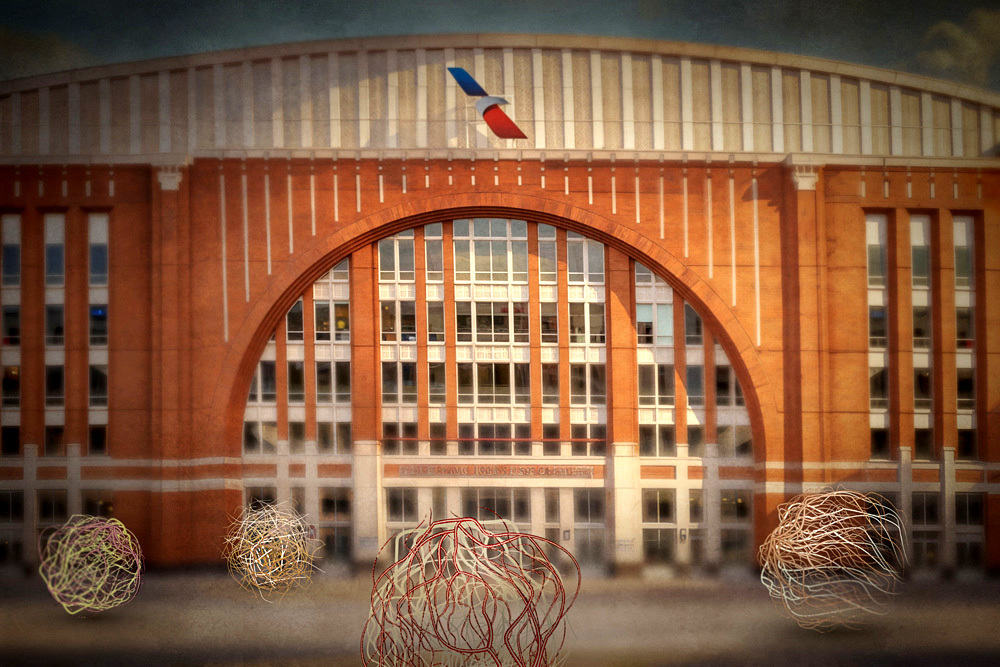
The Mavericks and Stars are planning to leave the American Airlines Center when the lease expires in 2031.
Michael Hogue/Staff Artist
On the one hand, this is a story of nothing more than two sports teams — check that — two local real estate companies that include a sports team in their portfolios moving to the greener pastures of Valley View Mall (hey, I helped open that place in the summer of ‘75!) and Plano. On the other, it feels like the death of downtown Dallas, which was mostly on life support, anyway, but now headed for something uglier and worse with AT&T, the Mavericks and Stars all running out the door as fast as they can.

One local Dallas Morning News story mentioned Dallas will now lead the country in vacant office space downtown. Good to be first in something.
Let me say right off the bat: I recognize that I am not the demographic that the Stars and the Mavericks are hoping to please by escaping the confines of downtown (or Uptown) and fleeing to the suburbs. That doesn’t mean I can’t explain why this is going to be a regrettable mistake and one that a lot of sports fans younger than myself will loathe as time goes by.
Article continues below this ad
But let’s start at the beginning. I was a child of the suburbs (Richardson, just north of Arapaho) who longed to attend NBA games, but the best I could do was ride with my older brother to Memorial Auditorium or, later, Moody Coliseum to see the ABA’s Chaparrals. Keep in mind that if Dallas had done a better job with that franchise, we might all be watching the Chaps prepare for their sixth NBA title. By the time they were set to escape for San Antonio, Dallas had them playing in Loos Fieldhouse.
We got our hockey fix going to Blackhawks games at State Fair Coliseum. If you had told 12-year-old me that Dallas would even have NBA and NHL franchises (and a couple of championship banners), I would have been fine with them building arenas in Sherman.
But why does Dallas have to do everything backward? Why always so late to the scene? The rush to the suburbs happened last century, when crime rates were higher and cities were scarier places to be searching for your car late at night.
Article continues below this ad
But it failed in Richfield, Ohio. Now the Cavaliers play in downtown Cleveland right alongside the Browns and Guardians. It failed in Auburn Hills and Pontiac, Mich. Has any city in this country taken the beating that Detroit took between, say, the 1967 riots and the turn of the century? Look at where all four Detroit teams play now.
There is no more lifeless place than the Meadowlands in New Jersey. To go see NFL teams there, well, that’s only eight or nine games. But the Nets moved to Brooklyn (gentrification run amok, now in some ways more expensive than Manhattan) and the Devils settled in, of all places, downtown Newark.
The inner city of Washington, D.C., has ranked right along with these others on the disparaged list over the last 30-40 years. Yet Capital One Arena, four years older than the AAC, is undergoing drastic improvements and major upgrades so that the Capitals and Wizards can continue to play there.
The Mavs’ Western Conference rivals are going the opposite direction. Oklahoma City is constructing a new arena even more centrally located than the Thunder’s current building. The Spurs are moving back downtown after being several miles removed since 2002.
Article continues below this ad
Storm clouds pass over the American Airlines Center in downtown Dallas, Wednesday, June 3, 2026.
Angela Piazza/The Dallas Morning News
The Stars point to one model — the Atlanta Braves and the entertainment district they built — that supports its move out of the inner city. So there’s one place this is working. But what is it exactly? Whether it’s the Mavericks’ Rick Welts or the Stars’ Brad Alberts, the fan experience they mostly describe is anything that doesn’t involve actually watching the teams play — elegant dining (i.e. much higher priced), Instagram-friendly (not even sure what that means), fans arriving early and staying late (let’s hope they use Uber).
While I’m sure they have some creative ideas about these new venues for 2031, neither CEO says much about Plano traffic at 6:30 p.m. or the fact that no one wants to drive on LBJ at rush hour.
Rapid transit actually works for Mavs and Stars games as I see scores of fans pouring out of the DART station when I leave the parking garage. This sounds headed for post-modern gridlock at its worst, but at least Plano is already used to dealing with it. Just throw in another 20,000 people.
How does having separate arenas work in terms of drawing all the concerts and shows that teams need to be viable? And does the AAC still get anyone to play there? Maybe after Paige Bueckers and Azzi Fudd lead the Wings to a title or two, with no progress being made at the old Memorial Auditorium, they can downsize the AAC and put the best local team in Dallas.
Article continues below this ad
I suppose that’s the only happy ending for this story.
It’s not the end of the world. The Mavs aren’t fleeing to Vegas as some fans, eager to run with the latest conspiracy theory, were starting to fear. The Stars of Willow Bend has an odd ring to it, but I suppose it works for a sizable portion of the population that gave up on everything south of Mockingbird long ago.
I just went the other direction, moving from Coppell to Victory Park to be closer to two teams and work in 2007 and settling in the Uptown area 1.5 miles from the AAC 12 years ago.
The Mavericks’ pride in fulfilling a promise of staying in Dallas suggests they barely know where they are headed. The good news is that in 25 years, they’ll be looking for a new place to play. Maybe the city leaders will have figured out an actual plan for downtown by then. It kind of sucks when you can’t keep up with Newark, much less Detroit when it comes to civic ingenuity.
Article continues below this ad
On Twitter/X: @TimCowlishaw