
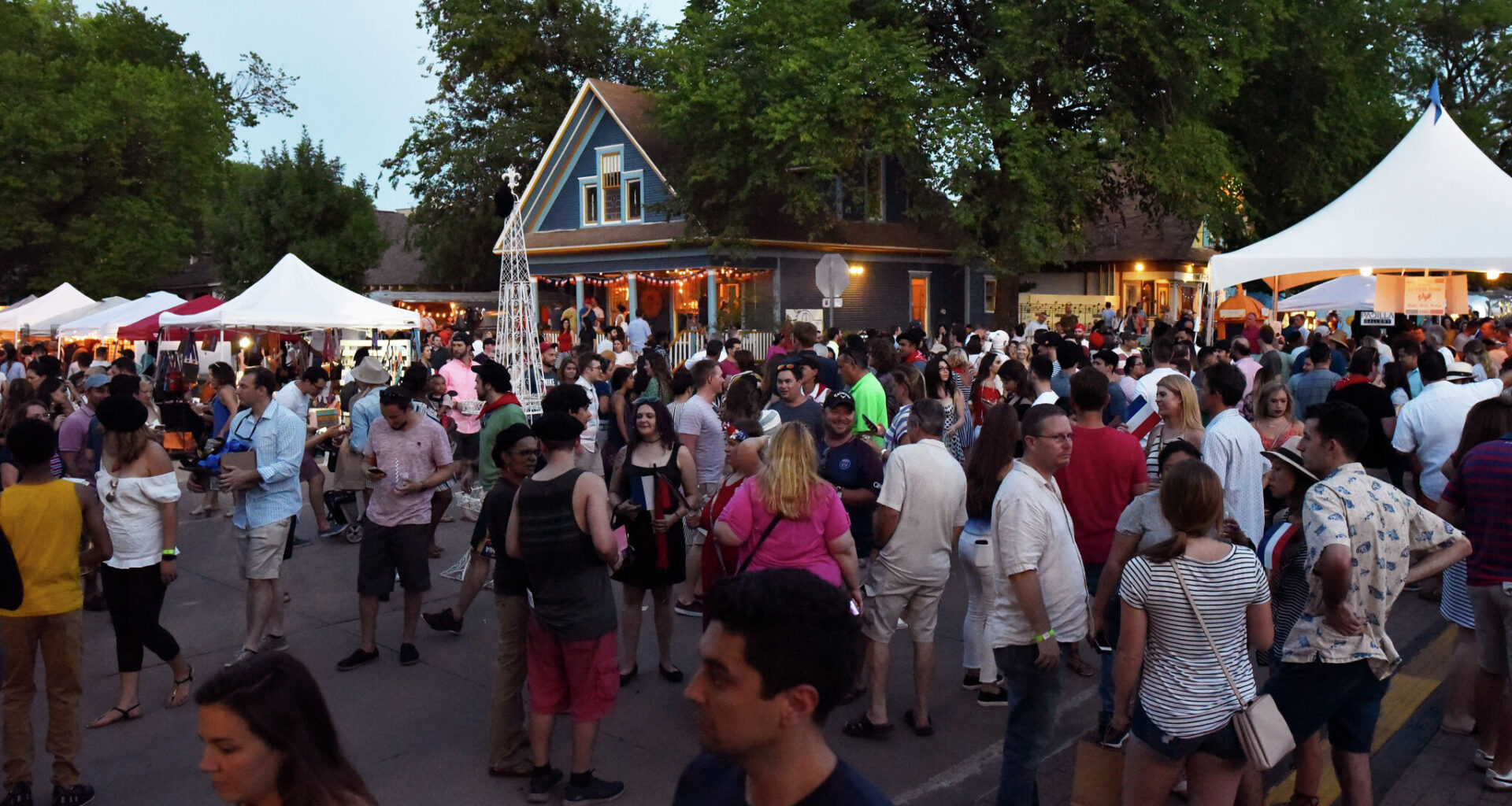
Maggie Parker argues that Dallas does not need to mimic the suburbs, but lean into our diversity of thought, people, and places. In this photo, a crowd gathers in Bishop Arts, in Oak Cliff, to celebrate Bastille Day.
Ben Torres/Dallas Morning News
I’m not sure we are getting it. We’ve seen the headlines: AT&T, Mavericks, Stars, Comerica, Neiman Marcus. I’m not sure how many more headline blows we can take. Is the narrative bad? Absolutely. Is there a reason we keep being caught flat-footed? Probably so.
Today the “we” is the city of Dallas, not City Hall as an institution. I’m talking about the 1.3 million of my fellow residents who call this 386 square miles home. Yes, we love our sports teams, and every city needs access to major job hubs, but it seems that we aren’t getting to the baseline sense of what this city needs, a little bit of Dallas-first mentality.
It’s not about comparing ourselves to Plano. I’m honestly not concerned their suburban-to-urban transition is imminent. We have to remember that most of the suburbs developed to “get away from those people” — centered on racial divides now masked as primarily perceptions, sprinkled with some realities, of safety or school choice.
Article continues below this ad
These issues are already surfacing in some of the northern suburbs with anti-Muslim sentiments and the quietly kept school closures. So, while we read the headlines, the “newness” of suburban communities eventually rubs off. It may be in the next 20 to 30-year neighborhood cycle, but there are too many examples of suburban areas looking to outpace the urban core not to anticipate their eventual decline
However, urban cores have a way of rejuvenating themselves. That should be our north star for downtown Dallas and beyond.
As a result, we shouldn’t get down on ourselves for the losses because we still have a lot of major successful anchor institutions here in downtown and throughout the city that are thriving, and we’ve put major investments into them.
Let’s not forget the $6 billion we just approved for Dallas ISD, the Dallas College transformation and the growth of the University of North Texas at Dallas. The grieving, pause and regrouping should all happen, but let’s lead into the reframe after we take some time to lick our wounds.
Article continues below this ad
We are missing the fact that one of our largest business recruiters is a regional player, with a regional focus: Plano and Frisco get the same business recruitment opportunities as downtown Dallas. And when that is the strategy, I’m not sure it’s going to be easy for Dallas to win.
An unfortunate reality is that Dallas is hard to do business in, and I can say that from my own experience as a real estate developer with a five-year process to simply start a four-year deal. I will have spent nearly 10 years of my life on one project, mainly because I love this city and I think all neighborhoods, especially in southern Dallas, deserve quality housing.
But for most business owners and developers, speed to development is what keeps the lights on. That will drive economic growth outside the urban core and to the new Oklahoma suburbs any day.
It’s time we look at the Dallas Economic Development Corporation as an existing organization that can bridge public-private partnerships and is focused on Dallas.
I think the next reframe is to understand our audience for revitalizing our city. We are a majority-minority city, trying to compare ourselves to suburban municipalities that have literally been created on the helms of white flight. I’m not sure we need to spend our energy trying to mimic the chain restaurants and the oversized parking lots either. Rather, how can we lean into our diversity of thought, people and places?
Article continues below this ad
To me it’s about cultivating what’s already here — the neighborhoods, community leaders and streetscapes. It’s about taking big swings with downtown Dallas by strategically resetting the market, while elevating Dallas culture.
Let’s take what we have and embrace it. It’s when we champion Hispanic and Muslim-owned businesses, beyond only pushing for government contracts. It’s when we stop shying away from Dallas’ Black history, and embrace the art, food and dancing that can thrive with new pedestrian-friendly and interconnected neighborhoods in downtown.
It’s the Dallas Museum of Art’s Late Night at the Museum or the weekend dance parties and family-friendly movie showings at the AT&T Discovery District plaza that are key examples of who Dallas wants to attract — diverse, vibrant crowds that continue to enjoy the city’s amenities.
It also means that small businesses and the culture scene have to be core to how we think about even downtown’s revitalization. That means some of our anchor institutions are going to have to take a new strategy on retention and attraction — for some, that looks like rethinking de-risking investments alongside local companies.
For some, these seem like unrealistic bets or too small of a swing, but at the end of the day, I’m not sure how we revive Dallas without investing in the people that call it home, and we have to lean into Dallas, first and foremost.
Article continues below this ad
Maggie Parker is founder and managing partner of Innovan Neighborhoods.
Have thoughts about this? Send a letter to the editor using our letters form or email letters@dallasnews.com. Letters should be no more than 200 words and include the first and last name of the writer and city of residence.