
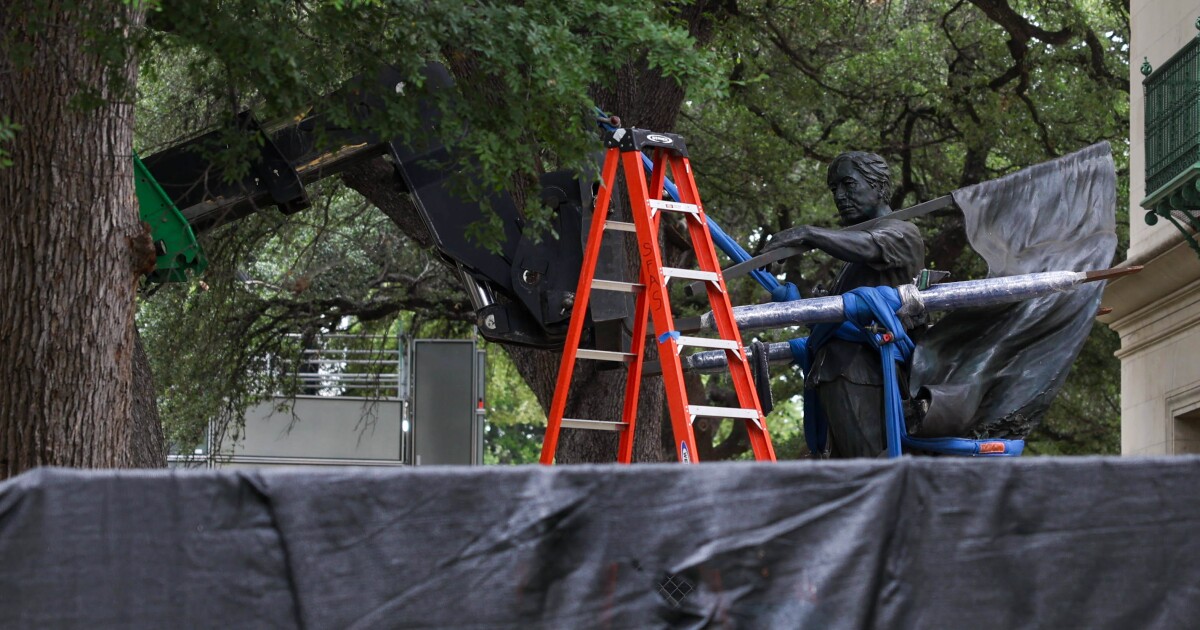
The University of Texas at Austin began removing a statue of labor rights activist Cesar Chavez on Thursday. The removal is the latest in a wave of backlash against the union leader after a New York Times investigation included allegations of Chavez sexually abusing women and girls.
The investigation sent shock waves through Austin’s Latino community and raised questions on how to continue to honor the labor movement. The Austin Independent School District canceled celebrations in his name. The city of Austin is also considering changing the name of Cesar Chavez Street. But many community members are split on whether to erase the union leader’s legacy.
When it was unveiled, the university said it was the first statue of a Latino on campus. It was created in 2007 by Bolivian artist Pablo Eduardo and installed on UT’s campus near Battle Hall.
Juan Gonzáles, a UT education professor who was involved in funding and installing of the statue, said it was erected after years of student effort to honor labor workers and Chavez’s legacy.
Gonzáles said the statue was largely funded by students and was put up at the same time as one of Barbara Jordan.
Gonzáles said it appears the university did not seek input from students or staff before removing the statue.
“I’m not in opposition of the removal,” he said. “I think there should have been an engaged conversation and debate, and I think the community, a well-standing community of faculty and students, could have come up with recommendations of how to keep honoring the current ongoing struggles of farm workers.”
UT officials have not commented on the decision to remove the statue.
The sudden removal is a shift away from how the university has approached removing controversial symbols on campus. In 2017, UT removed three Confederate statues on campus after meeting with students, holding two public hearings and deliberating with a 12-person task force.
Alfonso Ayala III, a third year doctorate student in the Mexican American and Latina/o Studies Department, said he hopes the university decides to replace the statue with one that honors the labor movement. Ayala said he has reached out to UT to ask about the rationale on why the statue was taken down and has not heard back.
“I don’t know the justification or rationale for its removal, but I do know that there are multiple things on campus that recognize the namesake of Confederate soldiers,” Ayala said. “I’m curious as to how decisions are being made on what’s remembered and what’s allowed to be forgotten.”
Mexican American and Latina/o Studies students and faculty told KUT News the university did not share its plan to remove the statue. The department is one of seven UT President Jim Davis announced will be consolidated within the College of Liberal Arts.
Karma Chávez, the head of the department, said the university did not reach out to her regarding the removal.
“But I hope they consulted members of the Chicano community before taking the statue down,” she said.
Karma said statues should honor movements instead of individuals, but it’s also important to take into account the current political context as this statue comes down.
“Though many won’t disagree with the action given what Chavez did, it can’t help but be put in a context where UT and Texas more broadly are trying to erase queer, trans and people of color from existence,” Karma said.