
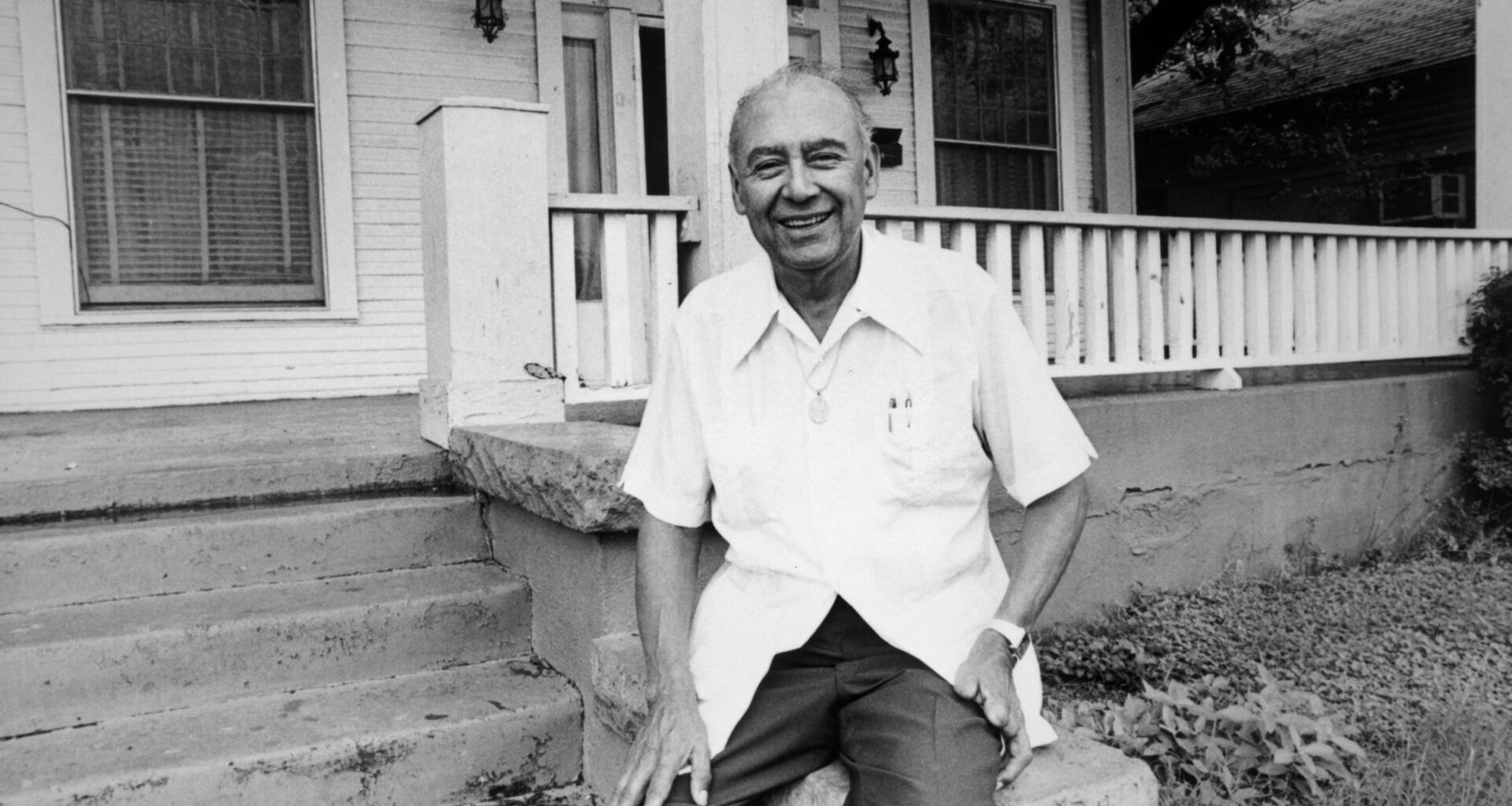
The first time I met him, he was yelling.
It was the spring of 1977, and I was looking for a better job than the one I didn’t have. I’d just walked through the side door of a two-story, white-frame house at 90 East Avenue, in Austin. Outside, half a dozen cars—painted sea-foam green with red roofs, the words “Roy’s Taxi” on their sides—awaited duty in a small dirt lot. Inside, I found a waiting room furnished with a few chairs and a card table. In the corner stood an elderly man in a white guayabera shirt, tan slacks, and house shoes, who was jabbing the stubs of his fingers into a bewildered hippie’s chest. “You drivers are just like cockroaches,” the man said. “I get rid of you, but you always come back!”
That was him: Roy Velasquez Sr. Everyone called him Big Roy—not because he was physically big, but because of his reputation as the brash, self-made owner of Roy’s Taxi, then the oldest taxi company in the country still run by its original founder. He was known for the color of his cabs, his democratic hiring practices, and operating in (and seemingly presiding over) East Austin, an area other cab companies tended to shy from.
But when I first laid eyes on Big Roy that day, I didn’t know any of this. I didn’t know how unlikely his success had been—that he’d come from nothing, working through the Great Depression, in Old Austin—and I definitely didn’t know that he was powerful enough that a United States president called him for favors.
No, all I knew was that this 67-year-old boss still had his bite. “Tell you what, bolillo,” he once bellowed at me, after I’d gotten hired. “You should go back to Tennessee and drive a mule, because you sure as hell can’t drive a car.” In his defense, I’d just crashed one of his.
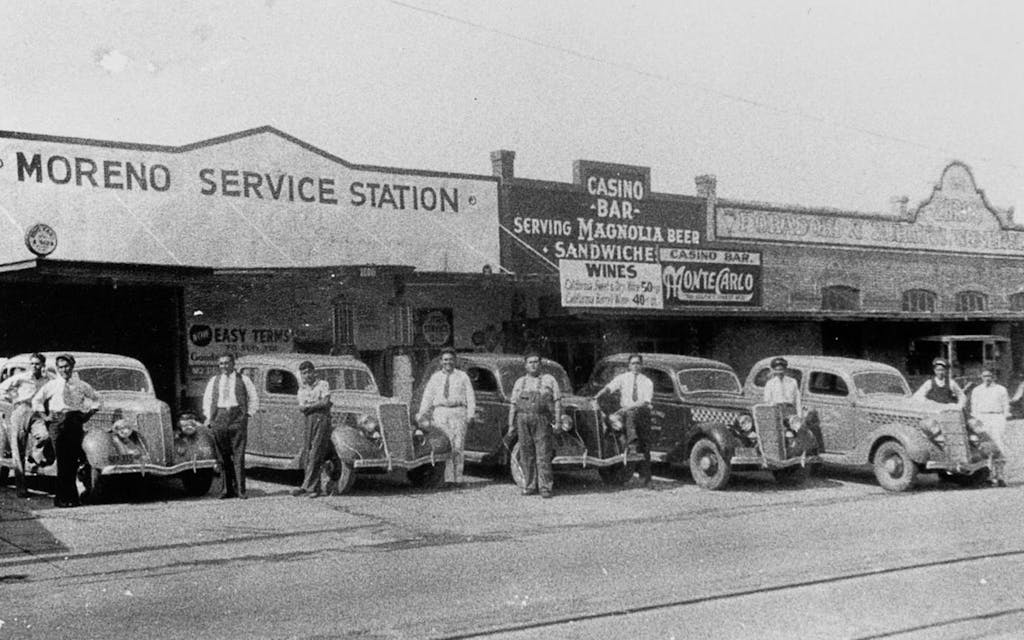 Early Roy’s Taxi cabs in front of Nash Moreno’s Auto Repair Service, in 1936.University of North Texas Libraries/The Portal to Texas History
Because we taxi drivers spent so much time driving around town, you might assume we were street smart, cool like Damon Runyon characters. It’s true that anybody who drove for Roy’s Taxi knew where to find the bookies and contraband, the after-hours booze. But that knowledge didn’t get you ahead; like any job, what mattered was hard work and a bit of guile. Roy knew that better than anyone.
He was born in 1910, in McNeil, in northern Travis County. His parents had immigrated from Monterrey, Mexico, and his father, Gilberto, worked for the Austin White Lime Company. The Velasquezes had five sons in all. Roy, the oldest, grew up riding a horse the five miles between his family home and a school in Merrilltown. (Roy’s mother had bought the horse from a neighbor, Henry Brock, who, after stabbing his wife seventeen times, earned the distinction of being the last man hanged in Austin.) One day, when Roy was fourteen, it snowed, and when he left school, he saw buzzards circling outside. The horse—his transportation—had died in the storm. His school days were over.
He joined his father at Austin White Lime shortly after. The company’s owner, A. H. Robinson, always liked Roy—he used to pay Roy a quarter to carry his suitcases to the office and seal pay envelopes. “I used the first quarter to buy a chicken and then I bought a rooster,” Roy remembered later. As with his future fleet of cabs, every time Roy got another quarter, he’d buy another chicken: “The first thing I know, I got forty chickens.” Once an official employee, his shifts were twelve hours long, seven days a week, at a salary of $4 per day. The work could be dangerous: Those stubs I saw Roy poke into a driver’s chest were the result of an exploding dynamite cap, which blew off the tips of the fingers on his left hand.
In 1927, Gilberto left White Lime and moved the family to Austin, renting a small house at 302 East Fifteenth Street. This was the same year the Austin City Council commissioned its master plan—concocted by the Koch & Fowler consulting firm—which instituted zoning laws meant to legally funnel the city’s Black and Latino citizens into East Austin. The plan went into effect in 1928, and East Avenue ultimately became the dividing line between white Austin, to the west, and the “Negro District,” to the east.
When they were instituted, Roy was working as a foreman. At twenty, in 1930, he was leading his own construction crew, but the stock market crash of the year before had slowed construction opportunities to a trickle. The Great Depression hit home for him when, that year, a Dallas company hired him and his crew for a job in Kingsland. When Roy and his team showed up, they were confronted by a local who told Roy that they better beat town by 5 p.m. or else. The belligerent man was joined by a crowd of sixty or so others armed with shotguns, pistols, and machetes. “To hell with it,” Roy decided. “I’ll drive a cab.”
Except cab companies in Austin didn’t hire minority drivers in the 1920s and ’30s. Roy applied for a job at Ten Cents Taxi, which operated thirty to forty cabs; the owner said he would scare off customers. Translation: No Mexicans. Those same companies rarely ventured into diverse East Austin—by the time I started driving, Roy’s Taxi served the whole city, but most of the cabs you saw east of Interstate 35 were still green and red. (We could make a lot of money on Friday and Saturday nights without ever leaving that area.)
That’d been true since 1931, when Roy realized there was a whole region of the city that lacked a cab service and decided to start his own company. “I had to make it,” he said of that time. “I had my mother, my father, and four brothers.” He borrowed $5 from his friend Braulio Reyes to pay for a $3 cab permit and a tank of seven-cents-a-gallon gas for his 1928 Ford Model A, which he’d bought the year prior for $450. He painted the sides green and the roof red and stenciled Roy’s Taxi in the same red on the side (a design immortalized in Richard Linklater’s Slacker). “In them days, there were so many cab companies, and all of them used some kind of tens in their name: There was Ten Cents Taxi, the Big Ten, the Ten Penny Taxi, the Dime Taxi,” he said. “So many that I didn’t have any room to get in. So I just put Roy’s Taxi.”
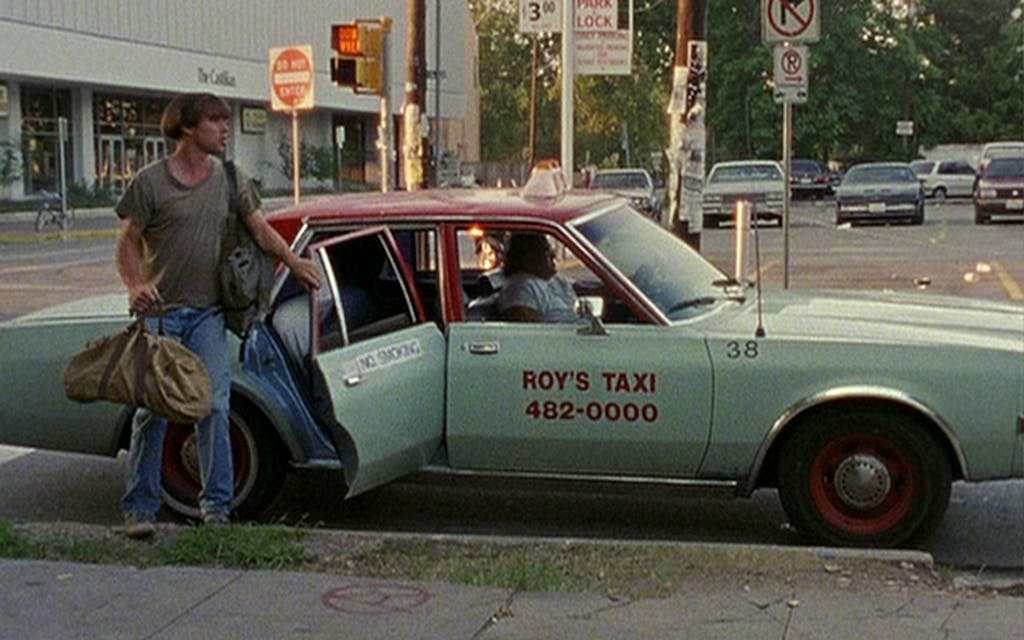 Linklater riding a Roy’s Taxi in ‘Slacker,’ his second feature film.Courtesy of Detour Film Production
Now he had a business: one car, one driver. Trolleys were then the primary form of public transportation in Austin (and were particularly relied upon by the city’s Black population, who were banned from cabs), so he steered his Model A to Sixth and Chicon—the heart of East Austin, and the end of the trolley line—to pick up where they left off. By 1932, Roy had a group of contract drivers working under him, and the trolley companies had begun to see him as a threat to their business, so Roy moved his base of operations farther from the trolley line, to Sixth and Lydia. The next year Roy moved once more, to Nash Moreno’s Auto Repair Service, on East Sixth; he ordered a telephone, bought a second car of his own and employed a driver for it, and hired his first dispatchers, who worked eight hours a day for $2.50 a week.
The end of 1933 found Roy with a fleet of more than thirty contracted cabs and at least that many drivers working under his name. Competing cabs in Austin often carried White Riders Only signs in their windows, but Roy refused to discriminate against the passengers he carried or the people he hired. In this period Roy and his brother Julius, along with Nash and Henry Moreno, founded the Austin chapter of the League of United Latin American Citizens (LULAC); his brothers maintain that, among Roy’s civic achievements, his was the first Austin cab company to hire both a female driver and a hippie.
My older riders told me stories of what Roy was like in those early days. An elderly woman from the Rosewood area said she used to take a Greyhound bus every Friday afternoon to see her mother in San Antonio, and when she came home—at the same time, every Sunday night—Roy was always idling there, waiting for her. Roy himself reminisced to Austin American-Statesman writer Cheryl Coggins in 1980 about a different sort of woman he often picked up (“the jealous type . . . she had already killed one man and gone to prison for it”), who, on one occasion, took out a gun during a ride and shot a man from the back seat. Rudy Cisneros, founder of East Austin’s Tex-Mex spot Cisco, recalled a similar instance, but with Velasquez holding the gun: Cisneros was late to pay Roy back a $5 loan, and Roy took an errant shot at him to settle the score. “We’re even,” Cisneros remembered him saying.
Of all I heard about Roy’s early days, though, the biggest revelation came on an afternoon when an older man got into my cab. It was George Christian, an Austin native who’d served as Lyndon B. Johnson’s White House press secretary from 1967 until 1969. He asked how the boss was getting along. “You had to have your jockstrap on when you dealt with Big Roy,” I remember him saying. “If he told you he would deliver the East Side vote, you could go to the bank with it. But I sure felt sorry for anybody who didn’t deliver on his end of the deal.”
Turns out, through LULAC, in the late thirties Roy was said to control the East Austin vote. That reputation didn’t escape the notice of a gangly, 28-year-old fledgling politician from the Texas Hill Country who was preparing to run for Congress. In 1937, that upstart—recently resigned from his position as state director of the National Youth Administration—made his way to Moreno’s Garage and introduced himself to Roy and Julius. It was Johnson. He said he’d seen Julius play the guitar around town and wanted the brothers to put together a band to perform at a series of his rallies in small Central Texas towns. The Velasquez brothers agreed.
“Lyndon was a man who say ‘yes’ and mean ‘yes,’ ” Roy later said. Unlikely as it was, their relationship lasted decades: Roy supported Johnson whenever he was up for an office, and in February of 1964, Johnson invited Roy to greet Mexico President-elect Gustavo Díaz Ordaz at the LBJ Ranch. “I worked for Lyndon then,” Roy said, referring to Johnson’s first congressional campaign, “and until he died.”
Come World War II many of the young men who might’ve driven Roy’s cabs went off to fight, and his business suffered. But afterward, Roy’s Taxi returned to form, and Roy moved his headquarters twice more: to 704 East Eleventh, and then, in 1957, to 90 East Avenue, where it remained.
By the early sixties Roy was done driving cabs himself, and he settled into his role as a living East Austin legend. “For three months after I retired,” he said in 1980, “if I wasn’t in a car by 5 a.m., I’d get the shakes.” Coggins asked how he spent his time now that he’d quit driving. “I look after my money,” he replied. I knew that to be true: I often heard Roy yell “Where my money?” in the garage, more as a threat than a question. He used the same tone when he reprimanded me for totaling one of his cars—I stood outside with him as a tow truck hauled the crumpled cab into the lot. Someone had rear-ended me. Roy didn’t ask for details, but he didn’t fire me either.
Roy’s Taxi owned about fifty cabs at that point, a significant brigade in a city with a population around 350,000. His army of drivers, myself among them, worked the radio—the secret was learning every street, alley, corner, and shortcut in the city—and mostly stayed away from the airport. We could describe in detail what a specific house on a particular corner looked like. We knew who lived there, where they shopped for groceries, how much they drank on weekends and of what whiskey brand. We recognized the address of every grocery store, laundromat, strip club, and state office building.
We also saw Roy less and less, and as the seventies rolled into the eighties, sightings of him were rare. With Roy’s Taxi soon to reach its fiftieth anniversary, Roy and the company found and restored a 1928 Ford Model A—a replica of the car he started with—and painted it in Roy’s Taxi colors, with a horn rigged to play the Godfather theme. And on April 5, 1981, fifty years to the day after Roy carried his first passenger, about two thousand attendees filled the Frank C. Erwin Jr. Special Events Center for an anniversary celebration.
Roy was there in his wheelchair, in a white Stetson and a cigar in hand. Braulio Reyes’s family accepted a plaque that commemorated the $5 he lent Roy. Roy’s brother Matias (Matt) Velasquez’s band played a rendition of “My Way.” Roy Ramirez, a LULAC official from San Antonio, called Roy, “the people’s champion in the barrios of the poor.” The event seemed to close a chapter in Roy’s life, and in mine. Roy died seven months later, on November 14, 1981, at age 71, right about when I started searching for what some might call a “real” job—although I still consider cab driving about as real as jobs get.
I found one eventually and left Austin for Georgetown in the mid-eighties. Under Roy’s five sons (of his and his wife Alicia Ortegon’s eleven children), Roy’s Taxi managed to survive without its founder for a few more decades, until it couldn’t. In 2006, 75 years after its founder first cruised East Austin for dimes, the Velasquez family sold its 155 permits to Yellow Cab. “Austin’s not the same,” the youngest Velasquez brother, Bobby, told The Austin Chronicle in 2006, as the sale was still pending. “The industry has gotten too big.”
The City of Austin named the Roy and Matias Velasquez Plaza in 2006; less than a decade later, rideshare companies, such as Uber and Lyft, came to town. Now, self-driving Waymos roam Austin’s streets, and taxi services like Roy’s seem leftovers of a dead era. These days, when I’m in Austin, I drive past the old haunts. The streets, lacking sea-foam green, are less colorful; East Austin is gentrified. For more than a decade after Roy’s Taxi met its end, that white, two-story house at 90 East Avenue remained standing. I liked seeing it there: a reminder of a person, a place, a stretch of time. Then one day a few years ago, I went to visit it, and it was gone.
Read Next