
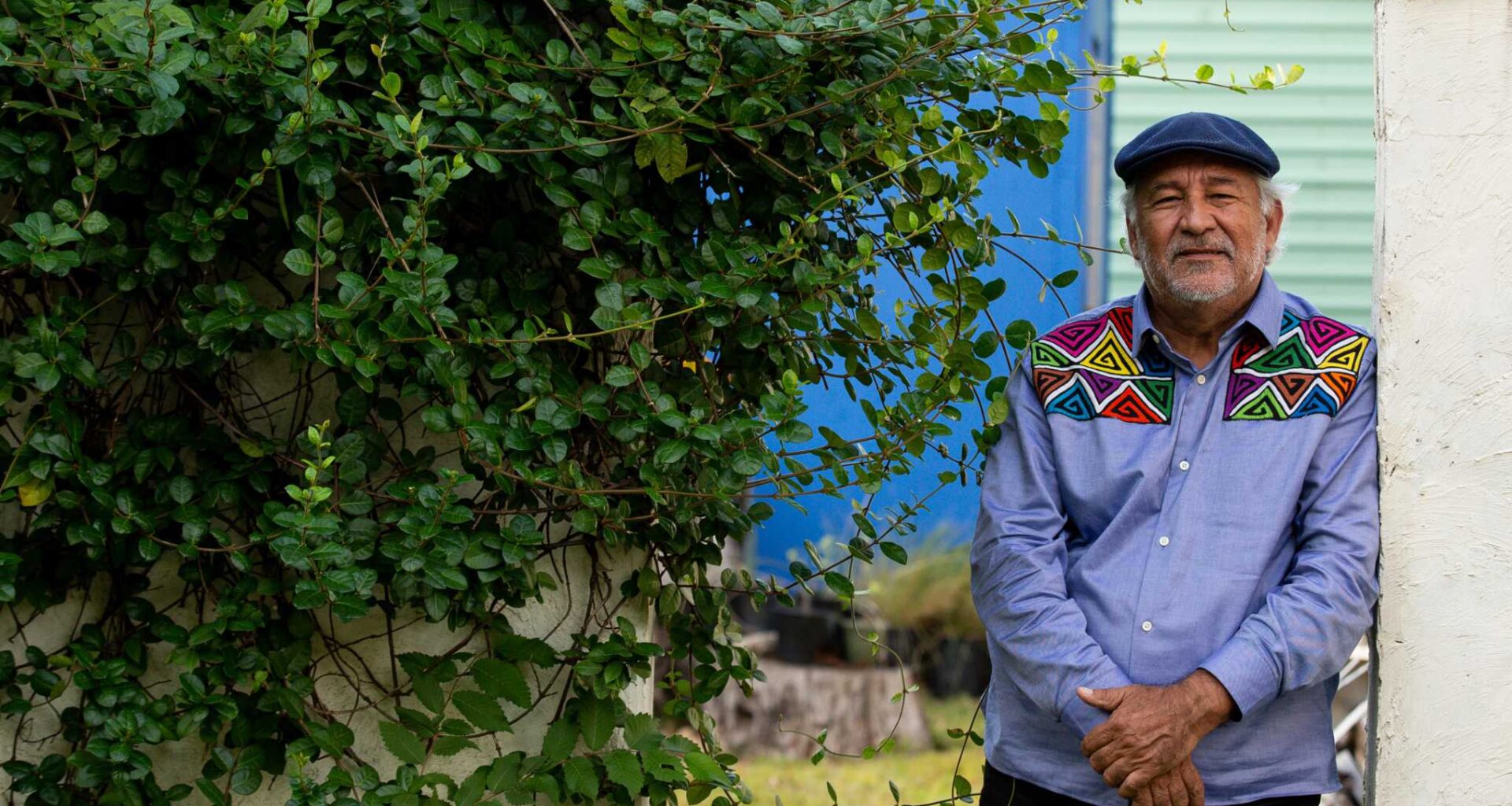
Jesus Cantu Medel still remembers the quirky cast of characters who lived on Cosmos Street in the 1970s, when he and his wife moved into the leafy neighborhood near Little White Oak Bayou in Near Northside.
At one end of the block was a musician who played in a local conjunto outfit. On the other end lived a blind man who used to make brooms in his garage. And a few houses down was his “compadre” Joe Cavazos, whose band has been practicing out of their garage for decades, since Cavazos was a teenager.
Sarah Castillo is seen in Near Northside neighborhood where her family has lived since the 1960s in Houston, Friday, May 22, 2026.
Jason Fochtman/Staff photographer
Most of them were Mexican American, or “raza,” as Medel calls them, and all except Cavazos are gone, either dead or moved to the suburbs. Many of the well-worn bungalows that once lined Cosmos Street have disappeared too, replaced in some cases with imposing two-story mansions selling for around a million dollars.
Article continues below this ad
“Every Chicano that moves out, an Anglo moves in, and they’re well-to-do people, they’re professionals,” Medel, 77, said. “I’m kind of glad they’re here but kind of sad also, because I don’t see ‘raza’ moving in.”
The changes on Cosmos Street are part of a broader demographic evolution taking place in the Near Northside, a historic Mexican American neighborhood just north of downtown.
As middle-class families and professionals seek housing in one of the last affordable neighborhoods in the loop, longtime residents are trickling out. Near Northside’s Hispanic population, which makes up the vast majority of residents, dropped by over 20% between 2019 and 2024, according to a Houston Chronicle analysis of U.S. Census Bureau data.
Article continues below this ad
Homes are seen in the historic Near Northside in Houston, Friday, May 22, 2026.
Jason Fochtman/Staff photographer
Gentrification has been on the radar of community leaders for a long time, and it’s crept over the area more quietly than in nearby Black and brown neighborhoods like Second and Third Wards.
But people are noticing the slow bleed of neighbors. Residents say they’re happy to see Near Northside evolve but worry that the neighborhood may lose some of the things that made it special.
MORE COVERAGE: How Houston neighborhoods have changed by race, age and population since 2010
“There are a lot of new people moving into the neighborhood and I think they value different experiences than we were all used to,” said Sarah Castillo, 46, who grew up in Near Northside and still lives there.
Article continues below this ad
“And I like them too, I like to go to the trail by White Oak Bayou and run down there. It’s a really wonderful thing that’s happened to the neighborhood,” Castillo said. “But I also want to be able to get breakfast tacos and see my family, and maybe they can’t afford to live here anymore.”
Declining Hispanic population
People who grew up in Near Northside tend to describe the neighborhood the same way: a place where kids could ride their bikes under the supervision of neighbors or play football in the street, like a scene out of “The Sandlot.”
They talk about trips to the panaderia and family dinners at the original Doneraki, and big family parties where English and Spanish conversations intertwined until the distinction became obsolete.
NORTHSIDE INSTITUTIONS: Beloved by Northside residents for 60 years, Poppa Burger stands strong in the face of gentrification
Article continues below this ad
Sarah Castillo describes how the neighborhood of Near Northside has changed since her family moved into the area in the 1960s in Houston, Friday, May 22, 2026.
Jason Fochtman/Staff photographer
Near Northside, in other words, has been a quintessential Tejano barrio for decades — the sort of neighborhood that could only develop in a place where families have grown over generations amid the clash and confluence of different cultures.
“Back then, the Northside was its own little community,” said Michael Tello, 66, who has lived in Near Northside his whole life. “We knew just about everybody in the neighborhood.”
The area remains predominantly Hispanic, but the latest census data show their presence is starting to decline.
In 2019, roughly 82% of the neighborhood’s population was Hispanic. Over the next five years, however, Near Northside lost about one in five of its Hispanic residents, roughly 4,000 people.
Article continues below this ad
Today, Hispanics make up about 72% of Near Northside’s population.
“There was an identity that we came to recognize as I was growing up, and came to appreciate as part of the neighborhood,” Castillo said. “I feel like it is still there, but it’s fading.”
Sarah Castillo looks out at her home in the Near Northside neighborhood in Houston, Friday, May 22, 2026. Castillo’s family has lived in the neighborhood since the 1960s.
Jason Fochtman/Staff photographer
Increasingly unaffordable
Longtime residents offer a variety of reasons for the exodus of Hispanics from the neighborhood and when it first began.
The extension of the light rail through Near Northside in 2013 was seen as a sign that gentrification was on the horizon, for better or worse. The opening of White Oak Music Hall three years later confirmed to some that those wheels had been irrevocably set in motion.
But all agree that the main factor driving Hispanics from Near Northside is that the neighborhood has become unaffordable for the working- and middle-class population that has lived there for decades.
“I feel like I’m going to be pushed out eventually. The taxes will go up, and people can’t afford to stay here at a layman’s salary,” said Joe Cavazos, a retired truck driver who grew up a few houses down from Medel. “These are well-educated people (moving here) making big money, and me, we’ve just been happy being poor.”
A home under construction is seen in the historic Near Northside in Houston, Friday, May 22, 2026.
Jason Fochtman/Staff photographer
The median home value in the 77009 ZIP code, which covers most of Near Northside and some of the Woodlands Heights neighborhood, was over $420,000 in 2024, according to the census bureau. In 2019, the median value was $281,000.
Those numbers may soon rise even higher, especially in the most desirable parts of the area. While home values in the ZIP code have since dipped back under $400,000, according to a Houston Chronicle tracker, median sale prices remain at $549,000.
MORE BUILDING: Development near popular White Oak Music Hall will bring new dining, shopping and apartments
Homeowners like Cavazos in Glen Park, a woodsy enclave near the music hall, say their phones regularly ring with offers from developers.
Cavazos, 66, won’t listen to anything under $1 million, but his friends tell him to be careful what he wishes for.
“(The developers) might say ‘OK,’ and then where am I going to go? I’ve been here all my life,” Cavazos said.
The good and bad of change
Most residents greet the changes in Near Northside with a cautious embrace. White Oak Music Hall itself is a prime example of the pros and cons that come with increased development.
On one hand, homeowners near the music hall say concert traffic makes nearby streets impassable on nights when a big act is in town, and they can often feel the bass bumping through their living room well past 10 p.m.
On the other hand, there are perks to living within walking distance of a venue that brings a diverse lineup of talent to Houston.
“It’s cool to go see an artist that you like a couple blocks away,” said Steven Bermudez, 53, of Glen Park. “It’s not cool when you come home and the party is going off and you can’t get in your neighborhood.”
Steven Bermudez, a Near Northside native and current resident, describes how the neighborhood has changed in Houston, Friday, May 22, 2026.
Jason Fochtman/Staff photographer
Similarly, new residents have not unconditionally embraced the existing culture of the neighborhood.
When Cavazos’ band practices in his garage, some curious newcomers stop by for a beer and listen to the tunes. Others complain about the noise.
Castillo used to host New Year’s Eve parties at her house, but retired the tradition as familiar faces left her block.
“I don’t feel like I can go outside and make noise because I feel like somebody might call the cops, and that was never the case before,” Castillo said. “We all talked to each other … and that just doesn’t exist anymore.”
Still, some neighborhood leaders welcome changes to Near Northside if they think they’ll improve overall quality of life in the area.
HOUSTON EXPLAINED: Remembering Joe Campos Torres and the Moody Park riot that shook Houston
Lynnette Tello speaks as community members with the Near Northside Super Neighborhood gather for its monthly meeting in Houston.
Jason Fochtman/Staff photographer
Lynnette Tello, a member of the Near Northside Super Neighborhood and Michael Tello’s wife, said new residents have brought “young energy” to the neighborhood. She pointed to the new Friends of Moody Park organization that is working to make improvements to Near Northside’s largest public greenspace.
“As lifetime residents of the Near Northside, we welcome young energy,” Lynnette Tello said. “I don’t care what ethnicity you are, I welcome new positive energy.”
Victoria Villanueva, Alma Winkel, Lynnette Tello and Heather McCullough gather to go over the meeting’s agenda as community members with the Near Northside Super Neighborhood gather for its monthly meeting in Houston.
Jason Fochtman/Staff photographer