
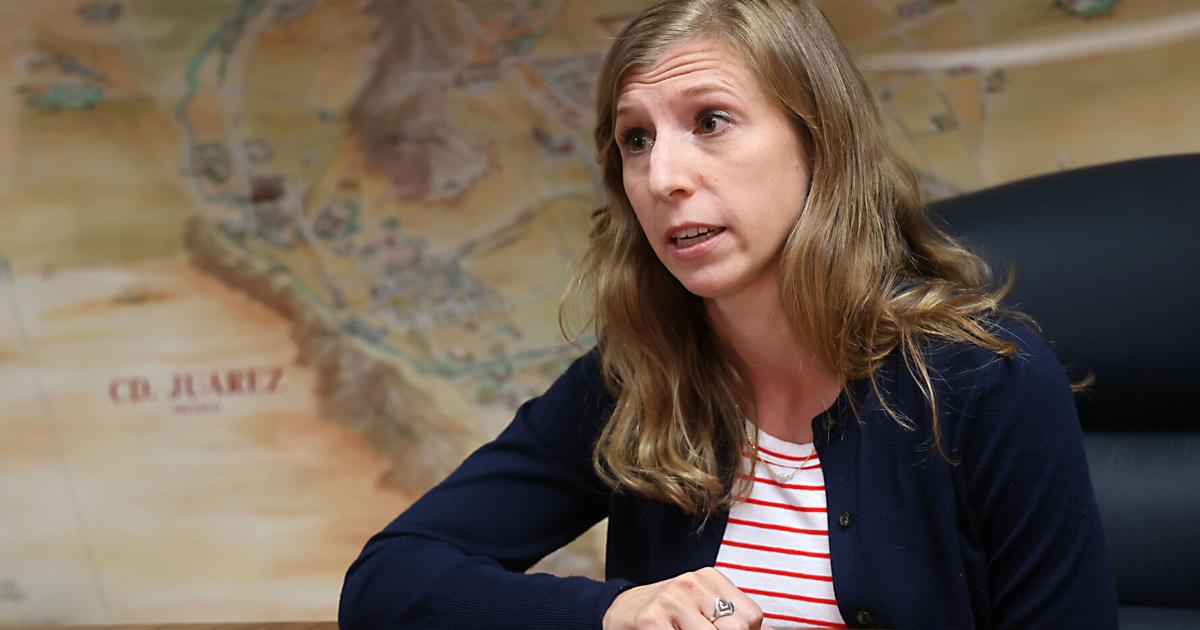
Fresh into her role as chairperson of the Public Service Board, which oversees El Paso Water, Anna Gitter is at the center of one of the region’s most pressing challenges: ensuring water remains accessible and affordable during a historic drought.
“Community engagement has increased. This past year, we’ve had a lot of events. I’m looking forward to hoping that we all can take a little bit of a deep breath, especially the staff here,” Gitter said, with a hint of irony in her voice, suggesting she’s prepared for the opposite.
As a relatively new El Pasoan, Gitter, 34, arrived four years ago from Central Texas, joining the local branch of the UTHealth Houston School of Public Health as an assistant professor. She applied for an available position on the PSB and was appointed by El Paso City Council in February 2024.
Gitter is a water expert with a master’s degree and doctorate in water management and hydrological science, both from Texas A&M University. Her research has focused on two areas especially relevant to her role on the board – using environmental data to inform public health decisions and strengthening community engagement.
“Something, as a board member, that I’ve been working hard on with the staff here at El Paso Water, which they’ve been very receptive to, is really increasing our work in the community and our communication,” she said, sitting at the long PSB boardroom dais at El Paso Water’s Eastside headquarters.
Confident that the infrastructure built by El Paso Water will provide long-term, reliable service for the area, she said she’s looking forward to sharing the challenges and progress facing the PSB and El Paso Water with the public.
“As board members and staff here at El Paso Water, we’re members of the community too,” Gitter said. “We’re all customers of this water system, and so we care just as much.”
In a conversation with El Paso Inc., she spoke at length on a range of topics, including her early interest in water issues, the unique relationship Texans have with water and the new technologies being employed to make sure El Paso never runs dry.
Q: Your educational background is in water. What was it about water that you found interesting?
It’s my passion. I’ve always had an interest in it, even as a small kid. I grew up in Central Texas and Austin, and I visited every natural spring in Central Texas one summer. It has just been something I’ve had interest in – how precious it is and the unique relationship that Texans have with water. That stuck with me throughout my entire education. And now it’s my passion, and my job.
Q: It’s fascinating how something can really catch a young person’s interest. Can you recall exactly what it was about water that drew you in?
It is what makes the world move. Water connects everything that we do, whether it’s the economy or public health. Cities thrive on it. Water affects everything.
The Central Texas area is special in having all those natural springs. There aren’t many places like that in our world. Having the opportunity to swim in water that is 50 degrees, and you see 40 feet to the bottom, it makes you realize how lucky we are to have that.
We are fortunate in Texas, where we recognize how important water is.
Q: What do you find unique about the relationship people in the state have with water?
What we have here, and El Paso Water is an example of it, is that Texans are innovative with how we handle water. We’ve really pushed the envelope. Other communities across the country haven’t quite taken that approach.
This is what excites me about being in El Paso with our water portfolio. There are some communities that rely on just one source of water, only groundwater, or maybe it’s only river water, which can be very variable. Here, we’ve had the opportunity to be innovative, where we have multiple sources of water.
Q: In your conversations with people around the state and around the country, have you found that El Paso has a reputation for being at the forefront of water innovation?
Yes, 100 percent. We are one of, if not the, leaders in how we manage water. We are obviously in a desert, and we are under drought conditions, but we have the resources, and the technology, and the infrastructure in place where we don’t need to worry about providing enough drinking water for our community right now.
There are other areas, like Corpus Christi, where they’re in a very different situation. But we aren’t in that position right now because of our innovation. We’ve been doing water reuse for 40-plus years, if not more.
We’ve got the Pure Water Center under development, we have an inland desalination plant, and there are other communities that aren’t even discussing that yet.
Q: How did El Paso get this reputation? What’s driving that?
We’ve just always been out-of-the-box thinkers. When you live in a desert, you have to be creative. Being in this kind of environmental situation, that’s what has spurred this.
From what I see in my work in this field, everyone knows El Paso Water. I’ve done quite a bit of work in Austin and other communities, and at the national level, and when you mention El Paso Water, people are like, “Oh, yeah.” There’s tremendous respect for the work that we do, and how we are setting the bar, and how we are thinking about the future.
Q: Some people have concerns about the management of water in the region. What are the things you would want more people to know about the PSB and El Paso Water?
It’s important to remember that, at least in the context of the PSB, we’re volunteers. I really want to drive that home. We are doing our service here because we are passionate about our community, and we’re passionate about water. That’s the only reason why. I think sometimes that is forgotten.
We all have lives outside the PSB. We all work full-time jobs, but we want to find a way to serve, and this is it.
With El Paso Water, as a utility, some of the challenges that they have faced, at least in recent months, are not anything that’s new to any utility. When we talk about infrastructure, and aging infrastructure, that is a challenge that every single utility in this country is facing.
If anything, we are addressing them in probably a much more proactive manner.
Q: How did that happen? Was there a particular person, coalition of people, or how did that foresight materialize?
With the creation of the PSB in 1952, that is what really set it apart. At that time, we were in record drought conditions. There are pictures of parts of Texas; they were just dried up. It was really horrific.
To have the foresight that we eed to be strategic in how we manage our water, and that we need representatives from our community to bring diverse experience and expertise, that is where it got started.
After that, under the leadership of El Paso Water’s CEOs and really brilliant staff, we were able to bring in this amazing technical expertise. The PSB was able to bring out some of these projects that really pushed the envelope and got us to where we are today.
Q: There is a lot of discussion about the potential environmental impact of the Meta data center under construction in Northeast El Paso. The PSB maintains that there is enough water to sustain that. What would you say to people who still have concerns about that?

Anna Gitter, chair, Public Service Board
Ruben R. Ramirez
It’s important to note that a peak summer day will have up to 160 million gallons of water that’s being treated, and when we look at the usage from this data center, it is truly a very small fraction of that. I know that the technical staff here has done the work to make sure there is more than enough capacity and supply for it.
What I would also like to emphasize is that the utility, and the PSB, we are obligated by state law to provide water in our service area. There are no ifs, ands, or buts about that. We have to. No matter what kind of user it is, that’s just something that we have to do.
I know that the utility did make sure that it would be feasible before anything was able to move forward.
Q: How do you feel about the community getting more outspoken about their water concerns?
I understand the concern, and I recognize and I truly appreciate the community expressing their opinions and coming to our meetings. It’s been great to have community input. For a while, we didn’t have people from the community speaking, so it’s been great to have that.
Q: Considering the lifelong interest you’ve had in water, and now being part of this effort to educate a community becoming increasingly interested in water, how meaningful has that been for you?
It’s fantastic. It’s great that we have a community watching the news and seeing what’s happening because that’s what we need to succeed, and I hope it continues.
The people of El Paso love where they live and are passionate and care about it.
Q: You’ve mentioned the Pure Water Center and its importance for El Paso’s water. What is it?
It is phenomenal what we’re going to have. It’s going to be essentially one of the nation’s first direct-to-distribution potable reuse systems. So to have something like that, and of that scale, in our community to meet the needs for the future, there’s really nothing else like it.
Q: When people think of wastewater being treated at the Pure Water Center, and then that they are going to be drinking it, what would you say to them to allay their fears about it coming from wastewater?
This is an extremely, highly treated water. It’s probably going to taste better than some of the other water in our system just because it is purified to that standard.
Think of the water cycle. All water is recycled. Every drop of water from the aquifer is recycled water. It has just been recycled on a larger time frame, like millions of years. With our cycle, we are expediting it, but it is the same thing.
We have the tools available and the expertise and the technology to do this. It’s happening at different scales in different parts of the country. We have the opportunity to have a full facility to do it at a much larger scale to meet water needs for the future.
Q: How much of a game-changer is that for El Paso?
It’s a game-changer in that it is extremely innovative. Historically, we could rely on river water as a very consistent and dependable water source. But as we’ve seen in recent years, with variability in the snowpack and how much water we receive downstream, it’s a great water source when we get it.
But to help offset dependence on that, and to have another source of water in our water portfolio, this is what it provides. It is so much more strategic to have multiple sources of water that we can utilize to treat – to drinking water standards – and meet the community’s needs, as opposed to solely relying just on groundwater or just one water source.
Q: How much attention is this center receiving nationally?
There are a lot of eyes on it, even on an international scale as well.
Q: With the drought and Elephant Butte levels being at very low levels, are we running out of water?
There’s not a lack of water. There’s a lack of cheap water.
Q: What are the guiding principles for the goal of affordability for El Paso ratepayers?
When it comes to water rates, front-of-mind is affordability.
Historically, El Paso actually had very low water costs compared to other communities. Unfortunately, we’re in a world where the cost of supplies and all these different factors are increasing rapidly. So to make sure that we have water for future generations of El Pasoans, we have to be strategic. We can’t delay. If we wait to do some kind of expansion, it’s going to be even more expensive. It’s better to be proactive than reactive.
When it comes to rates and affordability, it is important to be more incremental. I’ve seen other communities where they say, “OK, we’re not going to increase rates,” and they go five, 10 years, and then when they do have a rate increase, it is massive.
Q: What do you think the future holds for El Paso Water and water in this community?
I’m really excited about some of these big projects that we have coming up in the future. I am extremely excited about the Pure Water Center, about that opening to the public in the next few years and what that’s going to provide.
I’m also really excited to continue building on the momentum we have with community engagement. It’s helpful discussing water. The attention that we have on water right now, even though it’s from various perspectives, I think it’s all good. People should care about water.