
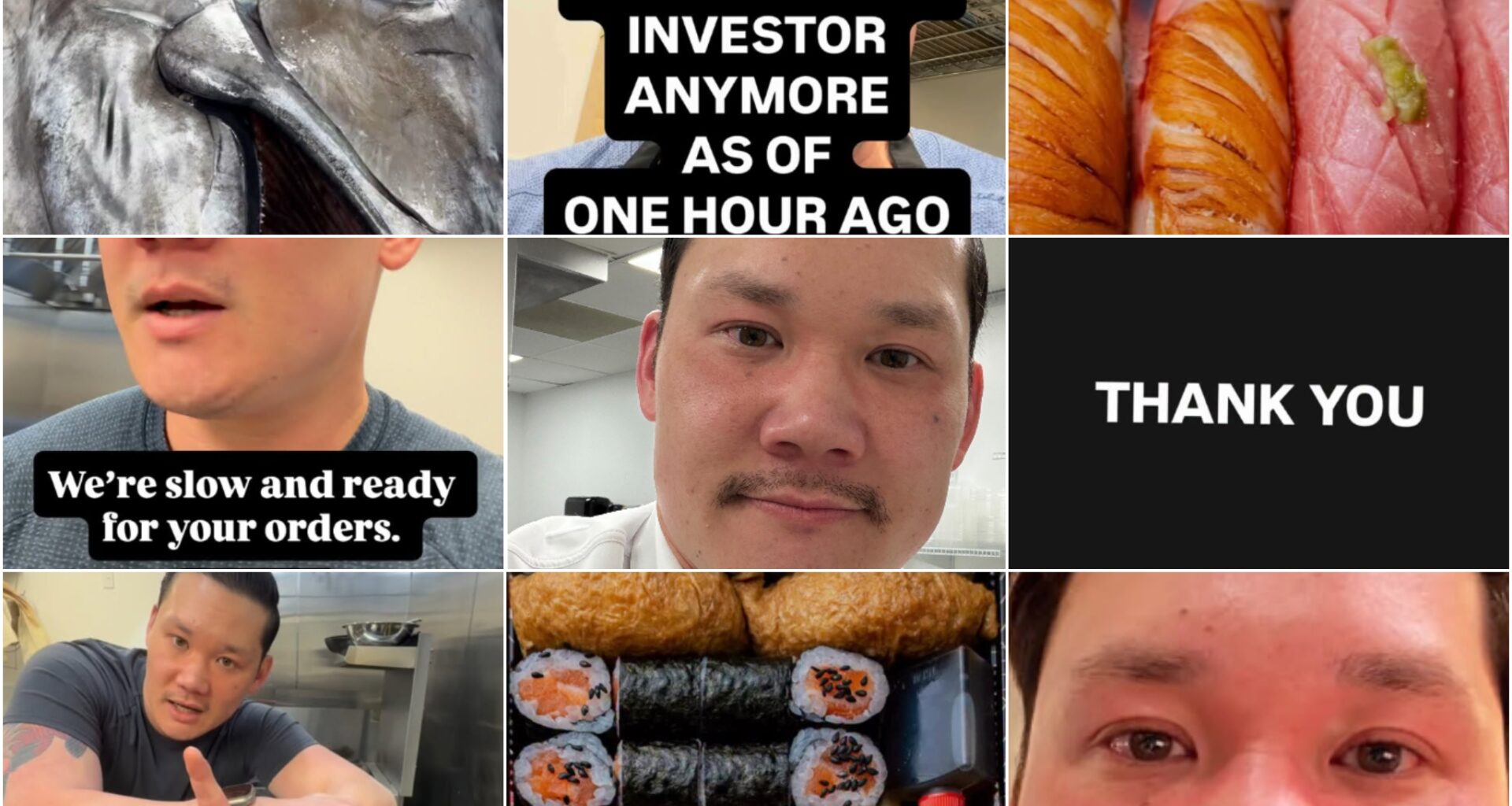
A photo composite of various videos and social media postings from Sunny Bertsch, owner of Kaisen Sushi in Houston, Texas. Bertsch has made it his mission to “demistify” the business of running a sushi restaurant, to both his detriment and his success.
Chron
Lately, Sunny Bertsch has been the main character in local foodie social media circles. The Houston sushi chef has been regularly posting videos about his struggles operating Kaisen, a ghost kitchen concept out of Blodgett Food Hall. In his last post, Bertsch said he was breaking down a tuna and presumably some other fish overnight to get ready for lunch and dinner service the next day.

Across the many videos he’s posted on Facebook, Instagram and TikTok, and often in excruciating detail, he’s touched on his wins and losses while running Kaisen. Many viewers have become fans, latching onto the raw pathos in Bertsch’s storytelling. Others, publicly and privately to Chron, have voiced outright skepticism, even disdain about how the sushi chef runs his business and behaves online.
Article continues below this ad
Thursday, I reached out to Bertsch to better understand the man at the center of such strong opinions. His almost immediate response: “I don’t know what the f–k you want.” It’s not the way most of my interviews have started, but I took Bertsch at his word when he said he had been operating on 40 hours without sleep.
In a lengthy conversation, I found myself like just another viewer of Bertsch’s Instagram reels. He was blunt and candid about the challenges that have come with operating the way he has, and, as ever, the future of Kaisen was still teetering on the edge.
From dog walker to sushi chef
Bertsch has had a colorful life. The self-described “three quarters Korean and one quarter white” chef grew up in a Korean household. “I was blessed to have a family that taught me how to cook growing up,” he said. “I remember my first complicated dish my dad taught me how to make, after Hamburger Helper, was Korean oxtail soup. It’s still my favorite dish to cook.”
Article continues below this ad
After dropping out of art school and joining and later quitting an aerospace firm, Bertsch said was walking dogs and making DoorDash deliveries, unsure of his next career move.
“I was talking to myself in 100-degree heat and I asked, ‘Sunny, what are you good at?'” he said. “I came to thinking: I love cooking. I cook complicated things. I can make my own pacha, my own kimchi. You know, f–k it, let’s make money cooking,” Bertsch said.
Bertsch became a private chef, working with one of his former dog-walking clients, and later expanded his Asian meal prep service to business firms around Houston. A birthday party request for a sushi omakase triggered Bertsch to transition away from Korean cooking and pursue Japanese cuisine. He found work with international grocer Seiwa Market, learning turn-and-burn sushi prep, and he eventually caught the attention of Uchi, Tyson Cole’s renowned Texas-based sushi brand with a long track record of developing star chefs. It was a short stint.
Article continues below this ad
“I thought it was a really big opportunity. I lasted three weeks before I decided to walk off the job,” Bertsch said, claiming a toxic work culture on the sushi line turned him off.
Rigorous honesty
Bertsch said he came up with the idea to start Kaisen the following week. He said he wanted to provide a better working environment and better pay, and also sought to demystify the “bulls–t” about the sushi industry overall. Demystification is a hallmark of many of Bertsch’s social media videos, wherein he’s often in some kind of distress about Kaisen. There aren’t many videos that show him having an easy time of it, and he’s unusually candid about the things that go wrong in the kitchen, be it a mistake with sushi rice or missing a scheduled fish delivery.
That vulnerability, or rather the lack of hesitation on his part to be vulnerable, stems from Bertsch’s sobriety. He said he’s been drug and alcohol free for 13 years. As it relates to his cooking, it’s provided a sense of courage when taking risks.
Article continues below this ad
“The reason I am the way I am, when I got sober, certain principles were instilled in me: One is rigorous honesty. I just kind of always stuck to absolute honesty,” Bertsch said. “And the thing about being sober, is I’m really good at being accountable and I’m really good at apologizing.”
As Kaisen approaches its one-year anniversary, it’s forced Bertsch to take a painful reassessment of his guiding principles. He thought he could provide better sushi at a more agreeable price. Instead, he’s found that he’s very likely undercharged his to-go products. He thought he could treat his employees better. Instead, he said it’s likely that he’s overpaid them. Those errors inevitably compounded when the new year kicked in and he found himself not turning a profit for months.
“I’ve made every mistake I can make in the restaurant space, and I didn’t know they would cost so much,” he said. “I’ve let two things hold me back from fixing things: pride and overconfidence in the model I wanted to pursue, and just being overly hopeful, over buying products while also being desperate and undercharging them.”
The court of public TikTok opinion
One of the unintended effects of Bertsch’s transparency about his situation is that it’s turned into a kind of referendum on his decision making and character. Some have questioned the way he’s run his business, wondering how he seems to always be struggling when he’s not operating a full dine-in restaurant. In one instance, he posted bank statements intended to show how thin the profit margins of his business were, but some readers alleged in response that he was defrauding his own business.
Article continues below this ad
A screenshot of an Instagram post from Sunny Bertsch, the owner of Kaisen Sushi in Houston, Texas, on May 30, 2026. Bertsch told followers that his restaurant would likely close after losing an investor and taking a $4,500 loan to make payroll. Less than 12 hours later, he posted another video, saying fans and other individuals reached out to support his business.
Others have lobbied criticism for the things he’s said in his videos, like calling Blodgett Food Hall, his landlord, “ghetto as s–t.” Bertsch has mostly shrugged off what he perceives as “haters,” people who willfully don’t understand the ins and outs of the restaurant business.
“I like to be ultra transparent, and I don’t like to apologize for who I am, including all the flaws. I’ve accepted me for me,” Bertsch said “I have some things that people find annoying. That’s okay with me.”
Bertsch’s approach to social media is unique in the Houston restaurant space. A handful of restaurateurs are fairly active, regularly posting on Facebook and other sites with sporadic videos, but none of them have broached the medium as aggressively and raw as Kaisen’s owner. Bertsch’s account pages aren’t filled with glossy photos of nigiri, handrolls and sashimi; instead, many of them feature reels of just his face and nothing else.
Article continues below this ad
Intentionally or not, Bertsch’s method is tailored for the moment. Industry experts and observers have said on record that consumers have begun shifting away from critics, Google and Yelp for restaurant advice, and they instead have begun to rely on their social media feeds for inspiration on where to go next. Abby Hughes of Belle Communication told Business Insider that “relatability” has become an additional hook for what attracts customers.
An audience shows up
Around 2 a.m. May 30, Bertsch posted a video of sad news: His investor, which he calls “mom,” had pulled out. He had to borrow an additional $4,500 to make payroll. With no additional investor in sight, and blinking back tears, Bertsch said Kaisen was officially done for good the coming weekend.
Then, a little more than just 12 hours later, Bertsch looked much more chipper in a new video. He spoke about a massive influx of orders coming into Kaisen. In addition, two sushi chefs, Matthew Mui from Mack Allen’s Steakhouse and Paul Fonzie from Dallas, were coming to help volunteer on Kaisen’s sushi line. He talked about investors and restaurant consultants who had reached out to help as well.
Article continues below this ad
It would appear, at the very least, that all of Bertsch’s struggle-posting had saved Kaisen.
But five days after that, Bertsch was again in the thick of it. He said he was supposed to order fish on Sunday, and he didn’t, likely because he thought he was going to shutter. He doesn’t have the time or money to be sustainable for the week, and so he raised prices to adjust, but he’s not too concerned about whatever numbers he makes. The hope is that whatever conversations he’s had starts to turn into something real by the next week. That includes the conversations he’s having with his followers on social media.
“What is wrong about being flawed or being transparent? What is wrong with being human and naturally contradictory about yourself? What is wrong with saying things that you’ll regret later?” Bertsch asked.
Article continues below this ad
Whether Bertsch sees it or not, he has emerged as new kind of restaurant operator in a social media-inundated era. The success or failure of Kaisen will see if that approach catches on anywhere else.
“When you own a company, you’re not allowed to be yourself. That’s what I’ve learned,” he said. “When you’re the owner, people think you’re not allowed to be 100 percent transparent online. That doesn’t make sense to me.”