
With a light snowpack in Colorado and a severe drought choking New Mexico and Texas, the Elephant Butte Reservoir – provider of nearly half of El Paso’s water – is critically low.
And amid the drought conditions, a public fight has emerged with many El Pasoans pushing back against Meta’s El Paso data center, a thousand-acre hyperscale AI processing operation that will tap into the region’s water supply.
The controversy has become a test of El Paso Water’s long-term drought strategy. While critics question whether large data centers belong in this water-stressed region, utility officials argue the city has spent decades preparing for a future with less Rio Grande water through investments in desalination, water reuse and groundwater projects.
Meta has pledged to fund a series of water conservation strategies and projects, including plans for eventual “zero-consumption” cooling systems and promises to restore 200% of the water it uses. The tech giant has also committed to investing $10 billion into the El Paso project.
Despite those commitments, community opposition has grown, targeting both the Meta project and proposed data centers in nearby Doña Ana County and at Fort Bliss.
John Balliew, CEO of El Paso Water, said concerns about data centers’ water consumption have been fueled by what he described as “a whole narrative” of inaccurate information.
“You have an anti-AI mindset that’s kind of becoming more and more prevalent,” he said. “You have, all of a sudden, these companies which were very popular previously, are now Public Enemy No. 1.”
Much of the public ire was raised when Meta, the parent company of Facebook and other social media platforms, backed off its original statements to rely on the existing El Paso Electric grid and solar power to run its operation.
Instead, the electric utility filed an application with the Public Utility Commission of Texas to build a 366-megawatt natural gas plant to power the data center, which is under construction in Northeast El Paso.
Since that application became public late last year, residents have voiced opposition to Meta at public forums, questioning both the value the data center will bring to El Paso and the incentives package awarded to Meta by the city and county.
Under pressure, El Paso City Council voted unanimously May 26 to stop recruiting or offering incentives for future data center projects. City Reps. Josh Acevedo and Lily Limón have also proposed terminating the city’s economic development agreement with Wurldwide LLC and its parent company, Meta Platforms Inc.

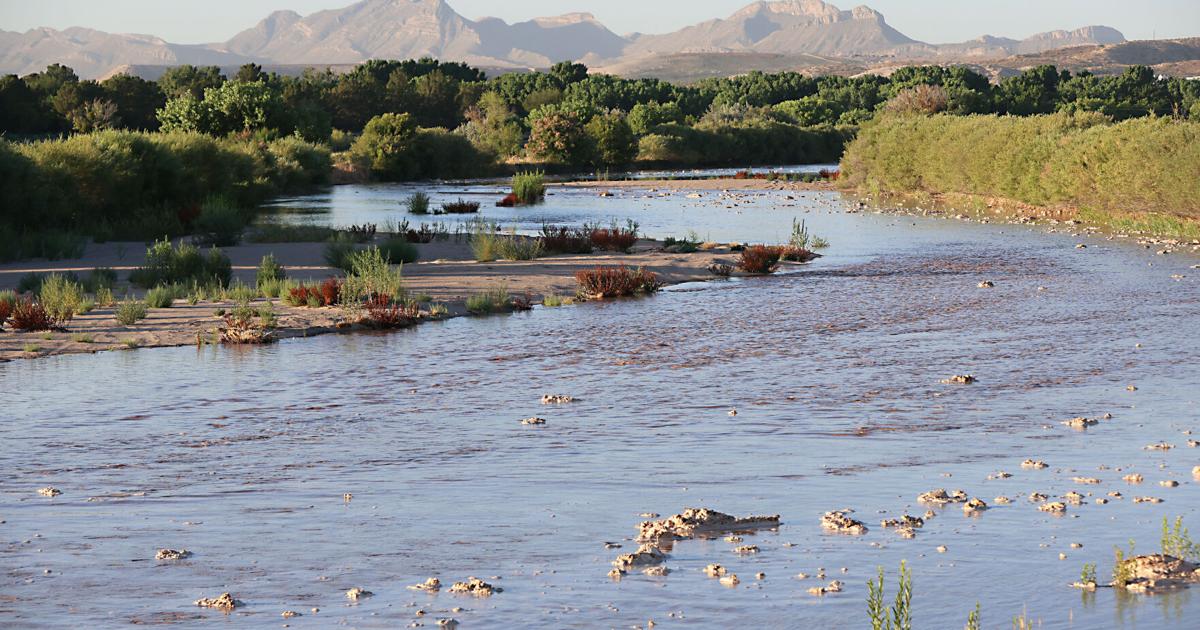
Water fills the Rio Grande as the sun rises Monday, June 1, in Sunland Park, looking east to El Paso.
Photo by Ruben R. Ramirez
How much water will Meta use?
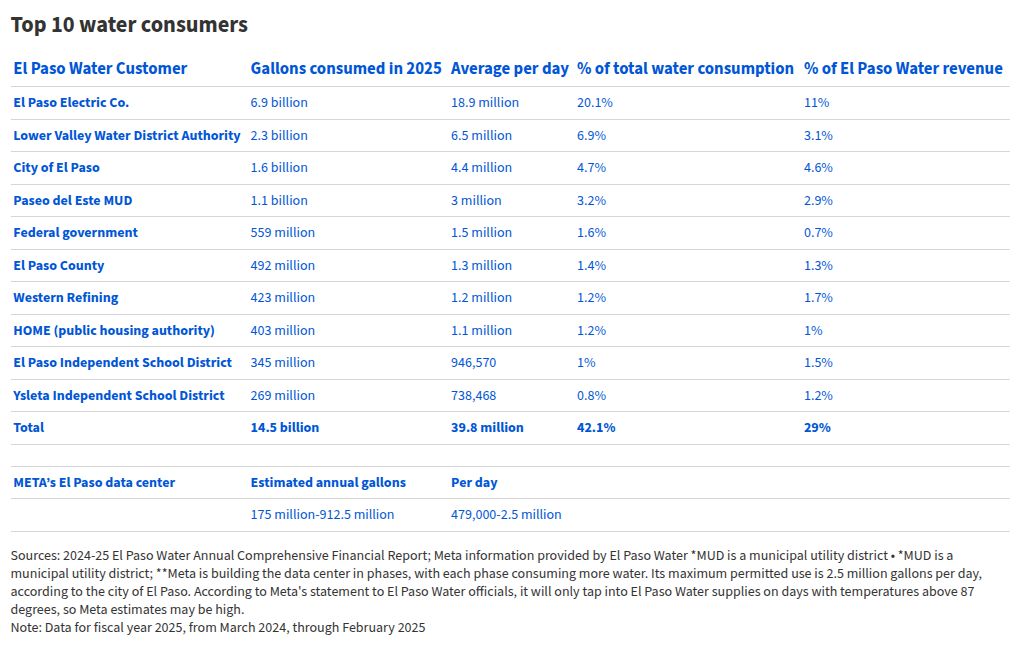
On peak summer days in 2025, water demand in El Paso County reached about 155 million gallons a day. El Paso Water officials said the data center’s estimated average annual use will be 479,000 gallons, representing less than 1% of the region’s summer water consumption.
The city of El Paso’s Meta FAQ webpage states the data center’s average daily water use will reach 1.5 million gallons in Phase 3. The maximum permitted amount of water is 2.5 million gallons per day.
An El Paso Water spokesperson said Meta’s data center would only use 2.5 million gallons “on a day above 117 degrees, which has never been recorded in El Paso history.”
“We do not expect them to use 2.5 million gallons in any given day,” El Paso Water public affairs officer Denise Parra said in a text message to El Paso Inc.
Meta is expected to use about 175 million gallons annually, according to El Paso Water. This is less than the utility’s largest customer, El Paso Electric, which uses almost 7 billion gallons annually, about 20% of the region’s total water usage, according to El Paso Water’s fiscal year 2025 financial report.
Lane Gaddy, a member of the Public Service Board, which governs El Paso Water, said he is confident that Meta’s operations do not threaten the region’s water supply, even during drought conditions.
“I feel very comfortable with the water usage,” he said. “I think there are a lot of questions communities should be asking about these data centers, but as far as El Paso’s water supply, the projects that have been announced in El Paso, there is no concern for sustainability.”
Balliew agreed, arguing that Meta’s water use has been misunderstood and would be comparable to that of a similarly sized residential development.
“If you had a footprint for a data center, let’s say in the case of Meta that it’s 1,038 acres, and instead of having the data center, you were to take that land and subdivide it and put in single-family homes with some apartments and some commercial stuff, it would be the same amount of water,” he said.
But the issue is more complicated, said Veronica Carbajal, an environmental lawyer and one of El Paso’s most outspoken opponents of data center development in the region.
“I would love to say that we can divorce water from all other issues and just focus on water, but we can’t,” she said.
The water required by the power plant serving the data center should also be considered, said Carbajal, lead organizer for Sembrando Esperanza, a coalition of neighborhood organizations advocating for economic, social and environmental equity in El Paso.
“If we’re only looking at the water consumption at the meter at the data center, it’s a myopic view of what’s really happening,” said Carbajal, adding that El Paso Water has not provided data addressing the connection between a data center’s electricity use and water consumption.
Carbajal, who has a degree in environmental studies from Brown University, said the technology for cooling data centers has been evolving to use less water, but she believes that rising temperatures across the Southwest could offset those gains.
“Meta and El Paso Electric are going to be operating within the context of a warmer climate, a warmer summer, which means that you have this loop of hotter temperatures and more electricity needed to keep everything cool,” she said.
How does El Paso Water plan to manage the drought and low river level?
The data center debate has also focused attention on El Paso Water’s long-standing plans for managing drought and the low level of the Rio Grande. Utility officials said there is enough water for El Paso’s needs and the infrastructure can handle the stress.
Asked whether incoming data centers pose a risk to El Paso’s water supply or could lead to disproportionate increases in water bills, the water resources manager at El Paso Water, Scott Reinert, gave a quick answer.
“No,” he said, and added, “We’re building for the future with or without Meta.”
The key question, according to El Paso Water officials, is not whether there’s enough water to support the region during a prolonged drought – there is plenty, their data shows – but how to finance the infrastructure and technology needed to deliver it in the most cost-effective way.
There isn’t a lack of water for El Paso, said Anna Gitter, the new Public Service Board chairperson, “There’s a lack of cheap water.”
The technology to reclaim, treat and reuse brackish groundwater and wastewater is expensive. Replacing century-old pipes, upgrading water delivery systems and training water emergency crews with the latest response protocols all require significant investments that are ultimately reflected in customer rates.
El Paso Water’s recently approved fiscal year 2026-27 budget includes a monthly $9.99 increase on the typical residential bill, which is a 12% jump from the previous year.
“We’ve been having to have rate increases, which we take very seriously,” Reinert said. “For a lot of these projects, we spread out the cost so we don’t hit customers at once.”
In addition to ratepayer revenue, the utility receives state and federal grants and partners with other government entities to pursue additional funding opportunities.
El Paso Water CEO John Balliew speaks at the groundbreaking for the Pure Water Center in March 2025.
Photo by Ruben R. Ramirez, file
In January, the Public Service Board approved about $775 million in budget priorities, including $118 million for two flagship drought-response projects: the Pure Water Center and the expansion of the Kay Bailey Hutchison Desalination Plant.
Balliew also highlighted the utility’s aquifer storage and recovery operation as part of a long-term strategy of managing the shortage of water in the Rio Grande.
“These are three drought-proof projects. They operate and produce water, whether we’re in a drought or not,” Balliew said, adding that they are valuable resources because they do not rely on the river.
The $295 million Pure Water Center, under construction next to the R.R. Bustamante Wastewater Treatment Plant in the Lower Valley, will convert treated wastewater into drinking water and provide 10 million gallons every day. It is expected to be completed by 2029.
The Kay Bailey Hutchison Desalination Plant on the Eastside, which turns brackish water from the Hueco Bolson into drinking water, is being expanded to boost its production from 27.5 million gallons per day to 33.5 million gallons. The project is supported by a $4 million grant from the Texas Military Preparedness Commission and is expected to be ready in about a year.
El Paso Water’s Aquifer Storage and Recovery facility, which Balliew estimated will cost about $30 million, is designed to recharge the Hueco Bolson with 6 million gallons of cleaned wastewater each day. The facility will feed the bolson the reclaimed wastewater from the Fred Hervey Reclamation Plant in Northeast and is expected to be completed in about two years, officials said.
With that trio of projects as part of their future water portfolio, El Paso Water officials said they are certain the region will have a steady supply of water to sustain its growth.
“We’ve been preparing for this for a long time,” Reinert said. “We like to say the next drought is right around the corner, and this is how we deal with it: diversifying, planning for our future, building water projects, expanding our desalination plant.”
Still, one reality remains unchanged: the Elephant Butte Reservoir – the source for more than half of El Paso’s summertime water – is facing one of the most severe shortages in its recorded history.
“We’re getting into near-uncharted waters of lowness,” Reinart said.
This assessment is backed by an April 16 Bureau of Reclamation report, which stated, “If monsoon rains do not materialize, Elephant Butte Reservoir could be at about 2% of its capacity by late August, slightly below lows experienced in 2013.”
What’s ahead?
El Paso’s diversified water portfolio, El Paso Water officials said, can sustain the region’s water needs through decades of drought and minimal surface water from the Rio Grande.
To accommodate El Paso’s expected population growth to 1.4 million by 2070, the Public Service Board has purchased the water rights to more than 70,000 acres of land in Hudspeth County.
The $600 million investment includes infrastructure, like pipelines and pumps, and officials said costs will be spread out from now until the project kicks off, likely in 2050.
Photo by Ruben R. Ramirez
Until then, Balliew said, taking a historical view of El Paso’s water issues helps keep a realistic perspective.
When asked by El Paso Inc. how worried El Pasoans should be about the drought, he pushed his chair back from a large conference table at the El Paso Water headquarters and stood up.
“Can I draw you a picture?” he asked, turning to a dry-erase board hanging on a wall of the room.
With a purple marker, he drew a line graph showing the years going back to the 1911 founding of Elephant Butte. He moved his marker slowly from 1911 to 1946 – years of adequate flows of rain and snowmelt into the Rio Grande – and he stopped at a point in the early 1950s.
“So, 1952 comes along, and boom, precipitation dropped to zero,” he said. “It was a drought of record.”
Balliew then slowly dragged his marker throughout that 27-year drought timeline, stopping at 1979.
“Boom, a huge amount of water fills up, all the way until 2003. Since then, we’ve been cycling in and out of drought this entire time period,” Balliew said. “There have been historical droughts and water surpluses.”
Should the drought endure and lead one day to an empty Elephant Butte and a dry summer river, water officials said the utility has built water infrastructure that can sustain the region and its growth.
“Even if you take surface water out of the equation,” Gaddy said, “our city – between the two aquifers, direct potable reuse, desalination and import – still has enough arrows in the quiver to manage our city’s water needs.”