
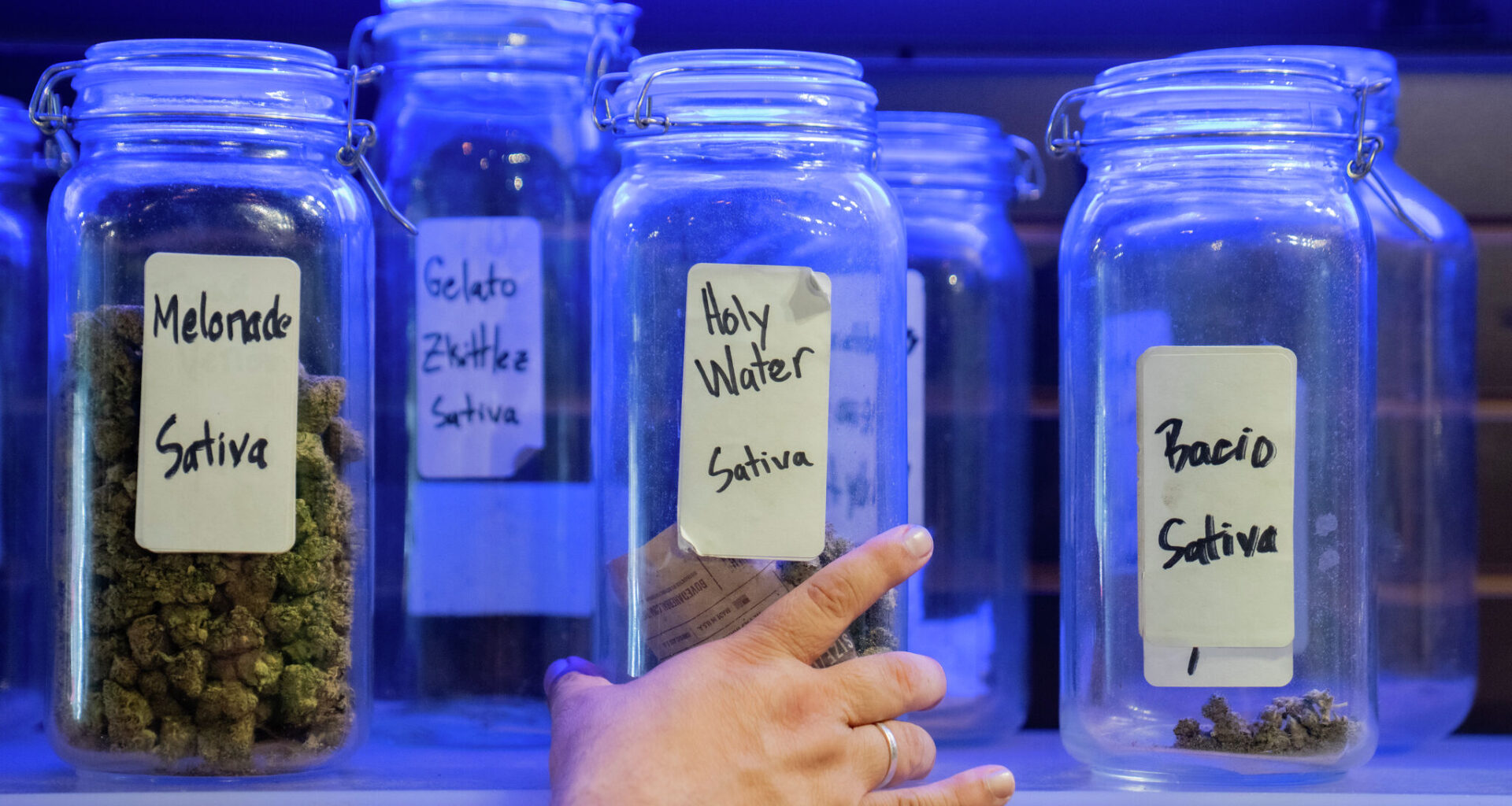
Hemp-derived THC products are shown at a Texas retailer. An Austin medical marijuana company has sued several hemp businesses, alleging their products exceed legal THC limits.
Mikala Compton/Austin American-Statesman
As Texas lawmakers and regulators continue to grapple with the future of hemp-based products, an operator in the state’s medical marijuana program says several hemp companies are selling illegal drugs under the guise of legal hemp.

Austin-based Texas Original Compassionate Cultivation has filed a lawsuit seeking to block several companies from doing business in Texas and recover damages for lost revenue. The case was removed to Texas Business Court last week by one of the defendants.
Article continues below this ad
Since 2017, the Texas Original has had one of the rare and valuable state licenses to sell low-THC medical marijuana through the state’s Compassionate Use Program. Known as TCUP, it was signed into law in 2015 to help Texans with conditions like intractable epilepsy, cancer and Lou Gehrig’s disease.
But the value of that license has been degraded, the company says, by “wildcat” operators in the hemp space it says are increasing THC levels beyond the legal limit and lying about it. The largely unregulated market is now competing with the highly regulated TCUP market to the detriment of its licensees, it argues.
Under House Bill 1325, passed in 2019, hemp-derived products are legal if they contain less than 0.3% delta-9 THC. The state’s Compassionate Use Program formerly allowed products with up to 1% THC before switching to a 10-milligram-per-dose limit.
The lawsuit alleges 10 companies are selling marijuana products as legal hemp, marketing them deceptively and offering products that may contain contaminants. It also claims many are poaching Compassionate Use customers through false advertising while operating outside the regulatory framework imposed on medical marijuana providers.
Article continues below this ad
TOCC says it has spent millions of dollars complying with state regulations governing the Compassionate Use Program, including security, inspections, testing and background checks.
By contrast, the company argues, hemp businesses face far fewer restrictions while potentially exposing consumers to unregulated products that may contain synthetic drugs and harmful substances.
The companies named in the lawsuit are Big Dan’s Hemporium, Cloud Ponics, Greenbelt Botanicals/Greenbelt CBD, JTE Enterprises, doing business as Green Cross ATX, Green Cross CBD and Greenbox; Restart CBD; CBD American Shaman LLC; Southeast Farming Partners, doing business as Haygood Farms; Cookies Creative Consulting & Promotions; VIIA Hemp/VIIA; and Mood/Hellomood.
Restart CBD filed to move the case to Texas Business Court. Its attorney disputed the allegation that the company was illegally selling marijuana.
Article continues below this ad
“This petition reads less like a legitimate effort to vindicate a legal right and more like a 39-page hissy fit from a company that appears to have confused a license to sell medical marijuana with a right to control every cannabis-related product sold in Texas,” said Joseph ‘Jeb’ Golinkin II, attorney for Restart.
TOCC says it commissioned independent national labs to test the defendants’ products and can prove they are exceeding the legal limit for THC.
“Our position is succinct, it’s based in law, and we are confident it will succeed in court,” said Heidi Coughlin, attorney for TOCC.
The defendants, it alleges, have managed to grow rapidly in an industry valued in the billions.
Article continues below this ad
TOCC is seeking damages for lost business, arguing that customers who should have purchased products through the Compassionate Use Program instead bought products from the defendants. The lawsuit alleges the companies were unjustly enriched through illegal sales.
Texas Original’s lawsuit accuses Mood and other hemp-based companies of telling consumers one thing, while selling them something else.
Court Records
Laboratory testing
According to the lawsuit, the tests TOCC commissioned of the defendants’ products show they have illegally high amounts of delta-9 THC, and a variety of other problems that would make them illegal in other states.
Article continues below this ad
“Over 200 independent chemical analyses proved that the vast majority of Defendants’ so-called ‘hemp’ products are not hemp at all,” the lawsuit reads.
Big Dan’s Holdings LLC, doing business as Big Dan’s Hemporium, sells a product called Marshmallow Dream cereal bar containing 116 milligrams of delta-9 THC — about 10 times the legal limit in Texas and above limits in some states where recreational marijuana edibles are legal, according to the lawsuit.
It goes on to argue Big Dan’s is deriving its products not from hemp, but from synthetic and illegal substances.
Restart sells a vape called “Green Crack,” which TOCC claims was “nearly pure” delta-9 THC, according to the lawsuit.
Article continues below this ad
Restart denied the allegation that it was selling products that violated Texas law.
A company called Cookies sells a product called “Tahitian Lime THC Flower” that was 22 times stronger than advertised and 10 times over the state limit, according to the lawsuit.
Rize Wellness, doing business as VIIA, sells a “Blackberry Kush Vape” that the lawsuit says has a 24% delta-9 THC level. Mood’s “Strawberry Cough Vape” has a nearly 15% delta-9 THC level.
The lawsuit says the labs also tested for pesticides and microbial contaminants which it says would be illegally high under TCUP or in other states.
Article continues below this ad
Big Dan’s Hemporium is among the defendants in a lawsuit alleging certain hemp products exceed legal THC limits.
Court Records
A growing industry
Texas has been grappling with what to do with the explosion in hemp-based companies since shortly after the 2019 Farm Bill passed.
The Texas Department of State Health Services said it has issued more than 9,000 retail registrations across Texas. The Compassionate Use Program, meanwhile, is only now expanding its number of licenses into the double digits more than a decade after lawmakers authorized it.
Article continues below this ad
And while TCUP licensees are regularly tested, inspected, and have vast guardrails over its locations, who has access and when — hemp-based companies have few.
The battle over regulating hemp businesses has divided some of Texas’ most powerful Republican leaders and sparked court fights over testing standards for hemp products.
The Texas Legislature failed to pass regulations last year which precipitated an attempt to add regulations administratively, which have now been challenged in court.
Article continues below this ad
The rules that have attempted to regulate parts of the hemp market have also spared some parts of the intoxicating hemp arena.
The battle continues in court and is likely to prompt additional efforts to regulate the industry in the Texas Capitol.